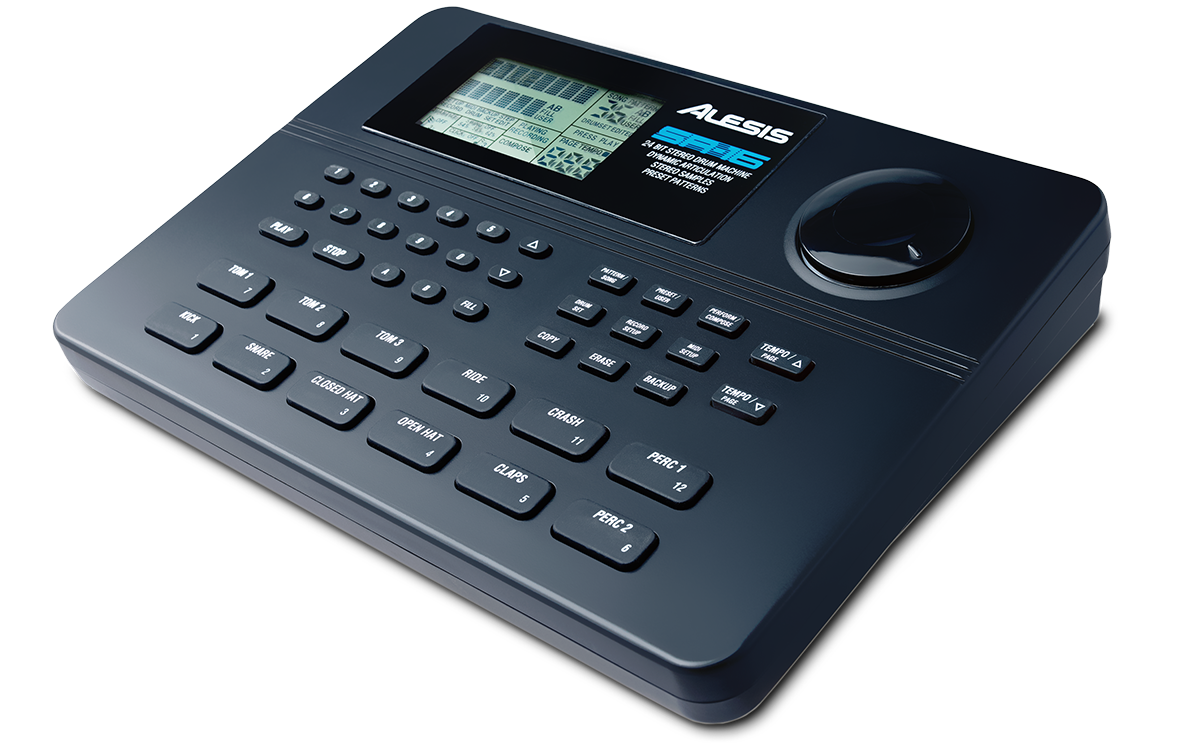
Alesis SR-16 Portable Electronic Drum Machine Review
The Alesis SR-16 first hit shelves in 1990, and it never really left. More than three decades later, it remains one of the best-selling drum machines ever made. That kind of staying power is rare in music gear, and it raises an obvious question: is the SR-16 still worth your attention, or is it riding on nostalgia?
After spending time with this machine across songwriting sessions, live jams, and studio work, the answer is more nuanced than a simple yes or no. The SR-16 does certain things exceptionally well, but it has real limitations that modern alternatives have long since addressed.
Who the SR-16 Is Actually For
The SR-16 was designed as a songwriter’s drum machine, and that remains its strongest use case. If you play guitar or keys and need a reliable rhythm section for writing, rehearsing, or performing solo, this machine delivers without getting in the way.
It also works well as:
- A live performance tool controlled entirely by footswitches (more on this below)
- A MIDI sound module triggered by a sequencer or DAW
- A practice companion for working on timing and arrangement
- A trigger source for electronic drum pads when you want hardware sounds
Where it falls short is sound design. If you want to shape and sculpt your own drum tones from scratch, or if you need modern production sounds, the SR-16 is the wrong tool.
Sound Quality: 233 Sounds, Mostly Good Ones
The SR-16’s 24-bit sound engine houses 233 drum and percussion samples. That number is generous even by current standards, though the distribution is lopsided in a useful way: 49 kick drums, 59 snares, and 51 toms make up the bulk, with 19 hi-hats, 12 cymbals, and 42 percussion sounds rounding things out.
What stands out is the quality of the acoustic drum samples. The kicks are punchy and sit well in a mix. The snares range from tight and dry to wide and ambient. Many of the sounds were clearly recorded from quality drum kits in proper rooms, and that attention to detail still comes through.
Roughly 94 of the 233 samples are in stereo, which adds a depth you do not get from cheaper machines. You also get both dry and reverbed versions of most sounds, so you can match the vibe of your track without needing external processing.
Dynamic Articulation
Alesis calls their velocity-response system “Dynamic Articulation.” In practice, this means that certain sounds change their tonal character — not just volume — based on how hard you hit the pads. A snare struck lightly sounds different from one struck hard, mimicking how a real drummer interacts with the kit.
The effect is subtle and only clearly noticeable on a handful of sounds (certain kicks, snares, congas, and toms), but it adds a layer of realism that helps patterns feel less mechanical.
What the Sounds Cannot Do
Every sound on the SR-16 is a fixed sample. There is no synthesis, no filtering, no effects processing beyond the baked-in reverb. You cannot edit the sounds themselves — you can only assign them to pads, adjust tuning, panning, and volume, and layer two sounds per pad.
For genres that rely on processed, synthetic, or heavily effected drum sounds, this is a hard limitation. The SR-16 sounds like a drum machine from the early ’90s — clean, direct, and sample-based. Whether that is a strength or a weakness depends entirely on what you are making.
Programming Patterns and Songs
Preset Patterns
The SR-16 comes loaded with 50 preset patterns programmed by professional session drummers. Each pattern includes four variations: an A section, a B section, and a fill for each. That gives you 200 distinct rhythm parts out of the box, covering rock, pop, funk, jazz, Latin, hip-hop, electronic, and several odd-time signatures.
These presets are genuinely useful for songwriting. They are not generic metronome-style beats — the fills are musical, the grooves have swing, and the A/B structure lets you sketch verse-chorus arrangements quickly.
User Patterns
Beyond the presets, you get 100 slots for your own patterns. Programming happens in real-time (playing along to a click) or step mode (entering hits one step at a time). Both methods work, though the small rubber pads and the non-backlit LCD screen make detailed programming sessions less comfortable than they need to be.
The tempo range spans 20 to 255 BPM with 16-voice polyphony, which is sufficient for most applications unless you are layering heavily.
Song Mode
You can chain patterns into songs, which is useful for live performance or running a full arrangement during rehearsal. The song structure is straightforward — sequence your patterns in order, set repeats, and let it play.
The Footswitch Advantage
This is arguably the SR-16’s most underrated feature, and it is the reason many musicians have kept theirs for decades.
Two footswitch inputs on the back panel let you control the machine hands-free. One footswitch starts and stops playback. The second switches between the A and B patterns, playing the corresponding fill during the transition. The timing of your footswitch press determines how much of the fill you hear — press early for a long fill, press late for a quick one-bar transition.
For solo performers and singer-songwriters, this is transformative. You can run an entire set with your feet while playing guitar or keys, transitioning between verse and chorus patterns naturally without ever touching the machine. No other drum machine in this class handles footswitch control this intuitively.
MIDI Implementation
The SR-16 has MIDI In, Out, and Thru ports — a full implementation that many modern budget machines lack. You can:
- Trigger individual sounds from an external MIDI controller or sequencer
- Sync the SR-16’s tempo to an external clock
- Record velocity-sensitive performances from a MIDI pad controller
- Use it as a sound module in a larger MIDI rig
One notable limitation: you cannot change patterns via MIDI program change messages. This means you cannot automate pattern selection from a DAW or external sequencer, which is a real inconvenience for more complex setups. Sound triggering and clock sync work fine, but pattern management stays manual.
The SR-16 also has a tape in/out mini-jack for backing up your patterns and songs to an external recorder — an archaic but functional data storage method.
Build and Ergonomics
The SR-16 measures roughly 9 by 6.5 inches and weighs about 1.5 pounds. It runs on an included 9V AC adapter (no battery option). The compact footprint means it fits on a crowded desk or pedalboard without issue.
The 12 velocity-sensitive rubber pads are small but functional for finger drumming. They register eight levels of velocity — enough for basic dynamics but not enough for expressive pad performances. You can set pad response to soft, medium, or loud weighting, or lock it to a fixed velocity level.
The LCD screen is not backlit, which makes it difficult to read in dim environments like stages or studios with low lighting. This is one of those design choices that was merely inconvenient in 1990 and feels genuinely frustrating now.
Four audio outputs (two stereo pairs — main and aux) give you routing flexibility. You can send specific sounds to separate mixer channels for individual processing, which is a thoughtful inclusion on a machine at this level.
SR-16 vs. SR-18: Is the Upgrade Worth It?
The Alesis SR-18 is the direct successor, and it addresses several of the SR-16’s gaps. The SR-18 adds over 100 additional drum sounds, doubles the preset patterns to 100, and includes bass sounds — a significant addition for solo performers who want a more complete backing track.
The SR-18 also has built-in effects processing that the SR-16 lacks entirely. If you are buying new and do not specifically need the SR-16’s particular sound character, the SR-18 is the more capable machine.
That said, many long-time users prefer the SR-16’s simpler workflow. Fewer options means fewer menus to navigate, and for straightforward songwriting and live use, that simplicity is a feature.
Strengths and Weaknesses
What the SR-16 does well:
- Clean, punchy acoustic drum samples that sit well in a mix
- Intuitive footswitch control for live performance
- Simple, fast workflow for songwriting and arranging
- Full MIDI implementation (In/Out/Thru)
- Four audio outputs for flexible routing
- Compact, lightweight, and road-proven
Where it falls short:
- No sound editing, synthesis, or effects processing
- Non-backlit LCD is hard to read in low light
- Cannot change patterns via MIDI program change
- Pads only register eight velocity levels
- No USB connectivity — MIDI only
- The printed manual has not been updated to reflect decades of use cases
- Sound library is fixed with no expansion options
The Bottom Line
The Alesis SR-16 is not the most powerful drum machine you can buy, and it was never trying to be. It is a focused, practical tool for musicians who need reliable drum sounds without a steep learning curve.
If you write songs, perform solo, or need a hardware drum machine that stays out of your way, the SR-16 remains a solid choice — particularly on the used market where they are widely available. Its footswitch implementation alone makes it worth considering for any guitarist or keyboardist who performs live.
For producers who need sound design capabilities, modern connectivity, or deep pattern automation, look at options in our best drum machines roundup instead.