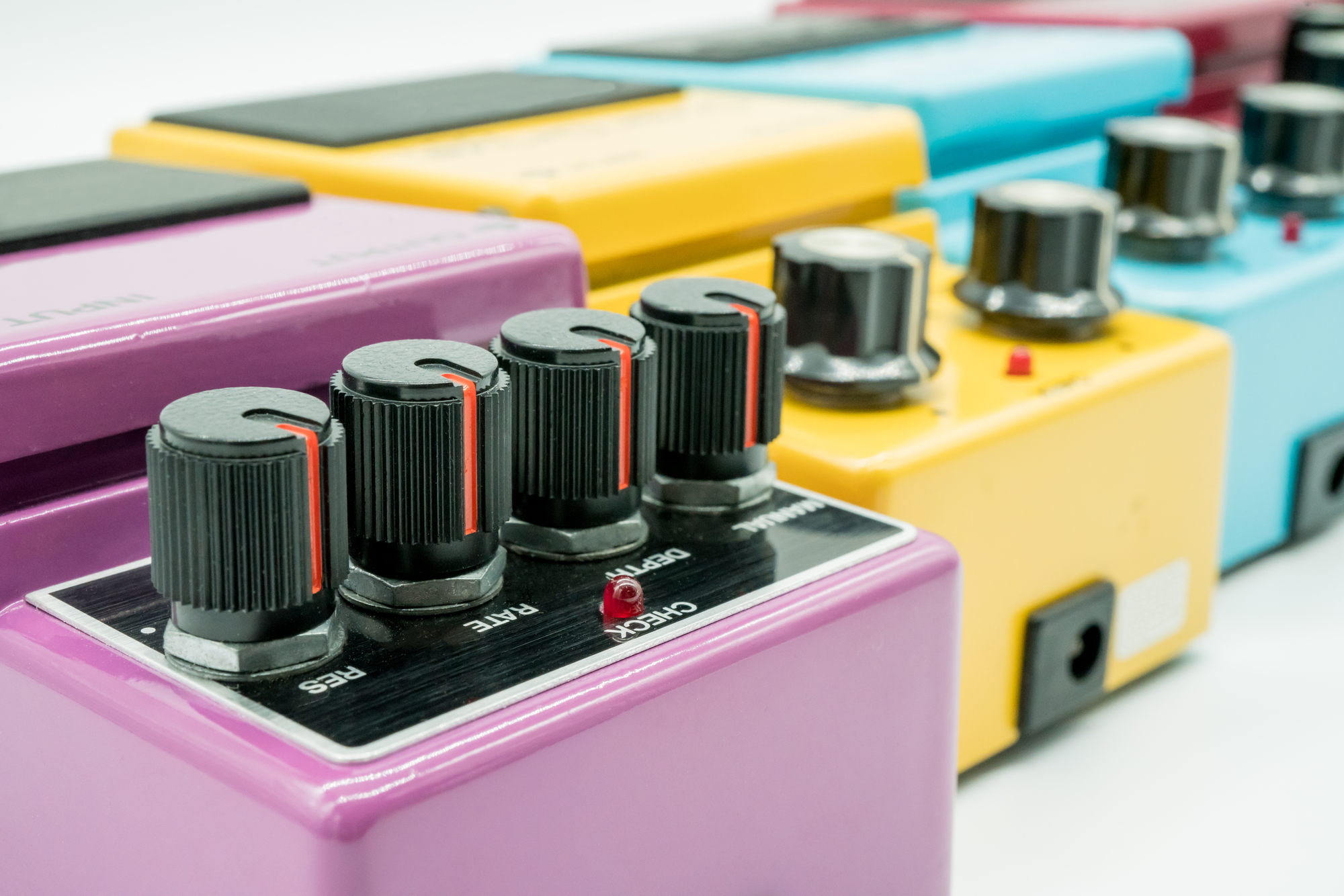
7 Best Bass Chorus Pedals in 2025
Chorus on bass is a different problem than chorus on guitar. A standard guitar chorus pedal modulates the entire frequency range, which works fine when your lowest note is around 82 Hz. On a four-string bass tuned to standard, your low E sits at 41 Hz. Modulate that and you get a seasick, undefined mess instead of the lush shimmer you were after.
That is why dedicated bass chorus pedals exist. The good ones split your signal at a configurable crossover point, keeping the low frequencies dry and tight while applying modulation only to the mids and highs. The result is chorus that adds dimension without destroying your foundation in the mix.
This guide covers seven pedals that handle that problem well, from a sub-$50 budget pick to the most fully featured option on the market. If you are building out a bass pedalboard, you might also want to look at bass compression pedals and bass EQ pedals — those two tend to pair well with chorus in a signal chain.
How Bass Chorus Works
Chorus creates the illusion of multiple instruments playing the same part slightly out of sync. The pedal duplicates your signal, delays the copy by roughly 20 to 50 milliseconds, and modulates that delay time using a low-frequency oscillator (LFO). When the dry and modulated signals combine, you hear the characteristic thickening and movement.
Two controls appear on nearly every chorus pedal:
- Rate controls how fast the LFO cycles. Low rates produce a slow, gentle sway. High rates create a more obvious wobble that borders on vibrato.
- Depth controls how far the pitch of the delayed signal deviates from the original. Subtle depth adds width. Heavy depth produces a more dramatic, watery effect.
Bass-specific pedals add a third critical element: a crossover filter (sometimes labeled X-Over, Low Filter, or Tone). This sets a frequency threshold — typically around 100 Hz — below which no modulation is applied. Everything above that threshold gets the chorus treatment. Everything below stays clean.
This is the single most important feature to look for in a bass chorus pedal. Without it, your low end will sound warbly and unfocused, especially in a full band context where the kick drum and bass need to lock together tightly. Jaco Pastorius could get away with full-range chorus because he played primarily in the upper register on a fretless — most working bass players cannot.
Analog vs Digital Chorus
Analog chorus pedals use a bucket-brigade device (BBD) chip to create the delayed copy of your signal. The result tends to be warmer, slightly darker, and carries a subtle lo-fi character that many players find musical. The tradeoff is more noise at extreme settings and fewer tone-shaping options.
Digital chorus pedals use DSP to generate the delayed signal. They are typically cleaner, more precise, and often include additional features like multiple chorus algorithms, preset storage, or software-based tone editing. The TC Electronic TonePrint platform is a good example — you can load custom chorus curves designed by other players or tweak parameters yourself.
Neither is objectively better. If you want the classic warm, slightly gritty chorus sound associated with 1980s bass tones, analog is the way to go. If you want clarity and flexibility, digital makes more sense.
The 7 Best Bass Chorus Pedals
1. MXR M83 Bass Chorus Deluxe — Best Overall
The M83 is the most complete bass chorus pedal you can buy at a mainstream price point. It is a true-bypass, all-analog pedal built around bucket-brigade circuitry, and it packs more controls than most pedals in this category.
You get three modulation knobs (Intensity, Rate, Width), a two-band EQ (Bass and Treble) that boosts or cuts the affected signal independently, and a crossover control that sets the low-frequency cutoff point. There is also a dedicated Flanger button that switches the pedal to a flanger mode — effectively giving you two effects in one enclosure.
The crossover is the standout feature. Unlike simpler implementations that use a fixed-point switch, the M83’s X-Over knob lets you dial in exactly where the modulation stops. Set it low to keep just the sub-bass clean. Crank it higher to restrict chorus to only the upper harmonics. That kind of precision matters when you are playing in a dense mix alongside keys, guitars, and drums.
The flanger mode is a genuine bonus, not a throwaway feature. It produces a warm, nasal sweep that works well for intros or bridge sections where you want a different texture without stepping on another pedal.
The only real downside is a slight volume boost when the pedal is engaged. Nothing dramatic, but worth noting if you run a tight gain structure.
Street price: Around $150. Available at Sweetwater and Amazon.
2. Boss CEB-3 Bass Chorus — Best for Reliability
Boss pedals are the workhorses of the effects world, and the CEB-3 has been the default bass chorus recommendation for over two decades. There is a reason it shows up on more professional pedalboards than any other bass chorus: it sounds good, it is built to survive touring, and it works predictably every time.
The CEB-3 gives you four knobs: Effect Level, Low Filter, Rate, and Depth. The Low Filter is Boss’s version of a crossover — turn it clockwise to allow modulation into the low end, counterclockwise to keep the lows clean. It is not as granular as the MXR’s continuous crossover knob, but it covers the practical range well.
The dual output jacks (A and B) let you run a wet/dry stereo setup. Output A carries the full effected signal. Output B carries the dry signal. This means you can send your clean bass tone to the PA or one amp while routing the chorus to a separate amp — useful for players who want chorus texture without sacrificing any low-end definition in the main signal.
The CEB-3 has a slightly more digital, present character compared to the warmer MXR. It sits well in a grunge or alternative rock context where you want the chorus to be obvious rather than subtle. Think Krist Novoselic’s bass tones on Nirvana records.
The LED is notoriously small and hard to see on a dark stage. That is the only real complaint after 20+ years of production.
Street price: Around $120. Available at Sweetwater and Amazon.
3. Electro-Harmonix Bass Clone — Best Budget Bass-Specific Option
The Bass Clone takes the circuit from EHX’s beloved Small Clone — the chorus pedal Kurt Cobain made famous — and adapts it for bass with a crossover switch and a two-band EQ.
Flip the X-Over switch and the low end tightens up immediately. The chorus effect concentrates on the mids and highs while the fundamentals stay dry and punchy. The bass and treble EQ knobs let you shape the tone further, though note that the treble control affects both the wet and dry signal while the bass knob only shapes the dry side. That asymmetry is actually useful: you can boost the dry low end for a fatter foundation without changing the character of the chorus effect itself.
The Bass Clone uses analog bucket-brigade circuitry, so it has that warm, slightly noisy character that pairs well with bass overdrive and bass distortion. Stacking chorus into dirt produces a thick, layered sound that works for anything from post-punk to stoner rock.
At higher Rate settings, the transition between modulation peaks is not perfectly smooth — you can hear the stepping if you listen for it. For subtle, slow chorus this is a non-issue. For extreme settings it becomes noticeable.
Street price: Around $80. Available at Sweetwater and Amazon.
4. TC Electronic Corona Bass Chorus — Best for Digital Tone Shaping
The Corona Bass Chorus stands apart from the analog options on this list because of TC Electronic’s TonePrint technology. You can connect the pedal to TC’s free software and load custom chorus algorithms, adjust parameters that are not available from the physical knobs, or download TonePrints designed by professional bass players.
Out of the box, the pedal offers three modes accessible via a toggle switch. The physical controls cover Speed, Depth, FX Level, and Tone. It is a clean, precise digital chorus that does not color your signal the way analog pedals do.
The FX Level knob is particularly useful — it controls how much of the effected signal blends with your dry tone, giving you fine control over subtlety. You can dial in just a hint of movement or push it to full wet for a dramatic effect.
The downside is the lack of a dedicated crossover or low-filter control on the physical pedal. You can address this through the TonePrint editor, but if you want to adjust the low-end cutoff on the fly during a gig, you are out of luck. For players who set their sound at rehearsal and leave it, this is fine. For players who tweak between songs, it is a limitation.
Stereo inputs and outputs make this a strong choice for studio work or stereo rig setups.
Street price: Around $100. Available at Amazon.
5. Walrus Audio Julia V2 — Best Boutique Option
The Julia V2 is not marketed specifically as a bass pedal, but it has earned a strong following among bass players for good reason. It is an analog chorus/vibrato pedal with a unique control set that gives you more tonal range than most dedicated bass options.
The key differentiator is the Lag knob, which controls the delay time of the LFO independently from Rate and Depth. Low Lag settings produce a tight, constrained chorus. High settings open it up into a wide, watery wash. Combined with the D-C-V blend knob (which sweeps continuously from full dry through chorus to full vibrato), you can dial in everything from barely-there thickening to extreme pitch modulation.
A small toggle switch changes the LFO waveform between sine and triangle. Sine is smoother and more subtle. Triangle adds a sharper, more angular modulation character.
The catch for bass players: there is no built-in crossover filter. If you need your sub-bass completely clean, you will need to pair the Julia with a bass EQ pedal or a dedicated signal splitter. Many players accept the slight low-end modulation because the Julia’s analog warmth is that good — but it is worth knowing upfront.
Street price: Around $200. Available at Sweetwater and Amazon.
6. Mooer Ensemble Queen Bass Chorus — Best for Tight Pedalboards
The Ensemble Queen packs a full bass chorus into Mooer’s micro-sized enclosure. If your pedalboard is already crowded with a bass preamp, compressor, and tuner, this pedal will fit in the gaps.
Despite the miniature footprint, it includes four controls: Level, Tone, Depth, and Rate. The Tone knob acts as a low-frequency filter, cutting modulation from the bass frequencies to keep your low end clean. It is not as precise as the MXR’s dedicated crossover, but it gets the job done.
True bypass circuitry prevents signal bleed when the pedal is off. The sound is a clean, focused chorus that works well for subtle applications — adding a touch of width to fingerstyle playing or thickening harmonics without overwhelming the fundamental.
The main limitation is power: it does not accept a 9V battery. You need a dedicated power supply, which means one more cable on your already crowded board. Current draw is 110mA, so make sure your power supply has a spare output with enough capacity.
Street price: Around $70. Available at Amazon.
7. Behringer UC200 Ultra Chorus — Best Under $30
The UC200 is the cheapest chorus pedal worth considering. It is not bass-specific — there is no crossover filter — but at this price it serves a purpose: figuring out whether you even want chorus on your bass before investing in a dedicated pedal.
The controls are straightforward: Level, Tone, Speed, and Depth. The Tone knob can help roll off some of the low-end modulation, though it is not as effective as a true crossover. Stereo outputs are a nice feature at this price point.
Build quality is the obvious compromise. The plastic enclosure will not survive being stomped aggressively night after night. If you gig regularly, treat this as a practice or recording pedal and budget for an upgrade later.
Despite the caveats, the UC200 sounds surprisingly good for what it costs. The chorus effect is lush and usable, clearly inspired by the Boss CE-2 circuit. For bedroom players or bass students exploring effects for the first time, it is hard to argue with the value.
Street price: Around $30. Available at Amazon.
Where to Put Chorus in Your Signal Chain
Signal chain order matters with chorus. Here is the standard approach for bass:
Tuner → Compressor → Overdrive/Distortion → Chorus → Delay → Amp
Placing chorus after your gain stages (overdrive, distortion, fuzz) means the modulation acts on the already-compressed, harmonically rich signal. This produces a smoother, more musical chorus effect. Putting chorus before dirt tends to create a more dramatic, sometimes unpredictable sound — interesting for experimental playing, but not ideal for most band contexts.
If your amp has an effects loop, consider running your chorus through it. This places the modulation after your amp’s preamp section, which can reduce noise and give you a cleaner, more controlled effect. The downside is running long cables from the amp to your pedalboard and back.
A bass compressor before chorus helps even out your dynamics, which gives the chorus a more consistent signal to work with. Without compression, hard-plucked notes will produce a more obvious chorus effect than soft notes, which can sound uneven.
What to Look for When Buying
Crossover filter: This is the single most important feature for bass players. Without it, chorus will muddy your low end. The MXR M83, Boss CEB-3, EHX Bass Clone, and Mooer Ensemble Queen all include some form of low-frequency filtering.
Analog vs digital: Analog for warmth and character. Digital for precision and flexibility. Both work. Try both if you can.
Size: Mini pedals like the Mooer Ensemble Queen save real estate. Full-size pedals like the MXR M83 give you more knobs and easier foot access. Match the size to your board.
Power requirements: Most bass chorus pedals run on 9V DC. Some accept batteries, some do not. Check before you buy, especially if your power supply is already maxed out.
Stereo outputs: Useful if you run two amps or record in stereo. Not necessary for a typical single-amp live rig.
Bottom Line
For most bass players, the MXR M83 Bass Chorus Deluxe is the best overall choice. It has the most complete feature set, the crossover is genuinely useful, and the flanger mode adds real value. The Boss CEB-3 is the safe pick if you prioritize reliability and simplicity. The EHX Bass Clone hits a sweet spot between price and bass-specific features.
If you are just starting to experiment with effects, grab a Behringer UC200 for $30 and see if chorus is something you actually use before committing to a more expensive pedal. And if you are building out a full pedalboard, make sure you have your compression and EQ sorted first — those two effects tend to make a bigger difference to your overall bass tone than any modulation pedal.