7 Best Distortion Pedals for Bass in 2025
Bass distortion is a different animal from guitar distortion. Push a guitar signal into clipping and you get something usable almost by default. Do the same with bass and you risk turning your low end into an undefined mess that disappears in a band mix. The pedals that work best for bass are the ones designed to handle low frequencies without losing the fundamental note, and most of them include a clean blend to let your dry signal anchor the bottom while the dirt stacks on top.
This guide covers seven pedals that bass players actually use on stage and in the studio, along with practical advice on choosing between overdrive, distortion, and fuzz for your playing style.
The 7 Best Bass Distortion Pedals
1. Darkglass Microtubes B3K V2 — Best Overall
The Darkglass Microtubes B3K V2 is the pedal that put Darkglass on the map, and it remains one of the most popular bass drive pedals in production. The Finnish company built its reputation on modern, aggressive bass tones, and the B3K delivers exactly that.
What makes the B3K work so well for bass is the combination of its Blend knob, Grunt switch, and Mid Boost switch. The Blend control lets you mix your clean signal with the driven signal, so your low end stays tight even at high gain settings. The Grunt switch adds low-end weight, while the Mid Boost helps your bass cut through guitars and drums in a dense arrangement.
The gain range runs from a subtle, warm breakup to a thick, saturated distortion with rich harmonic overtones. It responds well to playing dynamics — dig in harder and you get more grit, ease up and it cleans up. This responsiveness is what separates it from cheaper drive pedals that sound the same no matter how you play.
Best for: Modern rock, metal, prog, and any situation where you need an aggressive, well-defined bass tone that sits properly in a mix.
Street price: Around $130
2. Electro-Harmonix Bass Big Muff Pi — Best Fuzz
The EHX Bass Big Muff Pi takes the legendary Big Muff circuit and adapts it specifically for bass frequencies. The key addition is the Dry toggle switch that transforms the volume control into a blend knob, letting you layer thick fuzz on top of your clean bass signal.
The three-position toggle gives you three distinct modes: the full wet fuzz, a bass-boosted mode that fattens the low end, and the dry blend mode. In practice, most players live on the dry blend setting because it preserves note definition while adding that wall-of-fuzz sustain the Big Muff is known for.
The tone is classic and woolly — think Royal Blood, early Black Keys, or the thick fuzz tones you hear on Muse records. It is not a subtle pedal. With the sustain knob past noon, you get massive, singing fuzz that sustains for days. Roll it back and you land in a more manageable overdrive-adjacent territory.
For bass players who want the EHX Muff sound but in a smaller footprint, the Nano Bass Big Muff offers the same circuit in a compact enclosure.
Best for: Stoner rock, doom, grunge, shoegaze, and any genre that calls for thick, sustained fuzz.
Street price: Around $80—90
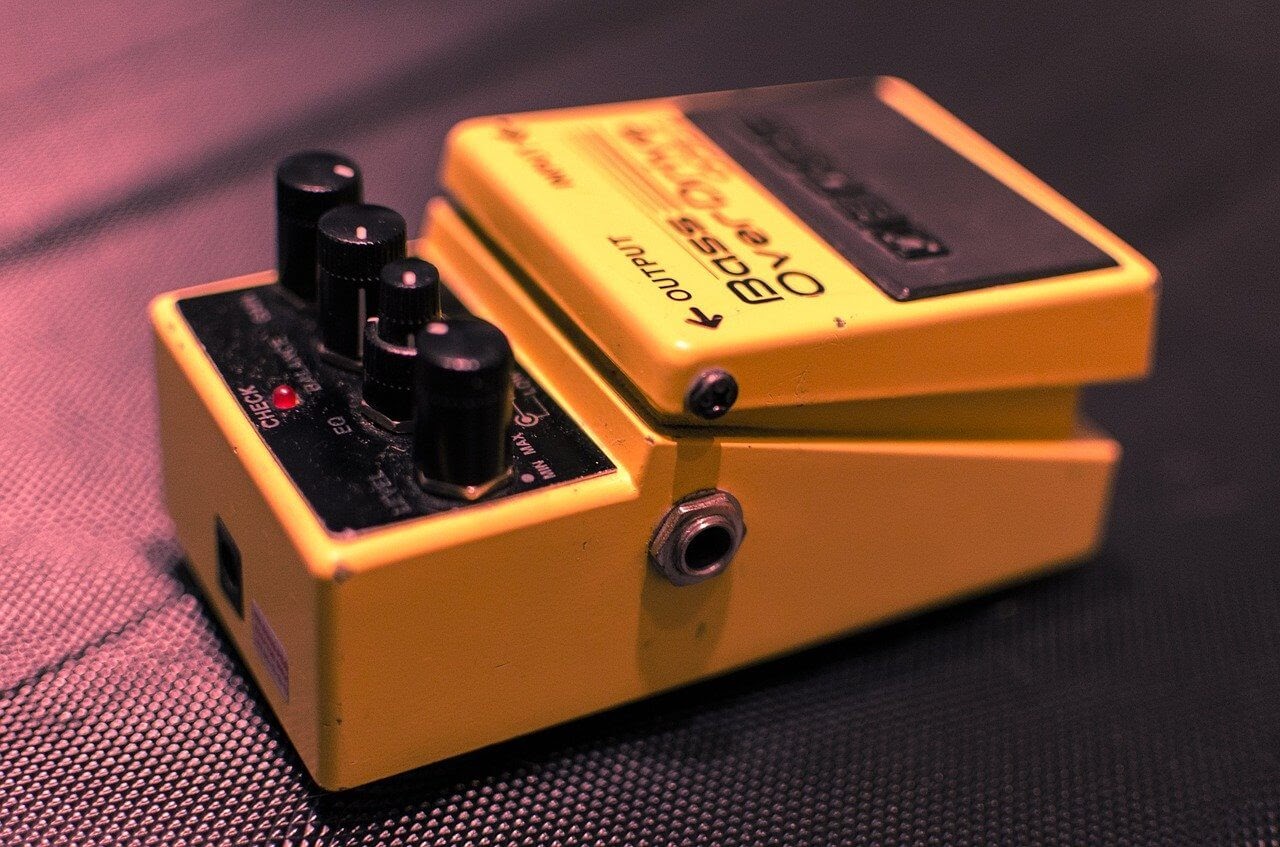
3. Boss ODB-3 Bass OverDrive — Best for Aggressive Tones
The Boss ODB-3 is built specifically for bass and has been on pedalboards since 1995. It is a workhorse with far more gain on tap than most overdrive pedals — it ranges from warm breakup all the way into full distortion and beyond.
The two-band EQ (high and low) gives you meaningful tone shaping, and the Balance knob blends your clean and overdriven signals. This is critical for keeping low-end clarity when you crank the gain. At moderate settings, the ODB-3 delivers a punchy, aggressive overdrive that cuts through a band mix. At higher settings, it enters fuzzy, almost synth-like territory that works well for industrial and punk tones.
Build quality is standard Boss — which means it will likely outlast you. The compact metal enclosure handles stage abuse without complaint, and the pedal runs on a standard 9V adapter or battery.
The main criticism is that at extreme gain settings, the ODB-3 can sound fizzy or harsh. This is worth knowing, but it is also easily managed with the EQ and balance controls. Many players keep the gain at around 10 to 2 o’clock and let the Balance knob do the heavy lifting.
Best for: Rock, punk, metal, and bass players who want a reliable, affordable drive pedal with a wide gain range.
Street price: Around $100
4. Source Audio Aftershock — Most Versatile
The Source Audio Aftershock is the Swiss Army knife of bass distortion. On the surface, it has a straightforward layout: Drive, Level, Clean (blend), and Tone knobs, plus a three-way toggle that switches between Tube (overdrive), Heavy (distortion), and Fuzz modes.
Where the Aftershock pulls ahead of every other pedal on this list is the Neuro Editor app. Connect via USB and you unlock dozens of additional drive engines — emulations of classic circuits like the Tube Screamer, RAT, Big Muff, and more. You can save presets, layer multiple gain stages, and route different effects to separate stereo outputs.
Even without the app, the three onboard modes sound excellent. The Tube setting delivers a warm, amp-like breakup. The Heavy mode is tight and aggressive. The Fuzz mode is massive and woolly. The Clean knob works across all three modes, so you always have the option to blend in your dry signal.
If you are the type of player who goes through multiple dirt pedals trying to find “the one,” the Aftershock might replace all of them.
Best for: Session players, experimenters, and anyone who wants one pedal that covers overdrive, distortion, and fuzz.
Street price: Around $150—170
5. Pro Co RAT2 — Best for Rock
The Pro Co RAT2 was designed for guitar, but it has been a staple on bass pedalboards for decades. Bass players in bands like Radiohead, Foo Fighters, and countless punk acts have used the RAT for its raw, biting distortion character.
The controls are dead simple: Distortion, Filter, and Volume. The Filter knob is a low-pass filter — turn it clockwise and it rolls off treble, giving you a darker, thicker sound. This is actually what makes the RAT work so well on bass. Roll the filter to around 1 to 3 o’clock and you tame the harsh high-end frequencies that can make guitar distortion pedals sound thin on bass.
The RAT does not have a blend knob, which is its biggest limitation for bass use. The practical workaround is to run it in a blend loop or pair it with a dedicated clean blend pedal. Some players also run the RAT at lower gain settings where the low end stays more intact.
The distortion character sits between overdrive and fuzz. At low gain it has a crunchy, amp-like breakup. Crank it and you get a thick, saturated fuzz that still retains some note definition. It is not as refined as the Darkglass, but it has a raw, organic quality that polished modern pedals cannot replicate.
Best for: Rock, punk, indie, and bass players who want a raw, unpolished distortion tone with character.
Street price: Around $70—80
6. MXR M85 Bass Distortion — Best Clean Blend Implementation
The MXR M85 Bass Distortion was designed from the ground up for bass, and it shows. The standout feature is the Dry knob, which controls the level of your clean signal independently from the distorted signal. Unlike a simple blend control that crossfades between clean and dirty, the M85 lets you set each level separately, giving you more precise control over the final mix.
The distortion circuit covers a range from mild grit to heavy saturation. A two-band EQ (Mid and Tone) lets you shape the driven signal without affecting the clean path. This means you can scoop the mids on the distorted signal for a scooped metal tone while your clean signal preserves its natural midrange presence.
The M85 also includes a Distortion On/Bypass toggle and a Mid Scoop switch for quick tone adjustments on stage. The whole package sits in a standard MXR-size enclosure and runs on 9V power.
The biggest strength of this pedal is how transparent the clean blend is. Even at high distortion settings, the low end stays defined and punchy because your clean signal is running through a separate path. If you have struggled with other distortion pedals making your bass tone muddy, the M85 is worth trying.
Best for: Any genre. Particularly good for players who want to add grit without sacrificing low-end definition, and for live situations where you need a consistent, mix-friendly tone.
Street price: Around $100—120
7. Catalinbread SFT — Best Amp-in-a-Box
The Catalinbread SFT emulates the sound of a cranked Ampeg SVT tube amp — the amp that defined rock bass tone. If you want that warm, growly, tube-amp breakup without hauling around a 300-watt head and an 8x10 cabinet, the SFT gets you remarkably close.
The pedal has two voicings selectable via a toggle: Stoner (looser, saggier, more vintage) and Stones (tighter, punchier, more modern). Both sound great on bass, but the Stoner mode is where this pedal really shines — it nails that classic SVT grind with a warm, harmonic richness that responds to your playing dynamics.
The EQ section includes active Bass and Treble controls that offer a useful range of adjustment. The Gain knob goes from clean with just a hint of warmth all the way to a thick, saturated overdrive. Unlike some amp emulations that sound good in isolation but disappear in a mix, the SFT sits well alongside guitars and drums.
Best for: Rock, blues, classic/stoner/doom, and bass players who love the SVT sound but want it in pedal form.
Street price: Around $160—180
Distortion vs. Overdrive vs. Fuzz: What Bass Players Need to Know
These three terms get thrown around interchangeably, but they describe different types of signal clipping that produce distinct sounds.
Overdrive
Overdrive emulates the sound of a tube amp pushed past its clean headroom. The clipping is soft and gradual, producing a warm, natural-sounding breakup that responds to your playing dynamics. Play lighter and the tone cleans up; dig in and the grit increases. On bass, overdrive adds warmth and presence without drastically changing your fundamental tone. Pedals like the Catalinbread SFT and the Boss ODB-3 at low gain settings fall into this category. If you want more options in this space, check out our guide to bass overdrive pedals.
Distortion
Distortion uses harder clipping to produce a more saturated, compressed signal. The tone is more aggressive and less dynamic than overdrive — the sound stays fairly consistent regardless of how hard you play. The Darkglass B3K and MXR M85 are distortion pedals, though both can dial back to lighter overdrive territory. Distortion works well for metal, hard rock, and punk where you want a consistent, aggressive bass tone.
Fuzz
Fuzz pushes the signal into extreme clipping, producing a thick, buzzy, almost synth-like tone. The EHX Bass Big Muff and the Pro Co RAT at high gain settings deliver fuzz tones. Fuzz is the most dramatic of the three effects, and it is also the most likely to bury your low end in a mix without a clean blend. Bass-specific fuzz pedals almost always include a blend knob for this reason.
Most bass players benefit from having at least one overdrive or distortion pedal on their board, even if they do not use it constantly. A touch of grit can help your bass cut through a loud band mix, add sustain to melodic lines, and fill out the sound during chorus sections.
Buyer’s Guide: What to Look for in a Bass Distortion Pedal
Clean Blend Is Non-Negotiable
The single most important feature on a bass distortion pedal is a clean blend control (sometimes labeled Dry, Clean, Mix, or Balance). This control lets you mix your unaffected bass signal with the distorted signal.
Why does this matter? Bass frequencies lose definition quickly when distorted. The low-end rumble that gives your bass its power in a mix gets turned into an indistinct roar. A clean blend preserves your fundamental low end while layering dirt on top. The result is a tone that sounds distorted but still feels like a bass, not a fuzzy guitar.
Every pedal on this list except the RAT2 includes a built-in blend control. If you are buying a distortion pedal that does not have one, budget for a separate blend loop pedal.
EQ Controls Matter More Than You Think
A simple Volume/Gain/Tone layout works fine for guitar pedals, but bass benefits from more EQ flexibility. Look for pedals with at least a two-band EQ (bass and treble) or a parametric mid control. The ability to boost or cut specific frequency ranges lets you shape the distorted signal to sit well in your particular band’s mix.
This is also why a dedicated bass EQ pedal is a smart companion to any drive pedal. Running an EQ after your distortion lets you fine-tune the driven tone without changing the distortion character itself.
Think About Where It Goes in Your Signal Chain
Distortion pedals generally go early in your signal chain, after your tuner and compressor but before modulation effects like chorus and delay. Running a compressor before distortion evens out your dynamics, which gives the distortion pedal a more consistent input signal and a smoother drive tone.
If you use a bass preamp pedal, place the distortion before the preamp. The preamp can then shape and refine the driven tone before it hits the amp or PA.
Power Supply Considerations
Most bass distortion pedals run on standard 9V DC center-negative power, which means they work with any standard pedalboard power supply. A few pedals (like some Darkglass models) can accept higher voltages (up to 18V) for increased headroom and a more open, dynamic sound. Check your pedal’s specs before running it at anything other than 9V.
All seven pedals on this list work with 9V power. If you are building a pedalboard, a dedicated isolated power supply is worth the investment — it eliminates ground loop noise that can make distortion pedals sound buzzy even when they are bypassed.
Frequently Asked Questions
Can I use a guitar distortion pedal on bass?
Yes, but with caveats. Guitar distortion pedals are not designed to handle low frequencies, so they often thin out the bass signal or lose low-end definition. The Pro Co RAT2 is one of the few guitar distortion pedals that works well on bass without modification, largely because the Filter control lets you tame the harsh high end. If you want to use a guitar pedal on bass, pair it with a clean blend loop to preserve your low end.
What is the best distortion pedal for metal bass?
The Darkglass B3K V2 is the go-to choice for modern metal bass tones. Its tight, aggressive character with rich harmonic content is exactly what metal productions call for. The Grunt switch and Blend knob let you keep the low end tight even at extreme gain settings. For a more affordable option, the Boss ODB-3 at high gain settings can get into metal territory.
Do I need a distortion pedal if my amp already has an overdrive channel?
A dedicated pedal gives you more control. Amp overdrive is typically an all-or-nothing situation — you are either clean or dirty. A pedal with a blend control lets you dial in exactly the amount of grit you want while preserving your clean tone. Pedals also let you switch between clean and dirty tones with a footswitch, which is faster and more reliable than switching amp channels mid-song.
How do I avoid losing low end with distortion?
Use a pedal with a clean blend control and keep it at least partially engaged. Run a compressor before the distortion to even out your dynamics. And if your pedal has an EQ section, make sure you are not cutting the bass frequencies. Some players run two signal paths — one clean and one distorted — and mix them at the amp or mixer for ultimate control.
Bottom Line
The Darkglass Microtubes B3K V2 is the best overall bass distortion pedal for most players. It sounds great, preserves your low end, and works across a wide range of genres. If budget is a concern, the EHX Bass Big Muff and Boss ODB-3 both deliver excellent results at lower price points. For maximum versatility, the Source Audio Aftershock replaces an entire drawer of dirt pedals with one box.
Whatever you choose, prioritize a clean blend control and take time to set it up properly in your signal chain. A well-dialed distortion pedal is one of the most powerful tools a bass player can have.