5 Best Banjo Tuners To Find Perfect Pitch in 2025
A good clip-on tuner is one of the cheapest upgrades that makes the biggest difference to how your banjo sounds. The five-string banjo’s standard Open G tuning (gDGBD) demands precision across all five strings, and even slight deviations are obvious in the bright, resonant tone of the instrument.
After testing clip-on tuners across practice sessions, jam circles, and stage performances, here are the five best banjo tuners worth your money.
The 5 Best Clip-On Banjo Tuners
1. KLIQ UberTuner — Best Overall
The KLIQ UberTuner is a chromatic clip-on tuner with +/- 0.5 cent accuracy — precise enough for banjo, where the short fifth string and open tunings leave little room for error.
What stands out:
- Full chromatic mode works with any tuning, not just standard Open G
- Bright, color-coded display (green when in tune, red when sharp/flat) is readable under stage lights
- Pivots 360 degrees and tilts, so it works whether clipped to the peghead or behind it
- Ships with a CR2032 battery and a 3-year warranty
The downside: A small number of users report display issues over time. Given the 3-year warranty, KLIQ handles replacements if that happens.
At around $13, the UberTuner hits a sweet spot of accuracy, visibility, and build quality that more expensive tuners struggle to beat. It also works well if you switch between banjo, guitar, ukulele, or bass, making it a solid all-purpose chromatic tuner.
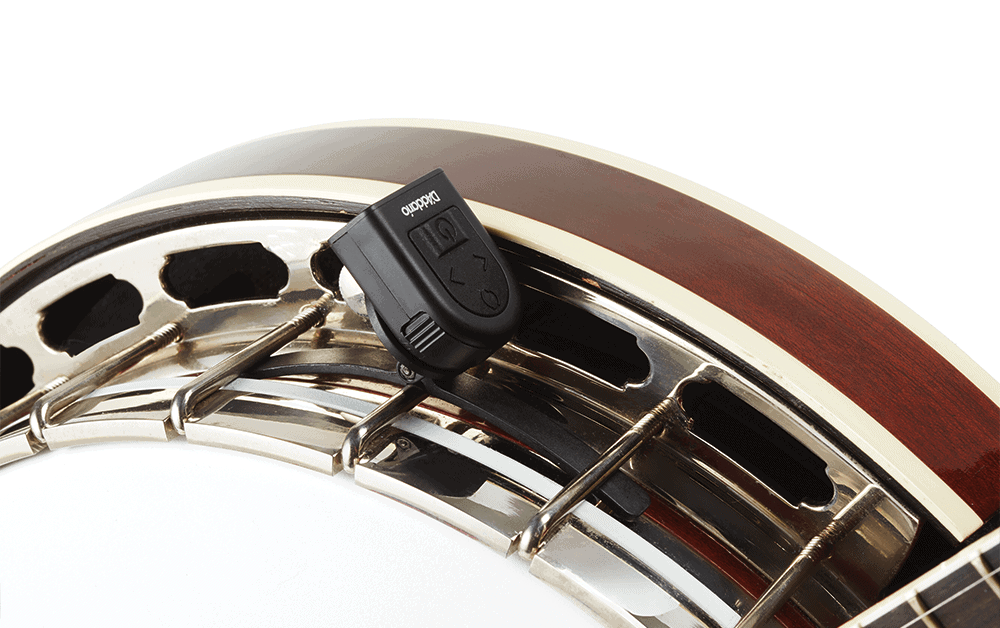
2. D’Addario NS Micro Clip-On Tuner — Best Compact Tuner
The D’Addario NS Micro Clip-On Tuner is the tuner to get if you want something that practically disappears on your headstock. It sits flush against the back of the peghead, invisible to your audience.
What stands out:
- Low-profile design tucks behind the peghead — no clunky tuner visible from the front
- Piezo vibration sensor reads string vibrations directly, so background noise in a jam session or on stage does not interfere
- Four preset viewing angles to match different peghead shapes
- Visual metronome function (handy for keeping time during practice)
The downside: The screen is small. In dim lighting or at arm’s length, it can be hard to read compared to larger-display tuners.
D’Addario also makes a banjo-specific version (PW-CT-16) that comes pre-loaded with standard Open G tuning and displays string numbers instead of note names. At around $23, it costs a bit more but saves time if you are a beginner still learning which string is which.
3. Snark ST-8 Super Tight — Best Budget Tuner
The Snark ST-8 Super Tight uses a high-sensitivity vibration sensor with what Snark calls “Super Tight” hertz tuning — it reacts faster and reads lower frequencies more reliably than their older models.
What stands out:
- Fast, responsive tracking that keeps up even when you are tuning quickly between songs
- Full-color display with a clear needle and note readout
- Stays on the headstock well with a firm spring-loaded clip
- Under $15, making it one of the cheapest reliable tuners available
The downside: Snark tuners have a reputation for the clip hinge breaking after several months of use. If you leave it clipped to your banjo during transport, the clip takes a beating. Remove it and store it separately.
For the price, the ST-8 is hard to argue with. Just treat it as a consumable — if it lasts a year of regular use, you have gotten your money’s worth.
4. Snark ST-2 — Best for Beginners
The Snark ST-2 is one of the most popular clip-on tuners ever made, and for good reason. It is dead simple: clip it on, pluck a string, and turn the peg until the display turns green.
What stands out:
- No modes to navigate, no buttons to confuse — it just works
- The bright red housing makes it easy to spot in a gear bag
- Firm clip holds well on most banjo pegheads
- Works on guitar, ukulele, violin, mandolin, and other stringed instruments
The downside: Like the ST-8, durability is the weak point. The plastic hinge can crack with rough handling.
If you are just starting out with banjo and want a tuner that requires zero learning curve, the ST-2 does exactly what you need for around $12.
5. Fender FT-1 Professional Clip-On Tuner — Best for Stage Use
The Fender FT-1 Professional has the largest, brightest display on this list. If you play on stage where lighting conditions are unpredictable, visibility matters more than compactness.
What stands out:
- Dual-color LCD screen (red/green) that is visible from several feet away
- A1-A7 tuning range covers everything from bass instruments to mandolin and banjo
- Chromatic mode for alternate tunings (Double C, Open D, and other popular banjo tunings)
- Solid build quality — the clip and hinge feel more substantial than Snark’s
The downside: It is bulkier than the D’Addario NS Micro or the Snark models. If you leave it on during a performance, your audience will see it.
At around $15, the FT-1 is a good choice if screen visibility is your top priority.
How to Choose the Right Banjo Tuner
Accuracy
All five tuners on this list are accurate enough for banjo. The practical differences between +/- 0.5 cents and +/- 1 cent are negligible for most players. What matters more is how quickly the tuner tracks the note — a slow-responding tuner wastes time, especially when tuning between songs.
Display Readability
This is the real differentiator. If you play mostly at home or in quiet settings, a small display like the D’Addario NS Micro is fine. If you play on stage, prioritize a bright, color-coded display like the Fender FT-1 or KLIQ UberTuner.
Vibration Sensor vs. Microphone
Every tuner on this list uses a piezo vibration sensor (also called a contact sensor). This is what you want for banjo. Mic-based tuners pick up ambient noise, which makes them unreliable at jams, rehearsals, or anywhere with other instruments playing. Vibration sensors read only the instrument they are clipped to.
Durability
Clip-on tuners live a hard life. They get knocked around in gig bags, dropped, and left clipped to headstocks during transport. The KLIQ UberTuner and Fender FT-1 tend to hold up better than the Snark models. If you go with a Snark, take it off and store it in a case pocket when you are not actively tuning.
Compatibility with Alternate Tunings
If you only play standard Open G (gDGBD), a banjo-specific tuner mode is convenient. But if you explore alternate tunings like Double C (gCGCD), Open D (f#DF#AD), or G Modal (gDGCD), you need a chromatic tuner. All five tuners on this list support chromatic mode.
Standard Banjo Tuning (Open G)
For a 5-string banjo, standard tuning is Open G:
| String | Note | Octave |
|---|---|---|
| 5th (short string) | g | 4 |
| 4th | D | 3 |
| 3rd | G | 3 |
| 2nd | B | 3 |
| 1st | D | 4 |
When you strum all five strings open, you hear a G major chord. This is the foundation for bluegrass, clawhammer, and most popular banjo styles.
A few tips for tuning your banjo accurately:
- Tune up to the note, not down. If you overshoot, go below the target pitch and come back up. This seats the string more securely at the nut and bridge.
- Stretch new strings. Fresh banjo strings need a few stretches before they hold pitch. Gently pull each string away from the fretboard, retune, and repeat until the pitch stabilizes.
- Check intonation at the 12th fret. If the 12th fret harmonic and the fretted note at the 12th fret do not match, your bridge placement may need adjustment.
- Use a tuner with your capo. If you capo at the 2nd fret (common in bluegrass), retune after placing the capo. Capos often pull strings slightly sharp.
Clip-On Tuner vs. Tuner App
Smartphone tuner apps like Master Banjo Tuner and GuitarTuna have gotten surprisingly good. They are free (or nearly free) and always in your pocket. So why buy a clip-on?
Use an app when:
- You are practicing alone at home in a quiet room
- You forgot your tuner and need a quick solution
- You want to learn what each note sounds like (many apps play reference tones)
Use a clip-on tuner when:
- You are at a jam session or rehearsal with other musicians playing nearby
- You are on stage with monitors, PA speakers, and crowd noise
- You need hands-free tuning (clip it on and tune with both hands on the banjo)
- You want fast, reliable tuning without pulling out your phone
The vibration sensor in a clip-on tuner is the key advantage. It reads string vibrations through the headstock, ignoring external noise entirely. A phone mic cannot do that.
FAQs
Can I use a guitar tuner for my banjo?
Yes, as long as it is a chromatic tuner. Chromatic tuners detect any pitch, so they work with banjo, guitar, violin, mandolin, ukulele, and any other stringed instrument. Tuners with only preset guitar tunings (E-A-D-G-B-E) will not help you tune a banjo’s Open G.
How often should I tune my banjo?
Every time you pick it up. Banjos are more sensitive to temperature and humidity changes than solid-body guitars. The drum-style head, the tension hoop, and the relatively light string tension all mean banjos drift out of tune more easily. A quick check before each session takes 30 seconds with a clip-on tuner.
What about geared tuning pegs vs. friction pegs?
This article covers electronic clip-on tuners (devices that detect pitch). If you are looking to upgrade your banjo’s mechanical tuning pegs, that is a different topic. Planetary geared tuners (from brands like Gotoh, Grover, and Rickard) give you finer control than friction pegs and hold tuning better. They are a worthwhile upgrade on budget banjos.
Do I need a tuner if I have good ears?
Even professional players use tuners. Your ears are valuable for detecting when something sounds off, but a tuner gives you objective confirmation. In a noisy environment or when playing with others, a tuner is faster and more reliable than tuning by ear.
The Bottom Line
For most banjo players, the KLIQ UberTuner is the best overall choice. It is accurate, readable, versatile across instruments, and costs around $13. Pair it with a good set of banjo strings and a comfortable banjo strap, and you have the essentials covered.
If you prioritize a discreet profile, the D’Addario NS Micro is the best compact option. And if you are on a tight budget, a Snark ST-8 will serve you well until the clip gives out.