The Best Banjo For Beginners To Start Their Journey in 2025
Buying your first banjo is more confusing than it needs to be. There are dozens of models under $500, and most online reviews just list specs without telling you what actually matters when you are starting out.
Here is what matters: playability, setup, and matching the banjo to the style of music you want to play. The specific model is less important than getting those three things right. A $300 banjo that is properly set up will sound better and be easier to play than a $1,000 banjo that is not.
This guide covers the decisions you need to make before buying, the models that are genuinely worth your money, and the setup steps you should check the moment your banjo arrives.
Open-Back vs. Resonator: The First Decision
Before you look at specific models, you need to decide between an open-back and a resonator (closed-back) banjo. This choice affects the sound, the weight, the price, and which playing styles work best. For a deeper comparison, see our open-back vs. resonator banjo guide.
Open-back banjos have no cover on the back of the pot assembly. The sound projects forward and is softer, warmer, and more mellow. They weigh less (typically 4-5 pounds), cost less, and are the traditional choice for clawhammer and old-time music. If you are drawn to folk, singer-songwriter, or old-time styles, start here.
Resonator banjos have a wooden back plate that reflects sound outward, making them louder and brighter. They are heavier (6-8 pounds) and more expensive. Resonator banjos are the standard for bluegrass, where you need projection to cut through a band. If bluegrass is your goal, a resonator banjo is the right starting point.
If you are not sure yet, an open-back banjo is the safer choice. They cost less, weigh less, and work for most styles. Some resonator banjos also have a removable back plate, giving you both options.
How Many Strings?
Most beginner banjos are 5-string instruments, and that is what you should buy unless you have a specific reason not to. The 5-string banjo is the standard for bluegrass, old-time, folk, and clawhammer music. For a full breakdown, see our guide on how many strings on a banjo.
4-string banjos come in two varieties: tenor (shorter neck, 17-19 frets) and plectrum (longer neck, 22 frets). Tenor banjos are common in Irish folk and Dixieland jazz. Plectrum banjos are used in jazz and chord melody playing. Neither is a typical starting point unless you specifically want to play those styles. For more on this, check out how to play a 4-string banjo.
6-string banjos are tuned like guitars. If you already play guitar and want a banjo sound without learning new fingerings, a 6-string lets you do that. But it will not teach you banjo technique, and experienced banjo players generally do not consider it a “real” banjo.
Stick with 5 strings unless you have a clear reason to choose otherwise.
What to Look for in a Beginner Banjo
Price is the first filter, but it should not be the only one. Here are the things that separate a good beginner banjo from a frustrating one.
Playability
This is the most important factor. A beginner banjo needs to be easy to fret and comfortable to hold. That means:
- Low action (the distance between the strings and the fretboard). High action forces you to press harder, which causes hand fatigue and makes learning harder.
- A smooth neck finish. Satin finishes let your hand glide up and down the neck. Glossy finishes can feel sticky.
- Comfortable neck profile. Thinner necks are easier for smaller hands. If you are coming from guitar, most banjo necks will feel narrow at first.
Tuning Stability
A banjo that will not stay in tune is miserable to practice on. Look for:
- Geared tuners (also called guitar-style or planetary tuners) rather than friction pegs. Geared tuners hold their position much better and make fine adjustments easier. A good banjo tuner helps too, but the pegs themselves matter.
- A quality head. Remo heads are the industry standard and come on most decent beginner banjos.
Build Quality
You do not need exotic tonewoods at this stage, but the basics should be solid:
- The neck should be straight with no visible warps or twists.
- Frets should be smooth and level. Run your finger along the edge of the fretboard — sharp fret ends are a sign of poor finishing.
- The bridge should sit flat on the head without rocking.
- Hardware should be tight. Loose brackets, wobbly tuners, or a rattling tailpiece all cause buzzing and tuning problems.
Weight
Banjos are heavier than they look. A resonator banjo can weigh 7-8 pounds, and you will feel that during a long practice session. Open-back banjos are lighter (4-5 pounds) and more comfortable for extended playing. Whichever type you choose, a good banjo strap makes a real difference.
Best Beginner Banjos by Budget
Under $300: Gold Tone AC-1
The Gold Tone AC-1 is the most commonly recommended budget banjo in the banjo community, and for good reason. It is an open-back 5-string that retails around $270.
Gold Tone manufactures the AC-1 overseas but ships every unit to their headquarters in Titusville, Florida for a full professional setup before it reaches you. That setup step is huge at this price point — most sub-$300 banjos arrive needing significant adjustment, and beginners rarely know how to do that.
The “composite” rim (a carbon fiber blend rather than traditional wood) keeps the weight under 4 pounds while still delivering a legitimate banjo tone. The nato wood neck is a cost-effective alternative to maple or mahogany, and the rosewood fingerboard plays cleanly. The guitar-style tuners work fine, though they lack the feel of planetary tuners on more expensive instruments.
Best for: Clawhammer, old-time, folk. Anyone who wants a playable banjo without spending $500+.
Under $300: Epiphone MB-100
The Epiphone MB-100 is another solid option at around $249. It is an open-back 5-string with a mahogany neck and resonator (it comes with a detachable resonator, giving you both open-back and closed-back options).
The mahogany gives it a warmer, rounder tone than the Gold Tone AC-1. The slim neck profile works well for players with smaller hands or those transitioning from guitar. Build quality is good for the price — Epiphone has decades of experience making affordable string instruments.
The main drawback is that it does not receive the same factory setup as the Gold Tone, so you may need to adjust the bridge position and action when it arrives.
Best for: Beginners who want the flexibility of a removable resonator. Good entry point if you are not sure whether you will play open-back or bluegrass style.
$400-$600: Deering Goodtime
The Deering Goodtime is the benchmark beginner banjo, and for many players it is the only one worth considering if your budget allows it. It runs around $499 new.
Deering builds the Goodtime in Spring Valley, California — it is one of the few beginner banjos made in the USA. The 3-ply maple rim delivers a clear, bright tone with surprising projection for an open-back instrument. The satin-finished maple neck is slim and fast, and the fretwork is clean enough that you will not need to worry about sharp edges or uneven frets.
The Goodtime holds its tuning remarkably well, which spares you the constant retuning that plagues cheaper instruments. It weighs about 4 pounds and feels balanced and comfortable. Most importantly, it is a banjo you will not outgrow quickly — many intermediate players still use theirs years later.
Best for: Any style. If you know you are committed to learning banjo and can afford it, the Goodtime is the safest investment.
$500-$700: Deering Goodtime 2
The Deering Goodtime 2 is the resonator version of the Goodtime. Same build quality, same neck, same tuning stability — but with a removable resonator that adds volume and brightness.
If you are specifically interested in bluegrass and need the projection of a resonator banjo, the Goodtime 2 is the beginner option that experienced players most often recommend. The removable resonator also means you can take it off for quieter practice or when playing old-time music.
At around $600-700, it is a bigger investment than the open-back Goodtime, but it gives you genuine versatility.
Best for: Bluegrass beginners. Players who want one banjo that works for both loud and quiet settings.
Budget Alternative: Recording King RKOH-05
If the Gold Tone AC-1 is sold out or you want an alternative in the same range, the Recording King RKOH-05 (around $250) is worth considering. It is an open-back with a traditional look and decent playability. The tone is warm and balanced, though it does not get the same factory setup as the Gold Tone.
What to Do When Your Banjo Arrives
This section matters more than which banjo you buy. A properly set up beginner banjo will outperform an expensive instrument that has not been adjusted. Here are the key things to check, in order of importance.
1. Check the Bridge Position
The bridge on a banjo is only held in place by string tension — it can shift during shipping. If the bridge is in the wrong spot, every note above the first few frets will be out of tune, no matter how carefully you tune the open strings.
To check: play an open string, then fret that same string at the 12th fret. Both notes should register as the same pitch (one octave apart) on your tuner. If the fretted note is sharp, move the bridge slightly toward the tailpiece. If it is flat, move it toward the neck.
2. Check the Head Tension
The banjo head is a drum head, and its tension affects the entire sound of the instrument. A head that is too loose will sound muddy and dead. A head that is too tight will sound thin and tinny.
Tap the head near the bridge with your finger. It should sound like a clear, crisp tap — not a dull thud. If it sounds dead, the brackets around the rim need to be tightened evenly, a quarter turn at a time, in a star pattern (like tightening lug nuts on a wheel).
3. Check the Action
Action is the height of the strings above the fretboard. Most beginner banjos ship with action that is too high, which makes them harder to play than they need to be.
Measure at the 12th fret. For a 5-string banjo, the first string should be about 3/32” (2.4mm) above the fret, and the fourth string about 1/8” (3.2mm). If the action is much higher than this, the bridge may need to be lowered (sanded down or replaced with a shorter one) or the neck angle may need adjustment via the coordinator rod.
4. Check the Strings
Many beginner banjos ship with low-quality strings. Replacing them with a good set of banjo strings is one of the cheapest upgrades you can make and will noticeably improve both tone and playability.
5. Check the Tuners
Turn each tuner slowly. They should move smoothly without any grinding or slipping. If a tuner slips and will not hold tension, it may need to be tightened (there is usually a small screw or nut on the tuner mechanism).
Choosing a Playing Style
Your playing style determines what kind of music you will make and, to some degree, what kind of banjo suits you best. You do not need to commit to one style forever, but it helps to start with one. For more on getting started, see our how to play banjo guide.
Clawhammer (Old-Time)
Clawhammer is a down-picking technique where you strike the strings with the back of your fingernail. It produces a rhythmic, percussive sound that is central to old-time Appalachian music. You do not need fingerpicks. An open-back banjo is the traditional choice.
Clawhammer is often recommended as a good starting style because the basic strum pattern (strike-brush-thumb) is relatively intuitive and you can play recognizable tunes within a few weeks.
Three-Finger (Bluegrass)
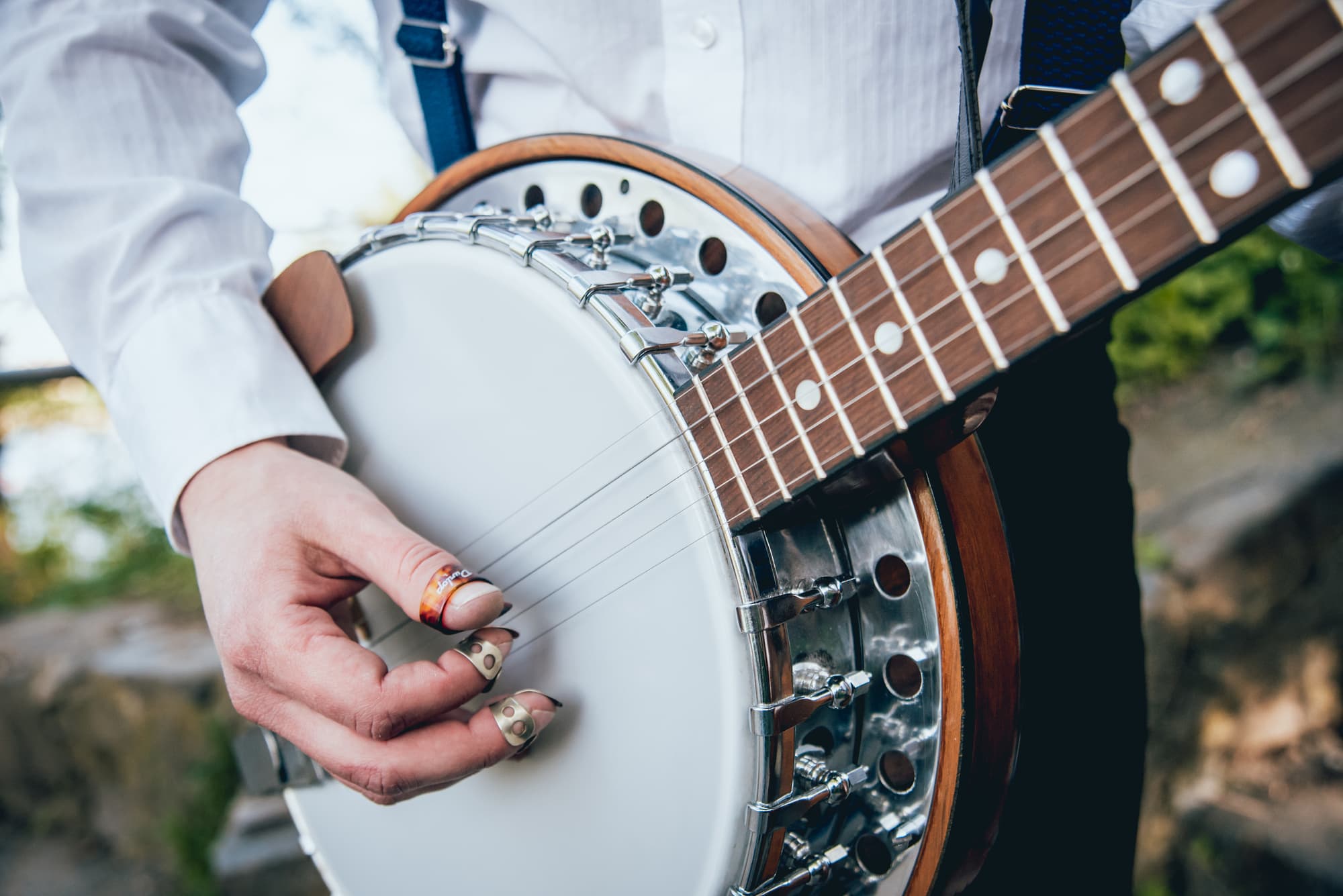
Three-finger picking, also called Scruggs style after Earl Scruggs who popularized it, uses a thumb pick and two metal fingerpicks to play rapid roll patterns. This produces the bright, cascading sound that defines bluegrass music. A resonator banjo is standard for this style.
The roll patterns take dedicated practice to internalize, but once you get them, they become automatic. Many bluegrass players start by learning forward rolls and “Cripple Creek.”
Folk and Fingerpicking
Folk banjo borrows from both clawhammer and fingerpicking traditions. You might play melody lines over simple chord progressions, mix picking with strumming, or accompany your own singing. Both open-back and resonator banjos work. This is the most flexible style in terms of equipment.
Common Beginner Mistakes
Buying the cheapest banjo you can find. Sub-$150 banjos from unknown brands are almost always a waste of money. They arrive with poor setup, bad tuners, and construction issues that make them genuinely difficult to play. You will spend more time fighting the instrument than learning it. $250-$300 is the realistic floor for a playable beginner banjo.
Ignoring setup. Most tone and playability problems on beginner banjos are setup problems, not quality problems. Learn the basics of bridge placement, head tension, and action adjustment, or pay a local luthier $30-50 to do a setup for you.
Not getting a strap. Banjos are awkward to hold without a strap. Get one before your first practice session. A comfortable cradle-style strap distributes the weight and lets you focus on your hands.
Skipping a tuner. Your ears are not trained yet. Use a clip-on tuner every time you play. Playing an out-of-tune banjo trains your ears wrong and makes everything sound bad.
Trying to learn without structure. Pick a method — an online course, a tab book, YouTube series, or a local teacher — and follow it. Randomly learning licks from different sources leads to scattered progress. Resources like Brainjo Academy and Jim Pankey’s YouTube channel are solid starting points.
The Bottom Line
If you can afford it, buy a Deering Goodtime. It is the most recommended beginner banjo for a reason: good build quality, made in the USA, holds its tuning, and will last you well past the beginner stage.
If your budget is tighter, the Gold Tone AC-1 is the best value under $300. The factory setup alone makes it worth choosing over competitors at similar prices.
Whatever you buy, spend 20 minutes checking the setup when it arrives. Bridge position, head tension, and string height make the difference between a banjo that inspires you to practice and one that collects dust in a closet.
For more on banjos in general, see our best banjo roundup. If you are wondering about the learning curve, read how hard is it to learn banjo. And once you are playing, our guides to banjo strings and how to tune your banjo will help you keep your instrument sounding its best.