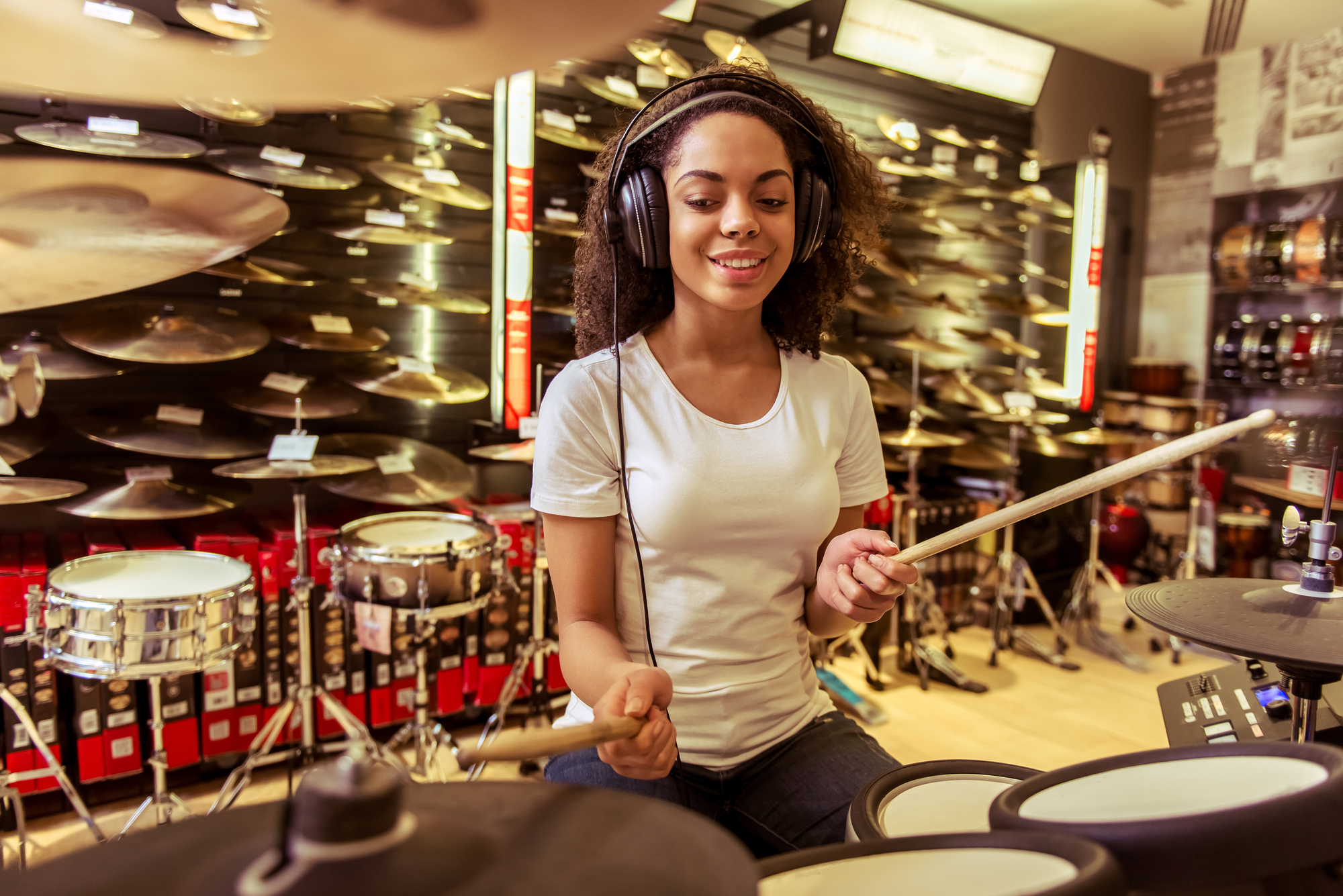
The Best Electronic Drum Headphones in 2025
Your headphones are half the equation with electronic drums. Unlike an acoustic kit pushing air through a room, every sound from an e-kit passes through your headphones first. A weak pair will make a $2,000 module sound like a toy. A good pair makes practice sessions feel like playing through a studio monitor rig.
After testing headphones across Roland, Alesis, and Yamaha modules, here are the seven best options for electronic drummers in 2025.
Best Overall: Beyerdynamic DT 770 Pro (80 Ohm)
The DT 770 Pro is the consensus pick for electronic drummers, and for good reason. The closed-back design blocks out the plastic tapping sounds from mesh pads and rubber cymbals, letting you hear only what the module is outputting. The 80-ohm version drives easily from any drum module’s headphone jack without needing a separate amp.
Sound-wise, the DT 770 Pro delivers tight low end for kick drums and crisp highs for cymbals and hi-hats. The slight high-frequency emphasis actually works in your favor here — it brings out cymbal shimmer and snare crack that cheaper headphones blur together.
The velour ear pads stay comfortable through multi-hour sessions and don’t trap heat the way pleather does. The spring steel headband is nearly indestructible. The only real downside is the non-detachable 3-meter coiled cable, which is long enough for drumming but can’t be replaced if it fails.
Why it wins: Best balance of isolation, sound quality, comfort, and price. The 80-ohm impedance is the sweet spot for drum modules. Available on Amazon for around $150-170.
Specs: 80 Ohm | 5 Hz–35 kHz | 96 dB sensitivity | 270g | Closed-back
Best Premium: Beyerdynamic DT 1990 Pro
If you want reference-grade monitoring and don’t mind spending more, the DT 1990 Pro is the upgrade path. These are open-back headphones with Tesla neodymium drivers that deliver exceptional clarity across the entire frequency range.
The open-back design means less isolation — you’ll hear pad tapping and ambient room noise. But the tradeoff is a wider, more natural soundstage that makes your drum kit sound more like it’s in a room rather than inside your head. For home practice where noise leakage doesn’t matter, this is a significant upgrade in listening experience.
Beyerdynamic includes two sets of ear pads (analytical and balanced) and two cables (coiled and straight). The build quality is premium aluminum and steel. The 250-ohm impedance means some drum modules may struggle to drive them to full volume — check that your module’s headphone output can handle higher impedance before buying.
Best for: Home practice where isolation isn’t critical and you want the best possible sound. Around $250-300 on Amazon.
Specs: 250 Ohm | 5 Hz–40 kHz | 102 dB sensitivity | 370g | Open-back
Best Drum-Specific: Roland RH-A30
Roland designed the RH-A30 specifically for monitoring V-Drums, and that tuning translates well to any electronic kit. The frequency response is voiced to emphasize the attack transients that electronic drum modules produce — snappy kick response, articulate cymbal decay, and punchy snare hits.
These are open-back headphones with an extra-long cable, giving you freedom to move around without feeling tethered. The lightweight build keeps them comfortable for long sessions. The downside mirrors other open-backs: you’ll hear the mechanical sound of sticks hitting pads, which can be distracting if you’re playing in a quiet room.
Best for: Roland V-Drums owners and drummers who want headphones tuned specifically for electronic percussion. Around $80-100 on Amazon.
Specs: 24 Ohm | 15 Hz–22 kHz | 102 dB sensitivity | 200g | Open-back
Best Value: Audio-Technica ATH-M50x
The ATH-M50x has been a studio staple for over a decade, and it works excellently for electronic drums. The closed-back design provides solid isolation, the 45mm drivers deliver accurate frequency response, and the detachable cable system (it comes with three cables — coiled, short straight, and long straight) solves the biggest reliability concern with drumming headphones.
The sound signature is relatively flat with a slight low-end bump, which gives kick drums satisfying weight without muddying the mids. The swiveling ear cups fold flat for storage, and the build quality holds up to regular use.
At around $150, the ATH-M50x competes directly with the DT 770 Pro. The main advantage is the detachable cable. The main disadvantage is that the ear pads can get warm during long sessions — the pleather doesn’t breathe like Beyerdynamic’s velour.
Best for: Drummers who want a detachable cable and a proven studio reference sound. Available on Amazon.
Specs: 38 Ohm | 15 Hz–28 kHz | 99 dB sensitivity | 285g | Closed-back
Best Budget: AKG K240 Studio
If you’re starting out with electronic drums and don’t want to spend $150+ on headphones, the AKG K240 is the best option under $80. The semi-open design gives you a taste of the open-back soundstage without completely sacrificing isolation.
The self-adjusting headband eliminates fit issues, and replacement ear pads are easy to find. The sound is balanced across lows, mids, and highs — kicks and cymbals sound equally defined. The 55-ohm impedance works fine with most drum modules.
The compromise at this price is build quality and comfort. The K240 feels lighter and less premium than the Beyerdynamic options, and the ear pads flatten faster. But for the money, nothing else delivers this level of audio accuracy.
Best for: Beginners and budget-conscious drummers. Around $50-70 on Amazon.
Specs: 55 Ohm | 15 Hz–25 kHz | 104 dB sensitivity | 240g | Semi-open
Best Isolation: Vic Firth SIH2 Stereo Isolation Headphones
The Vic Firth SIH2 blocks more external noise than any other headphone on this list — up to 25 dB of passive isolation. If you practice in a noisy environment, share a space, or simply cannot stand hearing sticks hit pads, these are the ones to get.
The 50mm drivers deliver decent sound quality, though the bass response won’t match the Beyerdynamic or Audio-Technica options. The tradeoff is deliberate: maximum isolation is the priority. The fixed headband doesn’t adjust as much as competitors, and the non-removable cable is a durability concern.
Best for: Drummers who need maximum noise isolation above all else. Around $70-90 on Amazon.
Specs: 50mm drivers | 20 Hz–20 kHz | Non-adjustable headband | Closed-back
Best for Monitoring with a Band: Sony MDR-7506
The Sony MDR-7506 has been an industry standard since 1991. It’s the headphone you’ll find in most recording studios, and it works well for electronic drums — especially if you’re playing along with backing tracks or monitoring a band mix.
The sound is detailed and forward in the upper mids, which helps drums cut through a dense mix. The 63-ohm impedance is easy to drive. The folding design and included carrying pouch make it portable.
The MDR-7506 is showing its age in some areas: the coiled cable is heavy and non-detachable, and the ear pads (while replaceable) use a sticky pleather that deteriorates over time. But at under $100, it remains a reliable workhorse for anyone who needs studio headphones on a budget.
Best for: Playing along with tracks, monitoring a mix, and studio use. Available on Amazon for around $80-100.
Specs: 63 Ohm | 10 Hz–20 kHz | 106 dB sensitivity | 230g | Closed-back
How to Choose Headphones for Electronic Drums
Not all headphones work well with electronic drum modules. Here’s what actually matters.
Closed-Back vs. Open-Back
This is the most important decision. Closed-back headphones (DT 770 Pro, ATH-M50x, Vic Firth SIH2) seal around your ears and block external noise. You won’t hear sticks hitting pads, which makes practice feel more immersive. The tradeoff is a narrower soundstage and more heat buildup during long sessions.
Open-back headphones (DT 1990 Pro, Roland RH-A30, AKG K240) let air and sound pass through. The result is a wider, more natural soundstage — drums sound like they’re in a room instead of inside your head. The tradeoff is zero isolation: you’ll hear every pad tap and ambient noise.
For most electronic drummers, closed-back is the better choice. The main reason you’re using headphones is to avoid hearing the mechanical noise of the kit, and closed-backs do that job.
Impedance and Your Drum Module
Impedance (measured in ohms) determines how much power your headphones need. Most electronic drum modules have headphone outputs designed for headphones in the 16–80 ohm range. Higher impedance headphones (250+ ohms) may sound quiet or thin when plugged directly into a drum module.
The safe zone for most drum modules:
- Under 80 ohms: Works with any module (DT 770 Pro 80 Ohm, ATH-M50x, Sony MDR-7506)
- 80–150 ohms: Works with most mid-range and premium modules
- 250+ ohms: May need an external headphone amp between the module and headphones
If you own a Roland TD-27 or TD-50, Yamaha DTX6 or DTX10, or Alesis Strike Pro — those modules have strong headphone amps that can handle higher impedance. Budget modules from Alesis Nitro or Roland TD-1 will struggle with anything over 80 ohms.
Frequency Response
Electronic drum modules output frequencies from deep sub-bass kicks (around 30 Hz) up to cymbal shimmer and hi-hat sizzle (12–16 kHz). Any headphone with a response range of at least 20 Hz–20 kHz will cover the full spectrum.
Extended ranges (like the DT 770’s 5 Hz–35 kHz) don’t mean you’ll hear ultrasonic frequencies — human hearing tops out around 20 kHz. But headphones with wider rated ranges tend to have better-engineered drivers that produce more accurate sound within the audible range. This is according to research from the Audio Engineering Society.
Comfort for Long Sessions
Drumming sessions can run hours. Key comfort factors:
- Ear pad material: Velour breathes better than pleather. Pleather isolates slightly more.
- Clamping force: Too tight causes headaches. Too loose and they slide when you move.
- Weight: Under 300g is ideal. The Roland RH-A30 at 200g is the lightest pick on this list.
- Headband padding: Critical for overhead weight distribution during long sessions.
If you wear glasses, avoid headphones with high clamping force — the Sony MDR-7506 and ATH-M50x can press frames into your temples after an hour.
Cable Considerations
Drumming is physical. You move, you reach, you lean. Cable matters more than you’d think:
- Length: 1.5 meters minimum, 3 meters ideal. Short cables tether you to the module.
- Detachable vs. fixed: Detachable cables (ATH-M50x) can be replaced when they fail. Fixed cables (DT 770 Pro, MDR-7506) mean the headphone is done if the cable breaks.
- Coiled vs. straight: Coiled cables add weight and can tug on your head. Straight cables tangle more but weigh less.
For electronic drumming specifically, a coiled cable of 1.5–3 meters is the sweet spot. It stretches when you move but retracts to stay out of the way.
In-Ear Monitors: An Alternative Worth Considering
Over-ear headphones aren’t the only option. In-ear monitors (IEMs) offer excellent isolation in a tiny form factor, and many professional drummers prefer them for live performance. The Shure SE215 and Westone UM Pro 10 are popular choices that work well with drum modules.
The advantage of IEMs is that they won’t shift on your head no matter how hard you play. The disadvantage is that the bass response typically can’t match full-size over-ear headphones — and for electronic drums, feeling that kick drum punch is part of the experience.
If you’re playing live with a band, IEMs are often the better choice. For home practice and recording, over-ear headphones generally win.
Do You Need a Headphone Amp?
Most electronic drum modules have built-in headphone amps, but they vary in quality. If your headphones sound quiet, thin, or distorted at high volume, the module’s amp may be underpowered.
A dedicated headphone amp (like the Behringer HA400 or Mackie HM-4) sits between your module’s line output and your headphones. This is especially useful if you’re using high-impedance headphones (250+ ohms) or if you want to connect multiple headphones for lessons or jam sessions.
If you’re running headphones through an electronic drum amplifier, the amp’s headphone output is usually stronger than the module’s built-in one.
The Bottom Line
For most electronic drummers, the Beyerdynamic DT 770 Pro (80 Ohm) is the best headphone to buy. It has the right impedance for drum modules, excellent isolation from pad noise, comfortable velour pads for long sessions, and sound quality that does justice to modern drum samples.
If you’re on a budget, the AKG K240 gets you accurate sound for under $80. If you want the best possible audio and don’t need isolation, the Beyerdynamic DT 1990 Pro is worth the premium.
Whatever you choose, make sure the impedance matches your module’s output and that you can wear them comfortably for at least an hour. Your headphones are the final link between your playing and what you hear — they deserve as much thought as your drum kit and sticks.