The Best Mandolin Models and Brands in 2025
Buying a mandolin is different from buying a guitar. The market is smaller, the quality gap between cheap and decent instruments is enormous, and a bad setup can make even a solid mandolin unplayable. Getting it right matters.
This guide covers the best mandolin models across budget, mid-range, and premium tiers, plus the brands worth knowing and the details that actually affect your playing experience.
Best Mandolins by Category
Eastman MD315 — Best Overall
The Eastman MD315 is the mandolin that shows up in nearly every serious recommendation thread, and for good reason. It features a solid spruce top with maple back and sides, giving it a clear, punchy tone that works across bluegrass, folk, and country.
Eastman builds their instruments in Beijing using traditional hand-carving methods rather than CNC machines, which means you get build quality that punches well above its tier. The MD315 is an F-style with f-holes, so it cuts through a band mix better than oval-hole alternatives. The nitrocellulose finish lets the wood breathe and the tone improve over time.
Why it wins: Solid tonewoods, hand-carved construction, and a sound that competes with mandolins at twice the price. The Mandolin Cafe community consistently ranks Eastman as the top entry-to-mid-range brand.
Kentucky KM-150S — Best for Beginners
The Kentucky KM-150S from Saga Musical Instruments is one of the most recommended beginner mandolins among mandolin teachers and luthiers. It is an A-style with a solid spruce top and maple back and sides.
Kentucky mandolins are known for shipping with a reasonable factory setup, which matters enormously for beginners. A mandolin with high action and poor intonation will discourage anyone from sticking with the instrument. The KM-150S keeps the action comfortable and the intonation accurate enough that you can focus on learning rather than fighting the instrument.
Why it works for beginners: Comfortable action out of the box, solid spruce top that responds well to light picking, and a reputation among teachers as the standard starter recommendation. If you’re also exploring other folk instruments, check out our guide to the best banjo for beginners.
The Loar LM-520-VS — Best Mid-Range F-Style
The Loar LM-520-VS is an F-style mandolin inspired by instruments from the 1920s and 1930s — the golden age of mandolin building. It features a hand-carved solid spruce top, maple back and sides, and an adjustable ebony bridge.
The Loar’s approach is to recreate the construction methods and tonal characteristics of vintage instruments at an accessible price point. The LM-520-VS delivers warm, complex tones with good projection, making it suitable for bluegrass jams where you need to be heard alongside guitars, fiddles, and banjos.
What sets it apart: Five-year warranty on materials and workmanship, vintage-inspired build, and a tone that rewards players as they develop their technique.
Gold Tone GM-70+ — Best Premium F-Style Under the High End
The Gold Tone GM-70+ sits in that sweet spot between mid-range and luthier-built instruments. It features a solid spruce top with solid maple back and sides, bound ebony fretboard, and Grover tuners that hold pitch reliably.
Gold Tone is a Florida-based company known for building quality folk instruments, and the GM-70+ reflects their attention to detail. The tonewoods are selected for resonance, and the instrument opens up significantly after a break-in period. Players who stick with it for six months report noticeably richer, more complex sound as the spruce top loosens.
Who it is for: Intermediate to advanced players who want professional-grade tone without stepping into custom luthier territory.
Ibanez M522S — Best for Cross-Genre Players
The Ibanez M522S is an F-style mandolin from a brand better known for electric guitars, but Ibanez brings serious craftsmanship to their acoustic folk instruments. It has a solid spruce top, maple back and sides, and a bound rosewood fretboard.
What makes the M522S stand out is its versatility. The tone is balanced enough to handle bluegrass, Celtic, folk rock, and even jazz without feeling out of place. The neck profile is slightly slimmer than traditional mandolins, which guitarists transitioning to mandolin tend to appreciate.
Best for: Players who move between genres and want one mandolin that handles everything competently.
Seagull S8 — Best A-Style for Fingerpickers
The Seagull S8 comes from the same Canadian workshop that builds Seagull guitars, and the quality carries over. It has a solid spruce top with wild cherry back and sides — an unusual tonewood choice that gives it a distinctive warmth.
The S8 uses a compensated Tusq saddle for better intonation across the fretboard, and the tapered headstock design improves tuning stability. The overall tone leans warm and mellow rather than bright and cutting, making it better suited to fingerpicking, folk, and small ensemble work than hard-driving bluegrass chop.
Stands out because: Canadian-made quality, unique tonewoods, and a warm voice that fingerpickers and folk players will love.
Rogue RM-100A — Best Ultra-Budget Starter
The Rogue RM-100A exists for one purpose: letting you find out if you like mandolin without a significant financial commitment. It is a basic A-style with a laminate top, maple neck, and rosewood fretboard.
Be honest about what this instrument is. The tone is thin compared to solid-wood mandolins, and the factory setup usually needs adjustment. But if you are testing the waters and want something you can strum for a few months before deciding whether to invest in a proper instrument, the RM-100A does that job.
Reality check: This is a starter instrument, not a keeper. If you decide you like mandolin, plan to upgrade within a year. For better options in the budget range, see our best mandolin under 1,000 guide.
Best Mandolin Brands Worth Knowing
Eastman
Eastman has become the default recommendation in mandolin communities, and it is earned. Founded in 1992, they build instruments in Beijing using traditional hand-carving techniques and quality tonewoods. Their mandolin line runs from the MD305 (entry-level A-style) through the MD815 (professional-grade).
What sets Eastman apart is consistency. Where other brands at similar price points have quality control issues, Eastman instruments reliably arrive well-built with decent setups. The Mandolin Cafe forums and the r/mandolin subreddit both point to Eastman more than any other brand for players moving past the absolute beginner stage.
Kentucky (by Saga Musical Instruments)
Kentucky mandolins, made by Saga Musical Instruments, have been a staple of the beginner and intermediate market for decades. Their lineup includes over 25 models across A-style and F-style configurations.
Saga focuses on Western acoustic folk instruments and sources quality tonewoods globally. The Kentucky range hits a particular sweet spot: solid enough construction to develop real technique on, without requiring a major investment. The KM-150S and KM-250S are the models you will see recommended most often.
The Loar
The Loar specializes in recreating the sound and feel of instruments from the 1920s and 1930s. Every mandolin in their line is designed to echo the golden age of American mandolin building, with hand-carved tops and vintage-appropriate appointments.
Their five-year warranty on materials and workmanship signals genuine confidence in build quality. The Loar occupies the mid-range market effectively, offering a clear step up from entry-level instruments without approaching custom shop pricing.
Gibson
Gibson is the original American mandolin brand. Orville Gibson patented his archtop mandolin design in 1898, and the company has been building mandolins ever since. The F-5, designed by Lloyd Loar in 1922 at Gibson, essentially defined the modern bluegrass mandolin.
Current Gibson mandolins are premium instruments built in Bozeman, Montana. Models like the F-5G and F-9 are professional-grade instruments used by touring musicians. These are aspirational mandolins for most players — if you’re at a point where a Gibson makes sense, you probably already know it.
Weber
Weber Fine Acoustic Instruments, based in Bend, Oregon, builds some of the finest mandolins available outside of individual luthiers. Bruce Weber’s instruments are hand-built in small batches and known for exceptional tone and playability.
Weber mandolins sit in the premium-to-custom tier. They are worth knowing about because they represent what is possible when you move beyond factory production into skilled individual craftsmanship.
A-Style vs. F-Style: Which Do You Actually Need?
This is the first decision most mandolin buyers face, and the answer is simpler than most guides make it.
A-Style Mandolins
A-style mandolins have a teardrop or pear-shaped body with a simple headstock. They are:
- Generally less expensive than equivalent F-style models
- Lighter and more comfortable to hold, especially for smaller players
- Tonally equivalent to F-style mandolins of the same build quality
- Best suited for folk, Celtic, classical, old-time, and general-purpose playing
The sonic difference between A-style and F-style mandolins of the same construction quality is minimal. The body shape affects ergonomics more than tone. If you are a beginner or play primarily folk and Celtic music, an A-style is the practical choice.
F-Style Mandolins
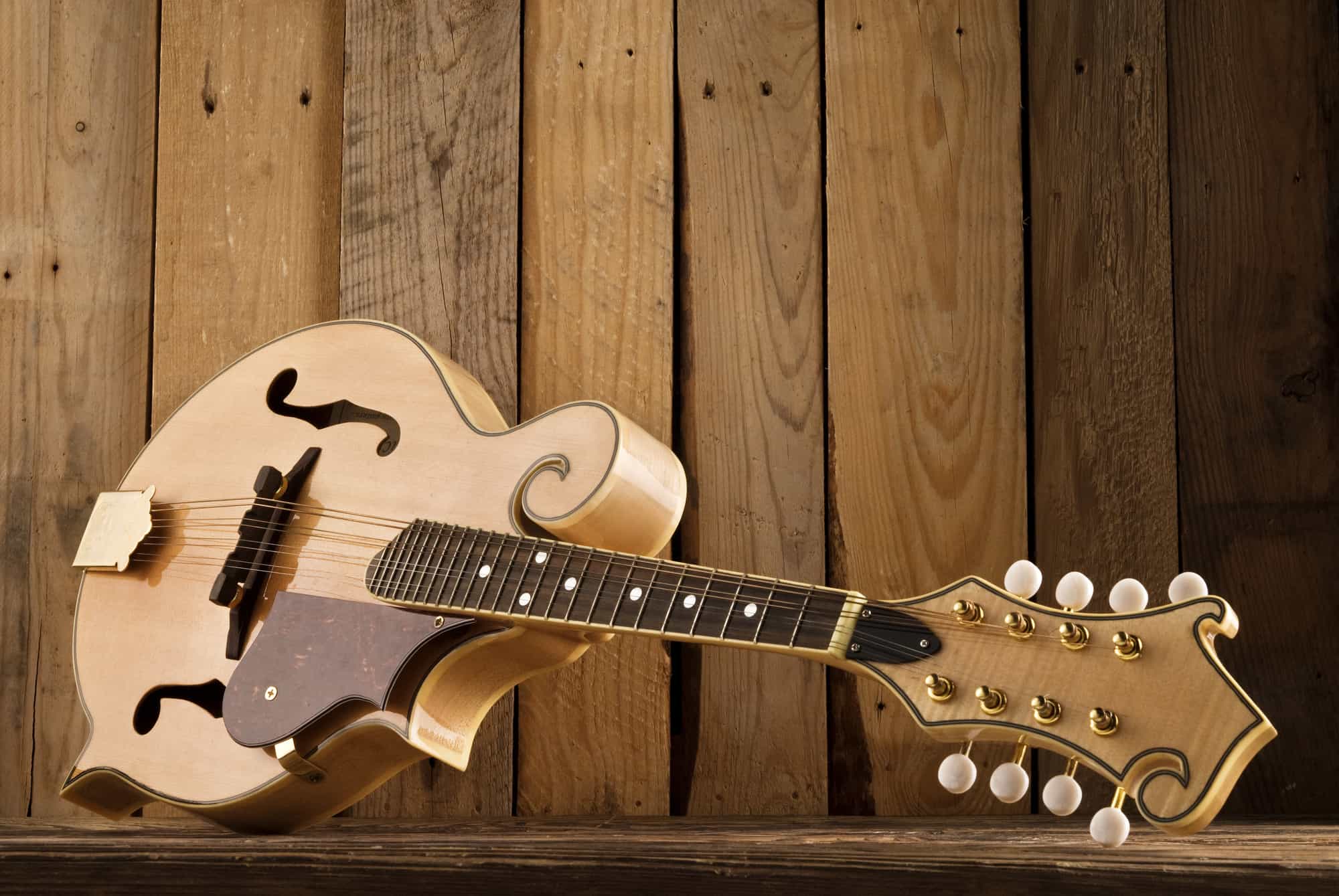
F-style mandolins have a decorative scroll on the upper bout and a point on the lower bout. They are:
- More expensive due to the additional carving and craftsmanship required
- Traditional for bluegrass, where the F-5 shape is essentially the standard
- Visually distinctive, which matters for stage presence
- Functionally similar in tone to A-styles of the same build quality
The scroll and points on an F-style mandolin do not meaningfully change the sound. What they do change is the aesthetic and the tradition. Bluegrass players gravitate toward F-styles because that is the tradition Bill Monroe established with his 1923 Gibson F-5. If bluegrass is your primary genre, an F-style makes sense culturally and visually.
What Actually Matters When Buying a Mandolin
Tonewood Selection
The wood used in a mandolin has the single biggest impact on its sound.
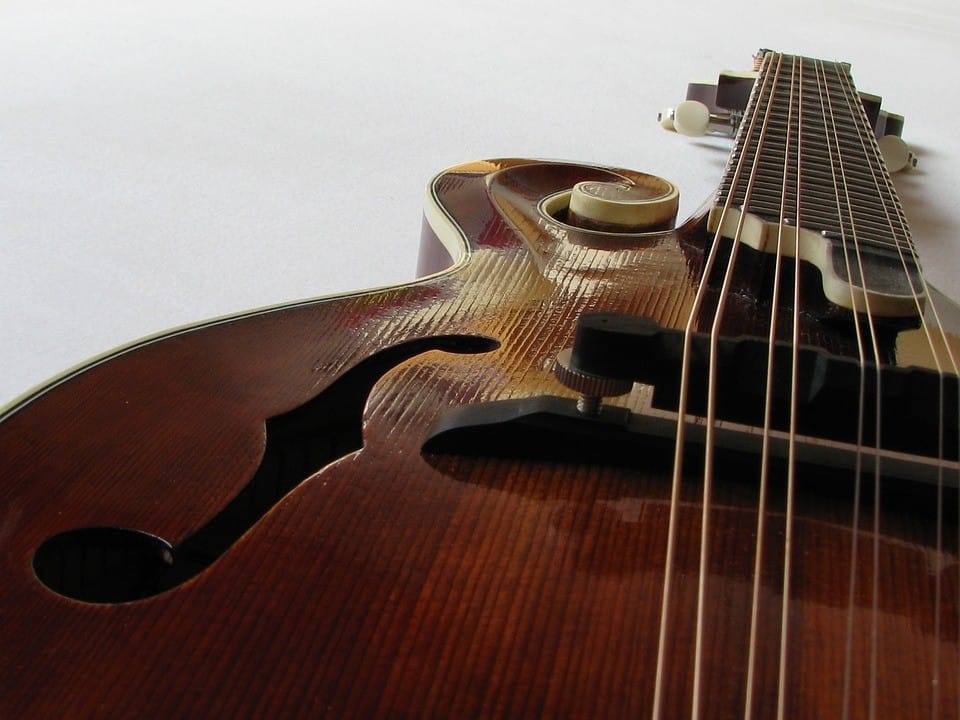
Tops (soundboards): Solid spruce is the gold standard. Spruce has a tight, even grain that transmits vibrations efficiently, producing bright, clear tone with good projection. Some builders use cedar for a warmer, darker sound. Laminate tops — layers of wood pressed together — are found on budget instruments and produce noticeably less resonance and volume.
Back and sides: Maple is the traditional choice, offering bright projection and clarity. Mahogany produces a warmer, darker tone. Some builders like Seagull use unconventional woods like wild cherry for a distinctive voice.
Fretboard: Ebony and rosewood are the standards. Both are dense hardwoods that provide a smooth playing surface and resist wear from fretting.
Neck: Maple and mahogany are most common, chosen for rigidity. Most quality mandolins have an adjustable truss rod embedded in the neck, allowing setup adjustments for action and relief.
Build Quality and Setup
A mandolin’s setup — the string height (action), nut slot depth, bridge placement, and neck relief — determines how it actually feels to play. A well-built mandolin with a poor setup will feel terrible. A modestly built mandolin with a great setup can feel surprisingly good.
What to look for:
- Action: Strings should be close enough to the fretboard for comfortable fretting without buzzing. Measured at the 12th fret, most players prefer about 2mm on the treble side and 2.5mm on the bass side.
- Intonation: Fretted notes should be in tune with open strings. A compensated bridge helps with this.
- Nut slots: Should be cut to the right depth. Too high means the first few frets are hard to play. Too low causes buzzing.
- Truss rod: An adjustable truss rod lets you (or a luthier) fine-tune the neck relief as the instrument settles and seasons change.
If you are buying online, factor in the cost of a professional setup. Many mandolins ship with adequate but not optimal setups. A setup from a skilled luthier typically runs a modest fee and transforms the playing experience.
Acoustic vs. Electric vs. Acoustic-Electric
Acoustic mandolins are the standard. No electronics, no batteries, just wood and strings. This is what most players need, especially beginners.
Electric mandolins have magnetic pickups and solid or semi-hollow bodies. They are specialized instruments for players in amplified bands who need consistent volume control. Not recommended for beginners.
Acoustic-electric mandolins are acoustic instruments with a built-in piezo pickup, allowing you to plug into an amplifier or PA system when needed. This is the practical choice if you plan to play live shows or jam sessions where volume matters. The Vangoa and some Kentucky models offer this configuration at accessible price points.
Tuning Hardware
Mandolins have eight strings in four courses (pairs), tuned in unison: G-D-A-E, the same as a violin. Quality tuners matter more than on a guitar because you are tuning twice as many strings to stay in unison.
Look for sealed-gear tuners or quality open-gear tuners with smooth, precise action. Cheap tuners with sloppy gears make tuning frustrating and make it harder to keep the instrument in tune during playing. Grover and Gotoh tuners are reliable choices found on mid-range and better instruments.
Mandolin Strings: A Quick Primer
Strings are the one component you will replace regularly, so understanding your options matters.
Gauge
- Light gauge: Lower tension, easier to press, brighter tone. Best for beginners and fingerpickers.
- Medium gauge: The standard for most players. Good balance of tone, volume, and playability.
- Heavy gauge: Higher tension, more volume and depth, but harder on the fingers. Preferred by some bluegrass players for aggressive chop chords.
Material
Phosphor bronze is the most popular choice, producing a warm, balanced tone with good longevity. 80/20 bronze is brighter out of the package but loses brightness faster. Stainless steel produces a darker, more focused tone and lasts longer.
D’Addario EJ74 medium phosphor bronze strings are the industry standard — affordable, consistent, and they work well on virtually any mandolin.
Coating
Coated strings like Elixir Nanoweb last significantly longer than uncoated strings and resist corrosion from finger oils. The trade-off is a slightly different feel and a small reduction in brightness. For players who sweat heavily or live in humid climates, coated strings are worth the premium.
Essential Mandolin Accessories
- Clip-on tuner: Mandatory. Mandolins need frequent tuning, especially with new strings. A Snark or TC Electronic Polytune clip-on works well.
- Case or gig bag: Mandolins are sensitive to humidity and temperature swings. A hardshell case is ideal for transport. A padded gig bag works for local travel.
- Strap: Essential if you play standing. Mandolins are light, but holding one without a strap while playing is awkward and limits your technique.
- Picks: Mandolin picks are typically thicker and stiffer than guitar picks. Start with 1.0mm or thicker. Many bluegrass players use picks in the 1.5mm range for clean, defined notes.
- Extra strings: Keep at least one spare set. Strings break, and you do not want a broken string to end a practice session or performance.
The Mandolin Family
The mandolin is actually part of a larger family of instruments, each tuned differently and filling a different sonic role.
- Mandolin: The soprano voice, tuned G-D-A-E. The instrument covered in this guide.
- Mandola: Tuned a fifth below the mandolin (C-G-D-A), filling an alto role similar to the viola in the violin family.
- Octave mandolin: Tuned one octave below the standard mandolin, producing a deeper, warmer sound. Popular in Celtic and folk music.
- Mandocello: A larger instrument tuned like a cello (C-G-D-A, one octave below the mandola). Used in mandolin ensembles and orchestras.
If you enjoy the mandolin and want to explore related instruments, the mandolin family page on Wikipedia provides a thorough overview of the history and variations.
Which Mandolin Should You Buy?
Skip the ultra-cheap instruments unless you truly just want to test the waters. A budget mandolin with a laminate top will sound thin and may discourage you from continuing.
If you are a beginner: The Kentucky KM-150S gives you a solid-top instrument with a playable setup at an accessible price. It is the safest first mandolin purchase.
If you are ready to invest: The Eastman MD315 is the consensus best value in mandolins. Solid tonewoods, hand-carved construction, and tone that improves with age. This is a mandolin you can grow with for years.
If you want an F-style: The Loar LM-520-VS delivers vintage-inspired build quality and tone at a mid-range price point. For a step up, the Gold Tone GM-70+ offers premium construction without custom shop pricing.
If you play multiple genres: The Ibanez M522S offers the versatility and playability that genre-hopping players need.
For deeper comparisons in the budget-to-mid range, our best mandolin under 1,000 guide breaks down more options. And if you are into folk instruments generally, our guides to the best banjo and best mandolin players are worth exploring.