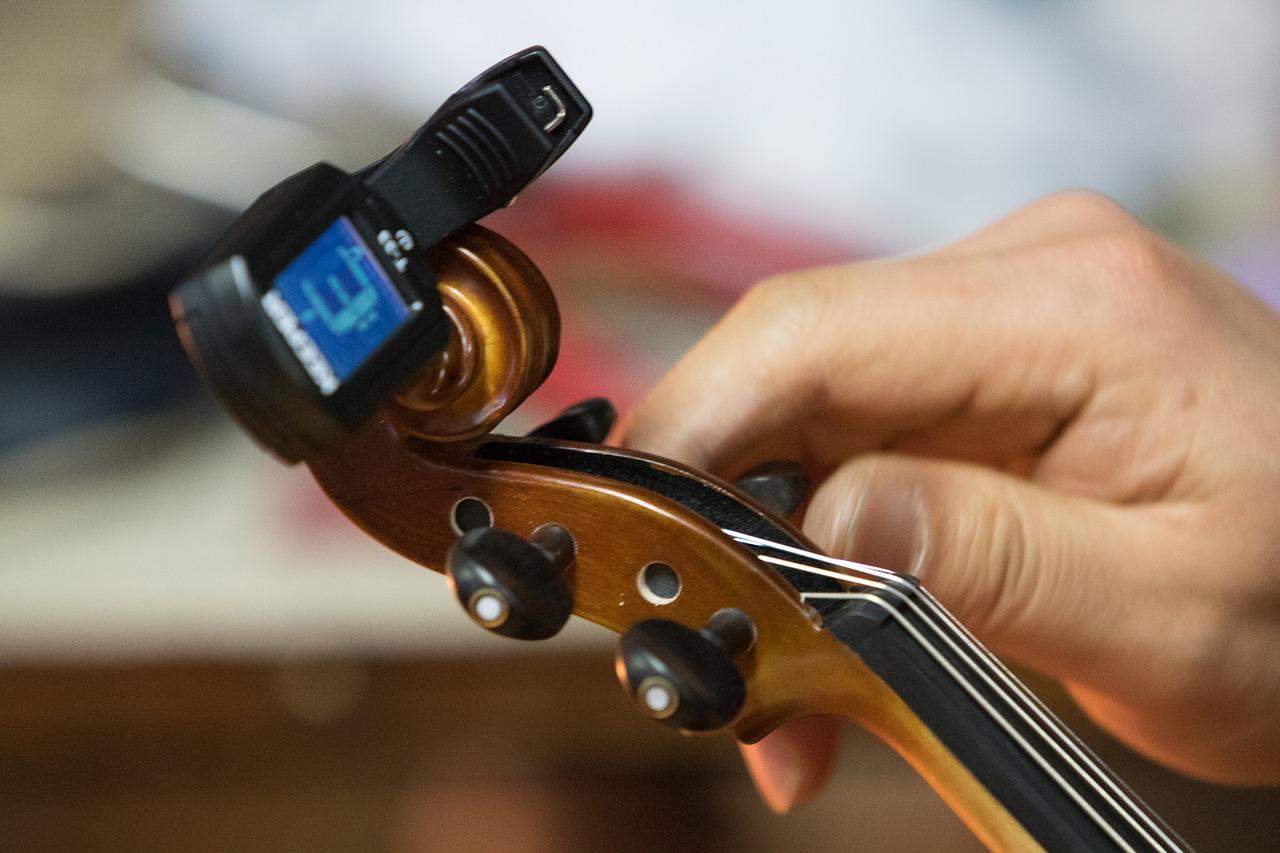
The Best Violin Tuner in 2025
A reliable tuner is one of the most essential accessories for any violinist. Unlike fretted instruments, the violin gives you zero visual reference for pitch — your intonation depends entirely on your ears and your tuning accuracy. Even a slight deviation on one open string throws off every note you play in that position.
Clip-on tuners that sense vibrations directly from the instrument are the most practical option for violinists. They work in noisy environments like orchestra warm-ups and group lessons where microphone-based tuners and phone apps struggle. After comparing tuners across practice rooms, lessons, and stage settings, here are the best violin tuners worth buying.
The 5 Best Violin Tuners
1. D’Addario NS Micro Clip-On Tuner — Best Overall
The D’Addario NS Micro Clip-On Tuner is a low-profile chromatic tuner that clips behind the scroll, making it nearly invisible to your audience. D’Addario designed it with string players in mind, and it shows.
What stands out:
- Piezo vibration sensor reads string vibrations directly, ignoring background noise from other instruments tuning nearby
- Sits flush against the pegbox — no bulky tuner visible from the front of the instrument
- Four preset viewing angles to match different scroll shapes
- Visual metronome function for practice sessions
- Calibration range from 410-480Hz, so it works for Baroque tuning (A=415) through modern bright orchestral pitch (A=443)
The downside: The screen is small. At arm’s length or in dim lighting, the display can be harder to read compared to larger tuners like the Snark or Boss models.
The NS Micro is the tuner to get if you play in orchestras, recitals, or any setting where aesthetics matter. It stays clipped on during performance without distracting the audience. It also works across violin, viola, cello, and bass, so one tuner covers your entire string collection.
2. Snark SN-5X — Best for Beginners
The Snark SN-5X is one of the most popular clip-on tuners ever made. The full-color rotating display makes it easy to read from any angle, and there is essentially no learning curve — clip it on the scroll, pluck a string, and turn the peg until the screen turns green.
What stands out:
- Bright, full-color display that rotates 360 degrees for easy viewing
- Fast, responsive tracking with minimal lag between plucks
- Simple single-button interface — no menus or modes to navigate
- Rubber-padded clip protects the instrument finish
- Works with guitar, ukulele, mandolin, banjo, and other stringed instruments
The downside: The plastic construction is the Achilles heel. The clip hinge can crack after months of heavy use, and the tuner is easy to lose given its small size. Store it in your violin case rather than leaving it clipped on during transport.
For beginners who want a tuner that simply works without any complexity, the SN-5X is hard to beat. It is accurate enough for daily practice and affordable enough to replace if it breaks.
3. Boss TU-02 Clip-On Tuner — Best Build Quality
The Boss TU-02 brings Boss’s reputation for bulletproof gear to the clip-on tuner category. If you are tired of replacing cheap tuners every few months, the TU-02 is built to last.
What stands out:
- High-contrast color display that is readable in bright stage lighting and dim practice rooms alike
- Accurate chromatic tuning with smooth, responsive needle movement
- Solid construction that feels noticeably sturdier than budget clip-on tuners
- Flat tuning support and A4 calibration (430-450Hz)
- Preset modes for guitar, bass, violin, ukulele, and chromatic
The downside: Slightly bulkier than the D’Addario NS Micro. If you want a tuner that disappears on stage, the NS Micro is a better choice.
The TU-02 is a strong pick for working musicians who need a tuner that survives life in a gig bag. Boss also makes the TU-05 clip-on tuner with a built-in metronome if you want both functions in one device.
4. Korg CA-2 Chromatic Tuner — Best Handheld Tuner
The Korg CA-2 is a compact handheld chromatic tuner that has been a staple in music classrooms and practice rooms for years. It is not a clip-on, which makes it better suited to desk or stand use.
What stands out:
- Wide detection range (A0 to C8) covers every note on violin, viola, cello, and bass
- Needle-style LCD meter gives precise visual feedback for fine-tuning
- Memory back-up function stores your reference pitch setting
- Built-in microphone plus 1/4” input jack for contact microphone use
- Runs on a single AAA battery with long battery life
The downside: Without a clip-on attachment, it cannot sense vibrations — it relies on its built-in microphone, which makes it less reliable in noisy rooms. You can buy a separate Korg CM-300 contact microphone to clip onto the bridge and run a cable to the CA-2, but at that point you are carrying more gear than a clip-on tuner requires.
The CA-2 is a solid choice if you practice mostly in a quiet room at home or if you teach and want a tuner that sits on a desk where students can see it. Many violin teachers keep one on their music stand alongside a metronome.
5. TC Electronic UniTune Clip — Best for Advanced Players
The TC Electronic UniTune Clip is a professional-grade clip-on tuner with a strobe tuning mode accurate to +/- 0.02 cents. That is an order of magnitude more precise than standard clip-on tuners.
What stands out:
- Strobe mode offers near-perfect tuning accuracy — essential for studio work and solo performance
- Standard chromatic mode also available for quick tuning
- Extremely bright display visible from any angle and in any lighting
- Stainless steel clip is more durable than the plastic clips on most competitors
- Fast response time, even on low-pitched strings
The downside: This is the most expensive tuner on the list. For daily practice, the extra precision may not be necessary — the D’Addario or Boss tuners get you close enough. The UniTune earns its keep in recording sessions and concert settings where every cent matters.
If you are an intermediate or advanced player who takes tuning seriously, the UniTune Clip is the gold standard in clip-on tuners. Professional violinists who previously used Peterson strobe tuners have increasingly switched to the UniTune for its combination of accuracy and portability.
Clip-On vs. App vs. Handheld: Which Type of Tuner Should You Get?
Clip-On Tuners
Clip-on tuners attach to the scroll or pegbox and detect pitch through vibrations. This is the best option for most violinists because they work in noisy environments — orchestra warm-ups, group lessons, backstage, jam sessions — where a microphone-based tuner would pick up interference from other instruments.
The trade-off is that you need to carry a physical device and replace batteries occasionally. Most clip-on tuners use CR2032 coin cells that last for months of regular use.
Tuning Apps
Smartphone apps like Cleartune and PanoTuner are free or nearly free and always in your pocket. They work well in quiet practice rooms.
The major limitation is that apps use your phone’s microphone, which picks up everything in the room. If someone else is playing nearby, the app gets confused. Apps also drain your phone battery and require you to unlock your phone, open the app, and grant microphone permissions — small frictions that add up during a practice session.
Apps are a fine backup but should not be your primary tuner.
Handheld Tuners
Handheld tuners like the Korg CA-2 sit on a desk or music stand. They are popular with teachers and multi-instrumentalists because the larger display is easy for students to read. The downside is the same microphone sensitivity issue as apps, unless you add a separate contact microphone.
Bottom line: A clip-on tuner is the right choice for most violinists. Get a handheld as a secondary tuner for your teaching studio or practice desk, and keep an app on your phone for emergencies.
What to Look for in a Violin Tuner
Chromatic vs. Violin-Specific Mode
A chromatic tuner detects all twelve notes in the Western scale. A violin-specific mode only detects G, D, A, and E — the four open strings.
Go chromatic. A chromatic tuner lets you check the intonation of any note on the fingerboard, not just the open strings. This is far more useful for practice, especially when you are learning new positions. Every tuner on this list is chromatic.
Vibration Sensor vs. Microphone
Clip-on tuners use a piezo vibration sensor that reads the instrument’s physical vibrations. This means they only “hear” your violin, even if twenty other musicians are tuning simultaneously.
Microphone-based tuners (apps, handhelds without a contact mic) pick up all sound in the room. In a quiet practice space, this is fine. In any group setting, it is a liability.
Display Brightness and Readability
You need to see the tuner while your violin is on your shoulder, which means viewing it from an odd angle in varying light. A bright, color-coded display (green for in tune, red for sharp or flat) eliminates squinting. Rotating displays that swivel 360 degrees help with viewing angles.
Calibration Range
Standard concert pitch is A4 = 440Hz, but orchestras and ensembles tune to different reference pitches. European orchestras commonly tune to A=442 or A=443. Baroque ensembles tune lower, around A=415. A tuner with adjustable calibration lets you match any ensemble’s pitch standard.
Battery Life and Durability
Clip-on tuners live a rough life — they get tossed into cases, sat on, and knocked around. Look for a tuner with a sturdy clip mechanism and decent build quality. Auto-off features that shut the tuner down after a few minutes of inactivity help extend battery life.
How to Tune a Violin
If you are new to the violin, here is the practical tuning process:
Standard Tuning
Violin strings are tuned to G3, D4, A4, and E5, from lowest (thickest string) to highest (thinnest string). Each pair of adjacent strings is separated by a perfect fifth.
Step-by-Step Process
- Start with the A string. This is the reference string. In an orchestra, the oboe plays an A and everyone tunes to it. At home, your tuner gives you the reference.
- Use fine tuners first. Most violins have fine tuners on the tailpiece — small screw-adjusted mechanisms that make micro-adjustments. Turn them to raise or lower the pitch in small increments. Beginners should rely on fine tuners rather than the pegs.
- Move to D, then G, then E. After A is set, tune D by bowing the D string and adjusting until your tuner reads D4. Then G3, then E5.
- Check in pairs. Once all four strings are tuned individually, bow two adjacent strings together and listen for the pure interval of a fifth. If it sounds “wavy” or out of tune, one string needs a slight adjustment.
Using the Pegs
The tuning pegs sit in the pegbox and make large pitch adjustments. Push the peg gently inward while turning to seat it in the tapered hole. If a peg slips, it may need peg compound (peg dope) applied to increase friction. If a peg is stuck, a small amount of peg compound also helps.
New strings stretch significantly for the first few days after installation. Expect to retune frequently until they settle in — this is normal and not a sign of a problem with your tuner or pegs.
Can You Use a Guitar Tuner for Violin?
Yes, as long as it is chromatic. A standard guitar tuner that only detects E, A, D, G, B, and E will not recognize all violin pitches correctly because the violin’s G3 and E5 are in different octaves than guitar strings. A chromatic tuner detects all notes regardless of instrument, so any chromatic tuner — including the banjo tuners and bass tuners on our other lists — works for violin.
Why Your Violin Keeps Going Out of Tune
If you find yourself retuning constantly, it is almost certainly one of these issues:
- New strings. Fresh strings stretch for 2-5 days depending on the string type. Gut strings take longer to stabilize than synthetic or steel core strings. This is normal.
- Slipping pegs. If the pegs do not hold, they need peg compound (apply to the shiny contact areas) or may need to be professionally refitted by a luthier.
- Temperature and humidity changes. Wood expands and contracts with changes in temperature and humidity. Moving from a cold car to a warm room will cause the strings to go sharp as the wood contracts. Give the instrument a few minutes to acclimate before tuning.
- Playing itself in. A brand-new violin or one that has sat unplayed for months will go out of tune frequently at first. Regular playing seats the strings, pegs, and fine tuners so they hold better.
None of these mean your violin is defective. Retuning is part of playing a stringed instrument, and having a fast, accurate tuner on hand makes the process painless.
Conclusion
For most violinists, the D’Addario NS Micro Clip-On Tuner is the best overall choice. It is discreet, accurate, and built for string players. The Snark SN-5X remains an excellent budget pick for beginners who want something simple and reliable. And if precision is your priority, the TC Electronic UniTune Clip delivers professional-grade accuracy in a clip-on form factor.
Whichever tuner you choose, the important thing is to tune every time you pick up your instrument. Consistent tuning builds your ear, improves your intonation, and makes practice more productive.