Boss VE-2 Vocal Harmonist Processor Review
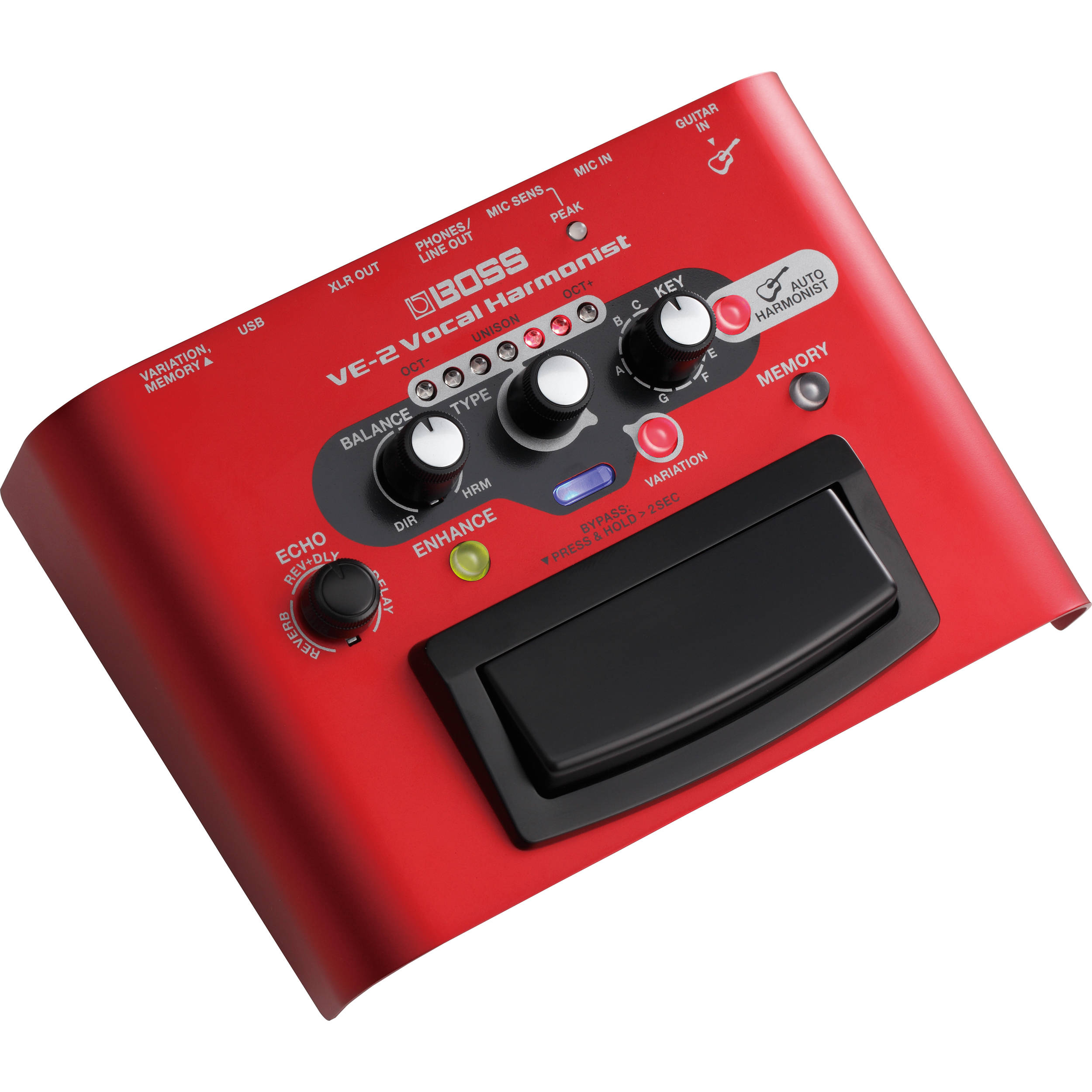
The Boss VE-2 Vocal Harmonist is a compact vocal effects pedal built for singer-guitarists who want real-time harmonies without a complex setup. It sits in Boss’s vocal lineup between the stripped-down VE-1 and the feature-loaded VE-8, giving you harmony, reverb, delay, and pitch correction in a battery-powered stompbox.
This review covers what the VE-2 actually does well, where it falls short, and who should consider it.
Who the VE-2 Is Built For
The VE-2 is designed for solo acoustic performers and singer-guitarists. If you play guitar and sing at the same time, the pedal’s standout feature — auto-tracking harmonies from your guitar signal — makes it uniquely useful. Plug your guitar into the rear input, and the VE-2 analyzes the chords you play to generate harmonies that follow your key changes in real time.
This is not a multi-effects workstation. It has no looper, no distortion, no amp modeling. If you need deep editing, programmable presets for every song, or multi-voice stacking, look at the TC Helicon VoiceLive series or the Boss VE-8 instead. The VE-2 trades flexibility for simplicity — and for many solo performers, that trade-off works.
Harmony Modes and How They Work
The VE-2 offers 24 harmony variations split across 12 types, each with a standard and “variation” version. The variation adds a wider, thicker character to the same interval. You scroll through types using the TYPE knob, with LEDs indicating your selection. Options include intervals above your voice (thirds, fifths, octave up), below (thirds, fifths, octave down), and combinations.
Three Ways to Set the Key
The pedal gives you three operating modes for harmony generation:
-
Manual key selection — You set the key using the KEY knob. This works for songs that stay in one key, but you will need to adjust between songs (or mid-song if there is a key change).
-
Guitar auto-detect — Plug a guitar into the rear input and the VE-2 listens to the chords you play to determine the correct harmony intervals. This mode activates automatically when a guitar is connected. It handles mid-song key changes and chord transitions well, as long as your chord voicings are clean.
-
Hybrid mode — The pedal tracks the guitar input when a signal is present, then falls back to your manually selected key during guitar breaks or silent passages. This is the most practical mode for live use, since it covers gaps where the guitar drops out.
The guitar-tracking is the VE-2’s strongest feature. Multiple long-term users report that it tracks reliably when you play clean, defined chord shapes. Sloppy fretting, open-string buzz, or heavy strumming near the mic can confuse the tracking algorithm, so technique matters.
What You Cannot Control
One limitation worth noting: the VE-2 does not let you specify exact intervals (like “always a major third” or “always a fifth”). The pedal selects what it considers the best-fitting harmony based on the detected key. The VE-20 and its successor, the VE-22, give you that level of control. For many acoustic performers, the VE-2’s automatic selection works fine. For studio-precise harmony arrangements, it can feel limiting.
Effects: Reverb, Delay, and Enhance
Beyond harmony, the VE-2 includes three vocal effects controlled by dedicated knobs and buttons.
Reverb and Delay
The ECHO knob sweeps through three zones: reverb only, reverb plus delay, and delay only. Turning the knob clockwise moves you through these zones, with intensity increasing within each. The sounds are usable for live performance — they add presence and space without overwhelming the vocal.
One common complaint: the reverb does not fully disengage. Even at the lowest setting, there is a small amount of ambient effect. If you want a completely dry signal, you will not get it from the VE-2’s effect section. For most live contexts this is not a dealbreaker, but studio purists should be aware.
Enhance and Pitch Correction
The ENHANCE button has two stages. Press once to activate a subtle compression and EQ circuit that evens out your dynamics — helpful for handling the volume swings of live singing. Press again to add gentle pitch correction on top of the enhancement.
These two functions are linked. You can run enhance without pitch correction, but you cannot run pitch correction without enhance. The pitch correction is mild — it is not an auto-tune effect. It nudges your pitch toward the nearest note, which also helps the harmony engine produce cleaner results.
A critical practical note: the pitch correction and enhance features are sensitive to ambient noise. If your microphone picks up stage noise, monitor bleed, or acoustic guitar body resonance, the pitch detection can produce a warbling artifact. Users who run the VE-2 successfully in live settings consistently recommend using a supercardioid or hypercardioid dynamic mic that rejects off-axis sound. A standard cardioid condenser will likely cause problems in any moderately loud environment.
Connectivity and I/O
The VE-2’s rear panel is well-equipped for a pedal at this level:
- XLR mic input with 48V phantom power and a mic sensitivity knob
- XLR output with a ground lift switch for eliminating hum
- 1/4-inch guitar input for auto-harmony tracking
- 1/4-inch guitar thru output to pass your guitar signal on to an amp or PA
- 3.5mm headphone/line output for monitoring or recording
- USB Type B output for use as a basic audio interface with a DAW
- 9V DC power input (Boss PSA-series adapter, sold separately)
The USB audio function is a genuine bonus. You can plug the VE-2 into your computer and record your processed vocal — harmonies, reverb, and all — directly into any DAW. For solo artists recording demos or content for social media, this eliminates the need for a separate audio interface for basic vocal capture.
The phantom power is a thoughtful inclusion, meaning you can use a condenser mic without an external preamp. That said, for live use with the VE-2, a dynamic mic will almost always give you better results due to the noise sensitivity issues mentioned above.
Build Quality and Portability
The VE-2 uses a brushed metal top panel that wraps around the sides, mounted to a plastic base. It feels solid without being heavy — the whole unit weighs about one pound. The footprint is roughly the size of two standard Boss guitar pedals side by side.
The large bypass/harmony footswitch takes up the entire bottom half of the pedal, which is a smart design choice. On a dark stage, you do not need to hunt for a small button. The three knobs (ECHO, BALANCE, TYPE) and the KEY selector are spaced well enough for quick adjustments, though some users with larger hands find the knobs a bit close together.
Power Options
The VE-2 runs on a 9V DC adapter or four AA batteries. Battery operation is a real advantage for buskers, street performers, and outdoor gigs where power is not available. Boss does not include the power adapter in the box, so budget for that separately.
For any gig longer than a couple of hours, use the AC adapter. Battery life is reasonable for short sets, but running harmonies and effects drains AA cells faster than you might expect.
Stored Presets and Memory
The pedal stores three user presets that save your harmony type, key, effect settings, and enhance/pitch correction state. You recall these presets using a combination of the VARIATION button, or more practically, with an optional Boss FS-series footswitch connected to the rear panel.
Three presets is enough for a typical set if your songs share similar settings. If you need per-song presets for a large setlist, you will outgrow this quickly and should look at the VE-8 or a TC Helicon unit.
How It Compares to Alternatives
Boss VE-8 Acoustic Singer
The VE-8 is the VE-2’s bigger sibling. It adds guitar effects (chorus, reverb, compression for your guitar signal), more harmony voices, a phrase looper, and a much larger preset library. If you want a single pedal to handle both your guitar tone and vocal processing, the VE-8 is the more complete package. The VE-2 makes sense if you only need vocal processing and already have your guitar effects sorted.
TC Helicon Harmony Singer 2
The Harmony Singer 2 is the most direct competitor. It also tracks guitar input for auto-harmonies and offers reverb and tone shaping. The main differences are in sound character — some players prefer the TC Helicon’s harmony voicing, while others find the Boss tracking more reliable. Both are comparable in simplicity and form factor.
TC Helicon VoiceLive Touch 2
The VoiceLive Touch 2 is a step up in complexity and capability. It offers four-voice harmony, a multi-track looper, and deep editing. It is a better choice for professional performers who need precise control over every aspect of their vocal sound. But it requires more setup time and stage management — the opposite of what the VE-2 offers.
Tips for Getting the Best Results
Based on user feedback and hands-on experience, here are practical tips that make a real difference with the VE-2:
- Use a supercardioid dynamic mic. This is the single most impactful thing you can do. A mic with tight pickup and strong off-axis rejection prevents the warbling and tracking errors that plague users with standard cardioid condensers.
- Play clean chord voicings. The guitar auto-detect works best with clearly defined chords. Avoid excessive string noise, muted strings, or complex extended voicings that obscure the root and quality of the chord.
- Keep the BALANCE knob moderate. Setting the harmony mix below center (around 9 or 10 o’clock) produces the most natural-sounding blend. Cranking it higher makes the harmonies sound synthetic.
- Cover your acoustic guitar’s soundhole. If you are using an acoustic guitar on stage, a soundhole cover reduces body resonance bleeding into the mic, which improves tracking accuracy.
- Use hybrid mode for live sets. The combination of guitar tracking with manual key fallback handles the widest range of live situations without mid-song adjustments.
The Bottom Line
The Boss VE-2 is a focused, well-built vocal harmonizer pedal that does one thing well: it gives solo singer-guitarists instant, guitar-tracked harmonies with minimal setup. The reverb, delay, and enhance features are functional additions rather than standout features.
Its limitations are real — no interval selection, noise sensitivity with the wrong mic, and only three presets. But for acoustic performers who want to add harmonies to their solo act without learning a complex system, the VE-2 remains a solid choice. It has been in Boss’s lineup since 2014 and continues to hold its #9 ranking among vocal effects processors on Amazon, which says something about its staying power.
Check the current price on Amazon to see if it fits your budget.