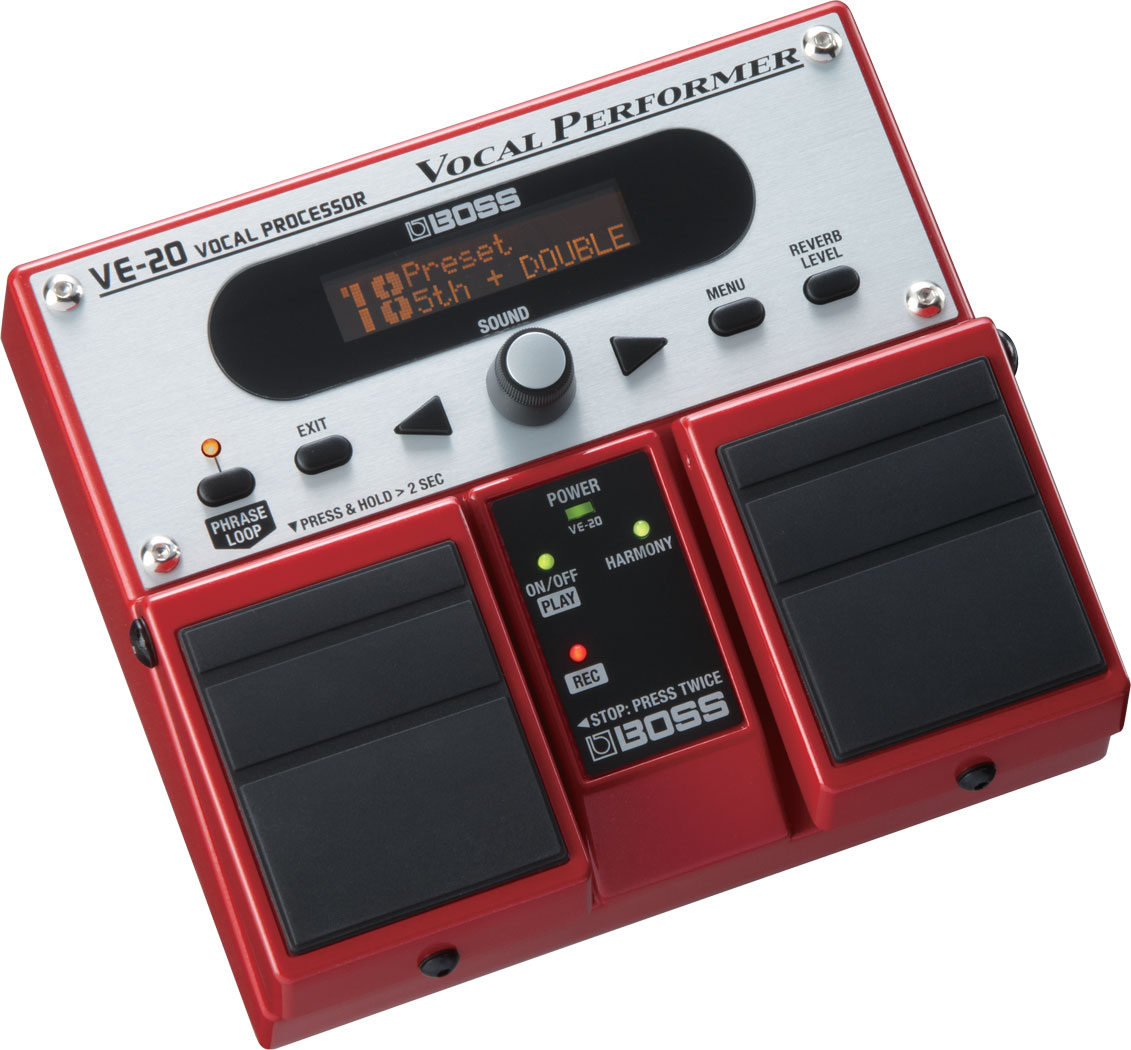
Boss VE-20 Vocal Effects Processor Review
The Boss VE-20 Vocal Performer is a floor-based vocal effects processor built for live singers who want harmonies, pitch correction, and effects without a rack unit or a laptop on stage. It sits in Boss’s twin-pedal format, takes a standard XLR mic input with 48V phantom power, and outputs stereo XLR at mic level so it drops straight into a PA system or stage snake.
Boss discontinued the VE-20 several years ago, but it remains widely available on the used market and still holds up as a capable tool for gigging vocalists. This review breaks down what it actually does well, where it falls short, and whether it still makes sense in a market that has moved on to newer options.
Effects Chain and Signal Path
The VE-20 runs your signal through up to six effect blocks in series: dynamics (compression/gate), pitch correction, tone/SFX, double/harmony, delay, and reverb. You build patches by combining these blocks, and each patch stores the full chain state.
The unit ships with 30 factory presets and has room for 50 user patches on top of that. Factory presets are genuinely useful as starting points. They give you a quick tour of what the processor can do and many are gig-ready with minor tweaks.
Pitch Correction
Four pitch correction modes are available:
- Soft applies gentle correction that smooths out minor pitch drift without obvious artifacts. You would struggle to hear this one working in a live mix, which is the point.
- Hard pushes correction further and starts to show audible stepping between notes. Useful if you want a tighter, more produced sound.
- Electric brings the characteristic auto-tune warble front and center as a deliberate stylistic effect.
- Robot locks all input to a single user-defined note, producing a monotone metallic drone.
You set the key and scale per patch, which means you need to plan your setlist patches around the keys of your songs. There is no MIDI input for external key changes, so mid-song key changes require either a pre-programmed patch swap or just turning pitch correction off for that section.
Harmony and Doubling
The harmony engine generates up to two harmony voices that track your input based on the key and scale you set. You can dial in intervals (unison, thirds, fourths, fifths, sixths, octaves up or down), pan each voice independently, and adjust a “gender” parameter that shifts the formant character to sound more masculine or feminine.
The doubling mode thickens your vocal by layering a slightly detuned and delayed copy of your voice. It gives you that classic double-tracked vocal sound without needing to sing the part twice. At moderate settings, it adds body to a thin vocal without sounding overtly processed.
Harmony tracking depends entirely on getting the key setting right. If you are singing in D minor and the patch is set to C major, the generated harmonies will be wrong. This is a common frustration for performers who play in multiple keys per set.
Tone and Special Effects
Beyond the core vocal tools, the VE-20 includes a bank of tone-shaping and special effects:
- Reverb and delay are solid and functional. Nothing remarkable, but they sit cleanly in a live mix and cover the essentials.
- Distortion adds grit to your vocal. It works better for aggressive genres than subtle applications.
- Radio simulates a lo-fi AM radio sound that can be genuinely useful for dramatic contrast in a performance.
- Strobe is a square-wave tremolo effect that chops your signal rhythmically.
- Chorus and flanger add movement and width to your voice.
Parameter control across all effects is relatively shallow. You get a handful of adjustable settings per effect, not the deep editing you would find on a rack processor or software plugin. For most live applications, this is a reasonable trade-off. You are tweaking patches at soundcheck, not mid-song.
The Looper
The VE-20 includes a 38-second phrase looper with sound-on-sound overdubbing. You control it with the left footswitch, which doubles as the global bypass switch. This dual function takes some practice to avoid accidentally bypassing your effects when you meant to stop the loop, and vice versa.
The critical limitation: loops are not stored in memory. The moment you stop playback, the loop is gone. You cannot save a loop, recall it later, or use it as a backing track across songs. It is a live performance tool only, meant for building up vocal layers in real time during a song and then clearing them for the next one.
If looping is central to your performance style, you will almost certainly want a dedicated vocal looper pedal instead. The VE-20’s looper works as a bonus feature for occasional use, but it is not robust enough to build a set around.
Build Quality and I/O
The VE-20 uses Boss’s standard all-metal twin-pedal enclosure, the same tank-like construction that has kept their guitar pedals on pedalboards for decades. It can take the abuse of regular gigging without concern.
The rear panel I/O layout is well thought out for live use:
- Input: Combo XLR/TRS jack with switchable 48V phantom power, so it works with both dynamic and condenser microphones
- Output: Stereo XLR pair at mic level (plugs directly into a mixer or snake)
- Headphone/line out: 1/4” stereo jack for monitoring or connecting to a line-level input
- Power: Runs on six AA batteries or a Boss PSA-series AC adapter (adapter sold separately)
The battery option is useful for buskers and situations where you cannot guarantee power at your performance spot. Expect roughly 5-6 hours on a fresh set of alkaline batteries with phantom power off.
One note on the microphone you pair with it: the VE-20’s pitch detection and harmony tracking perform best with a clean, direct signal. A dynamic mic like the Shure SM58 fed straight in tends to give the most reliable tracking. Condenser mics work fine but can occasionally confuse the pitch detection in noisy stage environments.
Real Limitations
The VE-20 has genuine weaknesses that are worth understanding before buying:
Two-footswitch problem. The right footswitch handles both patch selection and harmony bypass. You cannot independently turn off effects and harmonies during a song. If you want delay running but need to kill the harmony for a verse, you either need a separate patch programmed for that exact combination or you bend down and adjust it manually. Competitors like the TC Helicon VoiceLive series solve this with additional footswitches.
No tap tempo. Delay times are set per patch. You cannot tap in a tempo live, which means your delays will drift from the band’s tempo if the drummer pushes or pulls. For delay-heavy performers, this is a meaningful gap.
Menu-driven operation. Despite being a floor pedal, the VE-20 operates more like a rack unit. You build and edit patches through a menu system, not by tweaking knobs in real time. This is fine for careful studio prep but frustrating if you want to make adjustments on the fly between songs.
No feedback suppression. Running vocal effects through a PA system at stage volume can create feedback loops, especially with reverb and harmony engaged. The VE-20 offers no notch filter or feedback suppression, so you are relying entirely on your sound engineer to manage it from the desk.
Manual is sparse. The included documentation is brief and assumes familiarity with vocal processing concepts. Key operational details (like how to scroll patches with the footswitch) are buried in the manual and not printed on the unit itself. Plan to spend some time with it at home before your first gig.
Who Is This For?
The VE-20 fits best in a specific scenario: you are a vocalist who wants reliable harmony, pitch correction, and basic effects in a rugged floor unit, and you are willing to do your patch programming in advance. Singer-songwriters who play consistent setlists and worship leaders who know their song keys ahead of time will get the most out of it.
It is less suited for performers who need to improvise, change keys on the fly, or layer complex loops. For those use cases, look at the more fully featured options in our vocal effects processors guide or a dedicated harmonizer pedal with more footswitch flexibility.
Alternatives Worth Considering
Since the VE-20 is discontinued, you are shopping the used market. Here are current-production alternatives that address some of its limitations:
TC Helicon Play Acoustic
The TC Helicon Play Acoustic offers a similar harmony and effects engine with a large backlit display and guitar input. The guitar input is the standout difference: it can detect your chord changes from the guitar signal and automatically adjust harmony intervals, which eliminates the need to pre-program keys for every song. If you are a singer-songwriter who accompanies yourself, this is a significant practical advantage over the VE-20.
Roland VT-4 Voice Transformer
The Roland VT-4 takes a different approach entirely. It is a tabletop unit rather than a floor pedal, with hands-on knobs and sliders for real-time pitch, formant, reverb, and effects control. It is designed for performers who want to manipulate their voice actively during a performance rather than stepping through presets. The VT-4 also supports USB audio, making it a strong choice for streamers and content creators who need voice effects routed into their computer.
Boss VE-500 Vocal Performer
Boss’s own successor to the VE-20 line, the VE-500, addresses nearly every limitation listed above. It adds a third footswitch, deeper parameter editing, MIDI input for external key control, and a significantly more powerful harmonizer engine. If you were set on buying a VE-20 new, the VE-500 is what Boss would point you toward instead.
Final Verdict
The Boss VE-20 Vocal Performer is a well-built, clean-sounding vocal processor that does the fundamentals reliably. Its pitch correction tracks accurately, its harmonies sound musical when properly configured, and its effects are solid for live use. The all-metal build and battery option make it genuinely road-worthy.
Its main weaknesses are operational: limited footswitch control, no tap tempo, menu-driven editing, and a looper that does not save its content. These are design choices from an era before vocal processors had the feature density we expect today.
If you find one at a good price on the used market, it remains a capable tool for straightforward live vocal processing. But if you are buying new, the VE-500 or a TC Helicon unit will give you more flexibility for roughly the same investment.