Casio SA-76 Review
What the Casio SA-76 Actually Is
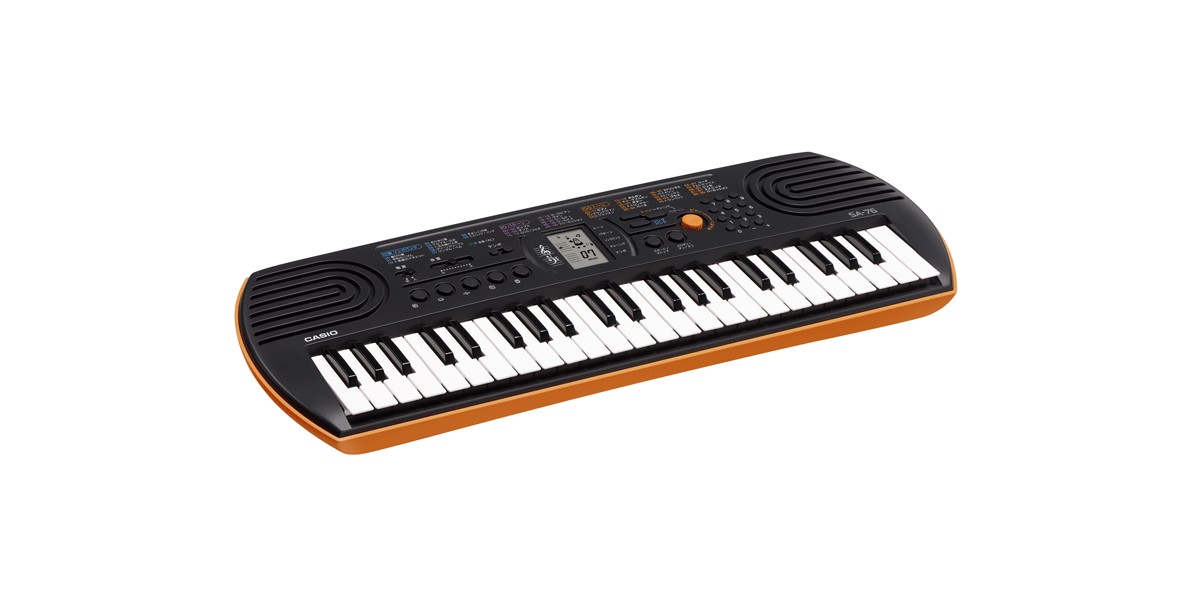
The Casio SA-76 is a 44-key mini keyboard built for young children getting their first taste of a musical instrument. It is not a practice keyboard for piano students, not a MIDI controller, and not a travel keyboard for working musicians. Understanding that upfront will save you from the most common complaint in every review section on the internet: “I expected more.”
What it does well is give kids roughly ages 3 through 7 a properly tuned, genuinely fun instrument packed with enough sounds and rhythms to hold their attention. Unlike many toddler music toys that play wildly out-of-tune notes, the SA-76 produces accurate pitch across all 44 keys — a detail that matters more than most parents realize when a child is forming their earliest sense of melody.
If you are shopping for a broader range of age-appropriate options, our guide to the best keyboards for kids covers several models at different skill levels.
Key Specs at a Glance
- Keys: 44 mini-sized keys (not touch-sensitive, not weighted)
- Polyphony: 8 notes
- Tones: 100
- Rhythms: 50
- Built-in songs: 10 (with melody-off function)
- Drum pads: 5
- Speakers: 2 x 0.8W
- Power: 6 AA batteries (not included) or optional AC adapter (not included)
- Weight: approximately 1.4 kg (3.1 lbs) without batteries
- Dimensions: roughly 604 x 211 x 57 mm
Three Playing Modes
The SA-76 organizes its features into three distinct modes, toggled by buttons on the front panel.
Tone Mode
This is the default mode where you simply pick one of 100 tones and play. The tones span pianos, organs, guitars, bass, strings, brass, reed/synth, ethnic instruments, and percussion. Some of the acoustic piano and organ tones are surprisingly convincing for this class of instrument. Others — particularly the synth and ethnic categories — are more novelty than realism, which is exactly what keeps kids entertained.
Pattern Mode
Pattern Mode gives you access to 50 drum rhythms across genres like pop, rock, jazz, dance, Latin, and world music. You select a pattern, hit start, and play along. For children, this is where the SA-76 goes from “toy” to “instrument” because they start learning to keep time with a beat. The five drum pads (kick, snare, hi-hat, tabla, and baya) are also active in this mode, so two kids can play simultaneously — one on keys, one on pads.
Song Bank Mode
Ten built-in songs including classics like “Ode to Joy,” “Greensleeves,” and “Twinkle Twinkle, Little Star” are available for playback. The melody-off feature lets you mute the lead voice and play it yourself while the accompaniment continues. This is the closest thing the SA-76 has to a structured lesson, and it works well for kids who learn by imitation.
What the SA-76 Does Well
Portability That Actually Gets Used
At just over 60 cm long and around 1.4 kg, this keyboard fits in a backpack. It runs on six AA batteries, so there are no cords to deal with on car trips, at grandparents’ houses, or in the backyard. The battery-powered design is probably how most families will use it day to day.
Enough Variety to Sustain Interest
100 tones and 50 rhythms is a lot for this category. Many competing mini keyboards offer 8 to 20 tones. The sheer number of options means a child can spend weeks discovering new sounds before the novelty wears off. The percussion category even includes non-instrument sounds like “train” and “seashore” — the kind of thing that delights a five-year-old.
Accurate Tuning
This point deserves emphasis. Research from the National Association for Music Education consistently supports the idea that early musical exposure should involve correctly pitched instruments. The SA-76 is properly tuned in equal temperament, unlike many toy keyboards that are not.
The LCD Display
A clear LCD screen shows the current tone number, rhythm, tempo, and the note being played. For young kids who are just learning note names, seeing “C” or “G” on screen as they press a key creates an extra learning connection.
Where It Falls Short
No Audio Output or MIDI
The SA-76 has no line out, no USB, and no MIDI port. You cannot connect it to a computer, a recording interface, an amplifier, or headphones with a standard cable. It does have a 3.5mm headphone jack, which is useful for quiet practice, but that is the only connectivity option.
This is the single biggest limitation. If your child outgrows the built-in speakers or wants to explore music production, the SA-76 is a dead end. For keyboards with more connectivity, take a look at arranger keyboards that offer MIDI and USB as standard.
No Power Adapter Included
The keyboard ships with no batteries and no AC adapter. You will need to buy one or both separately. Any center-positive 9.5V DC adapter with a 4.0mm barrel plug will work — it does not have to be the Casio-branded version. Just make sure the polarity is correct.
Keys Are Not Touch-Sensitive
Every note plays at the same volume regardless of how hard you press. This is normal for mini keyboards in this category, but it means a child will not learn dynamic control (playing soft vs. loud). For most kids under 7, this is a non-issue. For older beginners who might start formal lessons, a touch-sensitive keyboard is a better investment. Our lighted keyboard pianos guide covers several models with touch response and built-in learning features.
Build Quality Is Adequate, Not Rugged
The plastic housing is lightweight by design, but it will not survive being dropped on a tile floor or sat on. Children under about 3 years old are likely to be too rough with the mini keys. The recommended sweet spot is roughly ages 3 to 7.
Color Options
The SA-76 is available in orange, while the functionally identical SA-77 comes in grey and the SA-78 in pink. All three share the same internals — only the color of the lower case differs. The top panel and keys are black across all variants.
Power Options Explained
You have two choices:
- Six AA batteries — convenient for portability. Expect roughly 6 to 8 hours of play depending on volume and battery quality. Rechargeable AAs work fine and will save money over time.
- AC adapter — sold separately. Casio’s official adapter is the AD-E95100L, but a generic 9.5V center-positive adapter with a compatible barrel size works just as well.
Having both options is genuinely useful. Batteries for the car, adapter for home practice.
Who Should Buy the SA-76
Young children (roughly ages 3-7) who have shown any interest in music and whose parents want to give them a real instrument rather than a toy that plays random sounds. The SA-76 is properly tuned, has enough variety to hold attention, and is durable enough for supervised play.
Parents testing the waters before investing in a full-size keyboard or piano lessons. If your child plays the SA-76 consistently for a few months, that is a strong signal they are ready for something more serious.
Who Should Skip It
- Children under 3 — they will likely break the keys.
- Anyone planning to take piano lessons — the mini keys and lack of touch sensitivity will work against proper technique. A 61-key touch-sensitive keyboard is the minimum for lessons.
- Anyone who needs MIDI or audio connectivity — this keyboard has none.
- Adults looking for a travel practice keyboard — the 44 mini keys and 8-note polyphony are too limiting.
Alternatives Worth Considering
Casio SA-46
The SA-46 is the SA-76’s smaller sibling with 32 mini keys instead of 44. It shares the same 100 tones, 50 rhythms, and 10 built-in songs. If your child is very young (under 4) or you want something even more compact, the SA-46 is a reasonable option. The trade-off is less range for playing melodies.
Check the Casio SA-46 on Amazon
Yamaha PSS-E30 Remie
The Yamaha PSS-E30 takes a different approach with 37 mini keys and a built-in quiz mode that helps children learn songs step by step. It has fewer tones (49) and rhythms (28) than the SA-76, but the interactive learning features are more structured. Yamaha’s product page for the PSS-E30 shows the thinking behind their approach to children’s keyboards.
Check the Yamaha PSS-E30 on Amazon
Casio Casiotone CT-S200
If your child is closer to 6 or 7 and you want something they will not outgrow in a year, the CT-S200 is a significant step up. It has 61 full-size keys (still not weighted), 400 tones, USB-MIDI, and a Casio Music Space app for guided lessons. It costs more, but the longevity may be worth it.
Final Verdict
The Casio SA-76 does one thing and does it well: it gives young children a properly tuned, feature-rich mini keyboard that is fun enough to hold their attention and portable enough to go anywhere. It is not a learning tool for serious piano study, and it is not trying to be.
If your child is in the 3-to-7 age range, shows any curiosity about music, and you want to see whether that interest sticks before investing in something bigger, the SA-76 is a reliable, well-proven choice. Millions have been sold for exactly this reason.