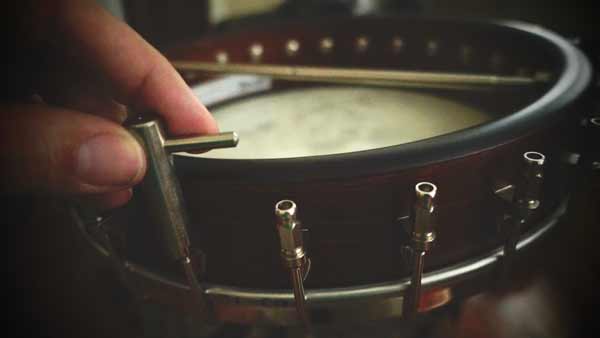
How to tighten a banjo head
The banjo head is the single biggest factor in your instrument’s tone. A loose head sounds tubby and hollow. An overtightened head sounds thin and choked. Getting it right takes about 15 minutes and one tool.
Head tension drops naturally over time from string vibration, bridge pressure, and changes in temperature and humidity. If your banjo has lost its brightness or the bridge sits in a visible dip rather than on a flat surface, it is time to tighten.
This guide covers how to diagnose a loose head, tighten it with even tension, and verify the result by ear. The process works on any type of banjo — five-string, tenor, plectrum, open-back, or resonator.
How to tell your head needs tightening
There are three quick tests. You only need one to confirm the issue, but running all three gives you a clearer picture.
The finger press test. Press the head near the bridge with your thumb. A properly tensioned head feels firm with very slight give. If it feels spongy or your thumb sinks in easily, the head is too loose.
The tap test. Mute the strings with a cloth, then tap the head near the bridge with a fingertip or pencil eraser. A tight head produces a clear, defined note with a quick decay. A loose head sounds dull and thuddy, more like a tom drum than a snare.
The string height test. Place a ruler at the last two frets and measure the string height. On a properly set up banjo, the strings should sit about 1/8 inch above the fretboard at the higher frets. If the strings are noticeably low, the head has sagged and is pulling the bridge down with it.
What you need
- Bracket wrench or 1/4-inch nut driver. Most banjos ship with a T-handle bracket wrench. A standard 1/4-inch nut driver from any hardware store also works. This is the only required tool.
- Cloth or felt strip. To mute the strings during tap testing. A folded hand towel threaded under the strings works fine.
- Chromatic tuner (optional). A clip-on chromatic tuner can help you identify the pitch of the head when tapped, though your ear is usually sufficient.
- Drum dial (optional). A drum dial gives precise tension readings if you want repeatable measurements. Useful but not necessary for most players.
Step-by-step: tightening the banjo head
1. Remove the resonator (if you have one)
If your banjo has a resonator, unscrew the thumb screws holding it to the pot assembly and set it aside. Open-back banjos skip this step. There is nothing intimidating inside — you will see the brackets, the tension hoop, and the back of the head.
2. Leave the strings on
Do not loosen or remove the strings. The strings and bridge apply downward pressure on the head, and you want to set the tension under real playing conditions. Removing the strings changes the load on the head and gives you a false reading. Place a cloth under the strings to mute them so you can hear the head clearly when you tap it.
3. Tighten in a star pattern
This is the most important part. Never work your way around the rim sequentially, bracket by bracket. That creates uneven tension that can warp the head or the tension hoop.
Instead, use a star pattern (also called a cross pattern), the same technique drummers use:
- Pick a starting bracket — the one nearest the neck is a natural choice. Call it 12 o’clock.
- Tighten it 1/8 turn only.
- Move to the opposite bracket (6 o’clock) and tighten 1/8 turn.
- Move to 3 o’clock, then 9 o’clock.
- Continue filling in the gaps: between 12 and 3, then opposite that, and so on until every bracket has been adjusted.
On a typical banjo with 24 brackets, the sequence looks like this: brackets at the neck (12 o’clock), then tailpiece (6), then the pair at 3, then 9, then fill in the remaining positions between those compass points.
Go 1/8 turn at a time. This is not a suggestion — it is how manufacturers like Deering recommend doing it. Larger turns risk cracking the head or bending the tension hoop. Modern Mylar heads have roughly one-third the tensile strength of steel. They will not stretch and warn you like old calfskin heads did. They will either pull off the flesh hoop or damage the banjo.
4. Tap and listen after each pass
After tightening every bracket by 1/8 turn, tap the head about 3/4 inch inside the tension hoop, directly in front of each bracket. Listen for the pitch at each position. All positions should produce roughly the same note.
If one spot sounds noticeably higher or lower than the rest, adjust that individual bracket until it matches. Even tension across the head matters more than overall tightness.
5. Check the target pitch
The standard recommendation from Deering is to tighten the head until it produces a pitch between G# and A when tapped. Roger Siminoff of Banjo Newsletter recommends tuning flathead banjos to D# and archtop banjos to F, based on the difference in active head area.
For most players, here is a simpler test: tap the head and listen for the point where the note becomes clear, loud, and defined. As you tighten from too-loose, you will hear the sound go from “bonk” to “BONK” — it gets noticeably louder and more alive at the right tension. That is your target.
If you go past it, the sound starts to thin out and lose fullness. Back off 1/8 turn on all brackets and you should be in the sweet spot.
6. Wait a week before tightening further
After adjusting, put the resonator back on, tune your strings, and play for a full week. New tension needs time to settle. The head may stretch slightly and the tone will evolve over a few days of playing. Only after a week should you decide whether another round of tightening is needed.
How head type affects tension
Different head materials respond differently to tension adjustments. Knowing which head is on your banjo helps you set expectations. If you are unsure what is on your instrument, check the anatomy of your banjo and look for markings on the head’s edge.
Frosted/coated Mylar (most common). The standard head on most production banjos. Responds predictably to tension changes. Aim for G# to A. These heads are durable but unforgiving if overtightened — they will not stretch to warn you.
Remo Fiberskyn. A synthetic head with a coating that mimics the look and feel of natural skin. Produces a warmer, mellower tone than clear Mylar. Popular for folk, old-time, and clawhammer playing. Fiberskyn heads tend to feel slightly softer at the same tension, so go by tap pitch rather than finger feel.
Clear Mylar. Transparent, bright, and punchy. Common on bluegrass banjos where projection and note definition matter most. Clear heads can handle high tension well and tend to produce more overtones.
Renaissance (by Remo). A thinner synthetic head designed to approximate the sound of calfskin. Warmer and more complex than standard Mylar. These heads are more sensitive to tension changes, so make smaller adjustments (1/16 turn) and check the pitch frequently.
Natural skin (calfskin or goatskin). Found on vintage and some specialty banjos. Highly sensitive to humidity. A skin head that sounds perfect in dry winter air may go slack in summer humidity. These require more frequent adjustment than synthetic heads.
Common mistakes
Tightening sequentially around the rim. Going bracket to bracket in order (1, 2, 3, 4…) creates uneven tension. Always use the star pattern.
Turning more than 1/8 turn at a time. Impatience here can crack a head, bend a tension hoop, or warp a resonator flange. Those are expensive problems to fix.
Removing the strings first. The head tension needs to account for the downward pressure of the strings through the bridge. Tightening without strings gives you a false reading, and the head will feel different once you string it back up.
Chasing a specific pitch without listening. G# is a guideline, not a law. Every banjo has its own resonant frequency based on the rim material, tone ring, head thickness, and other factors. Use pitch as a starting point, then trust your ears.
Tightening to fix a different problem. A dull tone can come from old strings, a dirty head, or a poorly fitted bridge. Before adjusting head tension, rule out these simpler causes. Cleaning your banjo and putting on fresh strings is a good first step.
Ignoring a bent tension hoop. If your tension hoop is warped, you cannot get even tension no matter how carefully you adjust. Place the hoop on a flat surface to check. If it rocks, it needs to be straightened before you adjust head tension.
How often to check head tension
There is no fixed schedule. Check the head tension:
- When the banjo sounds duller or less defined than usual
- After seasonal changes in temperature or humidity
- After changing strings, since you already have the setup tools out
- When the bridge appears to sit in a depression rather than on a flat surface
- After purchasing a new or used banjo, since you do not know when it was last adjusted
Most players who keep their banjo in a climate-controlled room find they need to adjust once or twice a year. Gigging musicians who take their instruments through temperature swings may need to check more often.
Quick reference
| Symptom | Likely cause | Fix |
|---|---|---|
| Dull, tubby tone | Head too loose | Tighten 1/8 turn, star pattern |
| Thin, tinny tone | Head too tight | Loosen 1/8 turn, star pattern |
| Uneven tone across head | Uneven bracket tension | Tap-test each bracket, equalize |
| Bridge sitting in a dip | Head sagging | Tighten until bridge sits flat |
| Buzzing on certain notes | Head too loose or uneven | Check and equalize tension |
Conclusion
Head tension is the most impactful and least expensive adjustment you can make on a banjo. The process is straightforward: check tension with the tap test, tighten in a star pattern using 1/8 turns, listen for the pitch to even out across all brackets, and wait a week before deciding to tighten further.
Once you are comfortable with this process, it becomes a routine part of banjo maintenance that takes minutes rather than a trip to a repair shop. For more on getting the most out of your instrument, check out our guides on banjo anatomy, tuning, and interesting facts about the banjo.