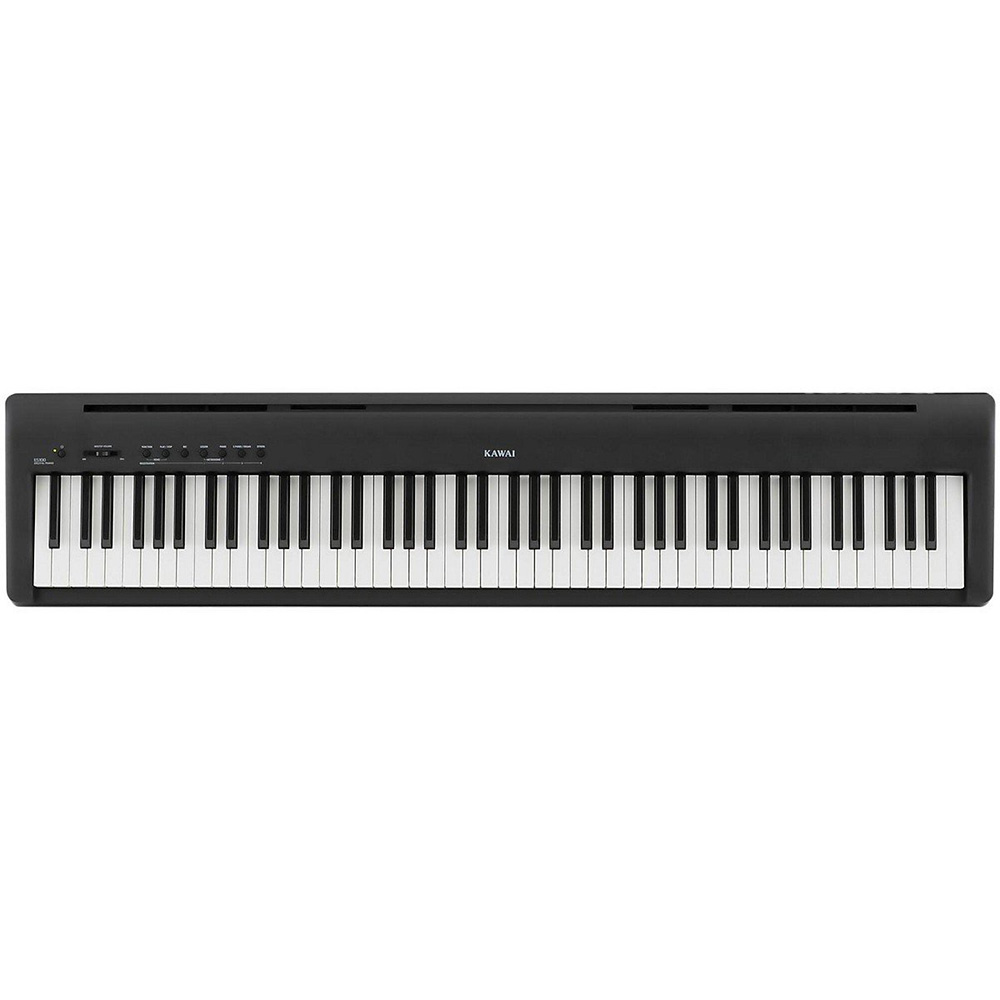
Kawai ES100 Review
The Kawai ES100 was one of the most well-regarded portable digital pianos in its class when it launched. It earned a loyal following among beginners, students, and gigging musicians who wanted an authentic piano feel without spending a fortune.
Important note: The ES100 has been discontinued. Kawai replaced it with the ES110 in 2017, and later the ES120. You can still find the ES100 on the used market, and it remains a solid instrument. This review covers what made it stand out and whether it is still worth tracking down.
Who the Kawai ES100 Is For
The ES100 was designed for players who care about piano sound and touch above everything else. It does not try to be a production workstation or an arranger keyboard. If you want hundreds of sounds, USB connectivity, or a built-in display, this is not your instrument.
It works well for:
- Beginners and students who need a proper weighted keyboard to develop good technique
- Intermediate players who want realistic dynamics and pedal response for classical or jazz practice
- Gigging musicians who need a portable, lightweight piano that sounds convincing through its built-in speakers
If you are starting fresh and want to buy new, you are better off looking at current models. Check our guide to the best digital pianos under $1000 or under $500 for recommendations that are still in production.
Key Action: AHAIV-F
The standout feature of the ES100 is its Advanced Hammer Action IV-F (AHAIV-F) keyboard. This is what put it ahead of almost every competitor at its original price point.
What makes it different:
- Graded hammer weighting — the bass keys are heavier than the treble keys, just like on an acoustic piano
- Rear pivot point — Kawai places the pivot at the back of each key rather than the middle, which makes the keys respond more naturally across their full length
- Minimal lateral play — the keys feel tight and solid with no wobble or clicking when you push them sideways, a common issue on cheaper keyboards
- Quiet action — the hammer mechanism is noticeably quieter than competing actions, which matters when you are playing at low volume or through headphones
Multiple professional reviewers noted that the ES100’s key action felt like it belonged in an instrument costing twice as much. The graded weighting and responsive return speed make it suitable for everything from scales to fast classical passages.
Sound: Harmonic Imaging Technology
The ES100 uses Kawai’s Harmonic Imaging sound engine with full 88-key piano sampling. This means every single note was individually recorded from a Kawai acoustic grand piano, rather than sampling groups of notes and stretching them across the keyboard. The difference is audible — transitions between notes sound natural, without the tonal jumps you sometimes hear on digital pianos that use grouped sampling.
The piano includes 19 instrument voices:
- 8 acoustic piano tones (the main concert grand is excellent)
- Electric pianos, organs, harpsichord, and strings
- All tones benefit from 192-note polyphony, meaning you can hold the sustain pedal down through complex passages without notes dropping out
The dynamic range is particularly good. Light touches produce genuinely soft tones, and playing harder gives you real volume and tonal depth without the sound becoming harsh or compressed. For a portable digital piano, the ES100 punches well above its weight in this area.
Built-In Speakers
The ES100 has a pair of speakers on its underside powered by 14 watts total (7W per channel). For practice at home or playing in a small to medium room, they are more than adequate.
The speakers resist distortion even at higher volumes, which is not something you can say about every portable piano. That said, they will not fill a large room or compete with a band. For performances, you will want to run a line out to an external amplifier or PA system.
Pedal and Pedaling
One often-overlooked advantage of the ES100 is its included damper pedal. Where most pianos in this range ship with a cheap plastic foot switch, Kawai includes a heavy-duty metal pedal that supports half-damper pedaling.
Half-damper pedaling means you get a partial sustain effect when you press the pedal halfway down, just like on an acoustic piano. This matters a lot for classical repertoire and expressive playing. On most budget digital pianos, the sustain pedal is strictly on or off.
Kawai also sells an optional furniture-style stand and three-pedal assembly (sustain, sostenuto, and soft) if you want a more traditional setup. The pedals are metal rather than plastic, and the whole assembly feels sturdier than similar options from other manufacturers.
Practice Features
The ES100 includes a few features aimed at students:
- Alfred Publishing lesson songs — a selection of pieces from Alfred’s first-year piano method, with the ability to practice left and right hand parts independently
- Three-song recorder — basic but useful for recording yourself and listening back
- 100 drum rhythms — a surprisingly good built-in rhythm section for practicing timing and groove, covering everything from jazz to rock to Latin styles
- Metronome with adjustable tempo
- Transpose and tuning adjustments
These are not headline features, but the drum rhythms in particular are worth noting. Practicing piano with a rhythmic backing track is far more engaging than a metronome click, and the ES100’s drum sounds are more realistic than you would expect.
Connectivity and Limitations
This is where the ES100 shows its age. It has:
- MIDI In/Out jacks (5-pin DIN)
- Two headphone jacks (useful for teacher-student setups)
- Line Out for connecting to an amplifier or recording interface
What it does not have:
- USB (no USB-to-host, no USB flash drive input)
- Bluetooth
- Built-in display
The lack of USB is the biggest practical limitation. To connect the ES100 to a computer for recording or using piano apps, you need a separate MIDI-to-USB adapter. It works, but it is an extra step and an extra cable. The ES110 added Bluetooth MIDI, which solved this problem entirely.
Portability
At roughly 26 pounds and 52 inches wide by 11 inches deep, the ES100 is genuinely portable. One person can carry it in a gig bag without much trouble. It fits in the back seat of most cars.
Compared to furniture-style digital pianos, the ES100 is easy to move between rooms, take to a lesson, or bring to a gig. This was a big part of its appeal for working musicians.
ES100 vs. ES110: Should You Buy the Successor Instead?
The Kawai ES110 replaced the ES100 in 2017 with several meaningful upgrades:
- Responsive Hammer Compact (RHC) action — a newer key mechanism that many players find slightly more refined
- Bluetooth MIDI — connect wirelessly to apps and computers
- Redesigned speaker system — improved sound projection
- Same 192-note polyphony and 19 voices
- Similar size and weight
The core character is the same — Kawai focused on piano sound and touch quality over bells and whistles. If you are buying new, the ES110 (or its successor, the ES120) is the obvious choice. The ES100 only makes sense if you find a good deal on the used market.
ES100 vs. Yamaha P-125
The Yamaha P-125 was the ES100’s closest competitor. Both are 88-key portable pianos aimed at students and home players.
The key differences:
- Key feel — the ES100’s AHAIV-F action is widely considered to have a more authentic, well-balanced feel than the Yamaha’s GHS action
- USB — the P-125 has USB-to-host connectivity, which the ES100 lacks
- Sound character — the Yamaha has a brighter, more forward tone; the Kawai sounds warmer and more nuanced
- Speakers — the P-125 has slightly better speaker placement (top-facing) for casual listening
- Pedal — the ES100’s included metal half-damper pedal is significantly better than the Yamaha’s plastic foot switch
If piano feel and expression were your priorities, the ES100 had the edge. If connectivity and a brighter sound mattered more, the P-125 was the better pick. Both are now superseded by newer models.
Verdict
The Kawai ES100 earned its reputation for a reason. The combination of the AHAIV-F key action, individually sampled grand piano tones, 192-note polyphony, and the included half-damper pedal made it one of the best values in portable digital pianos during its production run.
Its main limitations — no USB, no Bluetooth, only three recording slots — are products of its era rather than poor design choices. Kawai chose to invest in the parts that matter most for piano playing and succeeded.
If you are buying new, skip the ES100 and go straight to the Kawai ES110 or the current ES120. You get the same philosophy with modern connectivity. Browse our picks for the best digital pianos under $1000 if you want to compare across brands.
If you find a used ES100 in good condition, it is still a capable instrument. The key action holds up well over time, and the sound engine has not aged. Just factor in the cost of a MIDI-to-USB adapter if you need computer connectivity.