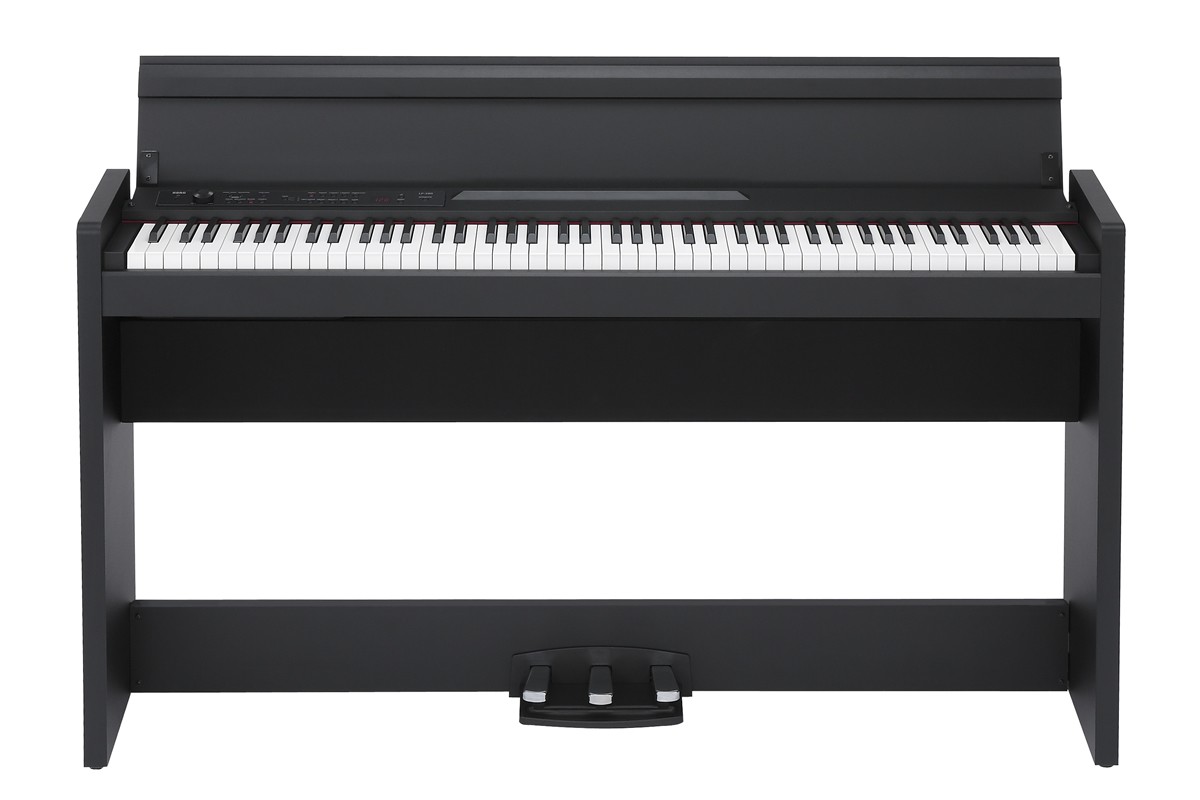
Korg LP 380 Review
Korg has been building keyboards and synthesizers since the 1960s. They are not as mainstream as Yamaha or Casio in the home digital piano market, but their instruments consistently punch above their weight. The LP-380 line is a good example of that.
The current version, the LP-380U, updates the original LP-380 with USB MIDI and USB Audio Streaming. That USB addition is more significant than it sounds. It turns a solid standalone piano into one that can interface directly with iPads, computers, and music apps, routing audio back through the piano’s own speakers. If you are shopping for a furniture-style digital piano that sounds great on its own but can also grow with your setup, this one belongs on your shortlist.
Who the LP-380U Is For
This piano fits a specific niche well. It is built for:
- Intermediate students moving up from a starter keyboard and wanting a weighted key action that prepares them for acoustic pianos
- Adult hobbyists who want a quality instrument that looks good in a living room
- Piano teachers who can use the partner mode for side-by-side lessons
- Players who value electric piano tones — Korg’s EP voices are widely regarded as some of the best in this class
If your priority is extensive onboard recording features or Bluetooth connectivity, other models may serve you better. The LP-380U keeps things focused: excellent sound, excellent key feel, and a clean design.
Key Action: Korg RH3 Real Weighted Hammer
The LP-380U uses Korg’s flagship RH3 (Real Weighted Hammer Action 3) keyboard. This is the same key action found in Korg’s higher-end stage pianos, which is unusual at this price point.
The graded weighting feels natural. Bass keys have more resistance, and the response lightens progressively as you move up the treble range, replicating the behavior of an acoustic grand. Three touch sensitivity settings (light, normal, heavy) let you dial in the response to match your playing style or gradually increase resistance as a student develops finger strength.
One thing worth noting: the keys do not have a simulated ebony and ivory texture. Some competing models from Roland and Yamaha include textured key surfaces at this price. It is not a dealbreaker, but if textured keys matter to you, be aware of it.
Sound Quality
Acoustic Pianos
The acoustic piano voices are sampled with four velocity layers per note, giving them a dynamic range that responds meaningfully to how hard you strike a key. The grand piano sound has solid depth, and Korg’s resonance modeling adds realistic sympathetic string and damper effects. It competes well against Yamaha and Casio instruments in the same bracket, though opinions vary on whether any particular brand has the “best” acoustic piano tone at this level.
Electric Pianos
This is where the LP-380U genuinely stands out. Korg has deep roots in synthesizer and electric piano design, and it shows. The Rhodes-style and Wurlitzer-type voices have a warmth and character that most reviewers consider best-in-class for a furniture digital piano. If you play jazz, funk, or anything that calls for electric piano regularly, this is a meaningful advantage.
Full Voice Library
There are 30 voices total, covering:
- Acoustic and electric pianos (multiple variations)
- Organs (jazz and pipe)
- Strings and choir
- Harpsichord
- Guitar and bass
- Vibraphone and percussion
You can layer two voices together for richer textures, and three built-in effects (brilliance, reverb, and chorus) let you shape the tone further. Each effect has three intensity levels.
Speaker System
The LP-380U packs a 44-watt amplification system (two 22-watt amps) driving a pair of speakers positioned beneath the keyboard. That 44-watt total output is the highest in its class, and it makes a noticeable difference. The piano fills a room without distortion, and the downward-firing speaker placement creates the impression that sound is coming from within the instrument body itself.
Two headphone jacks are included, which is a practical touch for late-night practice or partner-mode lessons where both players need to hear without external sound.
Design and Build
Slim Profile
At just under 14 inches deep, the LP-380U is one of the most compact furniture-style digital pianos available. When the key cover is closed, it resembles a sleek console table rather than a musical instrument. Available color options include black, white, red, rosewood, and red-black, though black and rosewood are the most commonly stocked in the US.
Soft-Close Key Cover
The key cover doubles as a music stand when open, which is a nice space-saving touch. A soft-close mechanism prevents it from slamming shut. The tradeoff is that anything placed on top of the piano becomes inaccessible while playing, since the open lid covers the top surface.
Weight and Portability
At roughly 82 pounds assembled (a significant reduction from the older LP-350), this is not a portable instrument. It is meant to be placed in a room and stay there. The reduced chassis does make initial setup and occasional repositioning manageable for two people.
Build Quality Considerations
Most owners report solid construction, but some reviewers have noted the build quality does not feel quite as robust as comparable Yamaha Arius or Casio Privia models. The slim design contributes to a lighter overall feel. For most home use this is perfectly fine, but it is worth being aware of if durability is a top priority.
Connectivity: The USB Audio Streaming Advantage
This is the biggest upgrade the LP-380U brought over the original LP-380.
What you get:
- USB MIDI — connect to a computer or tablet for use with DAWs and music apps
- USB Audio Streaming — route audio from an iPad, phone, or computer back through the piano’s 44-watt speakers
- LINE OUT — connect to external speakers or a PA system
- MIDI IN/OUT — traditional 5-pin MIDI for connecting to other hardware
The USB Audio Streaming feature deserves emphasis. With a standard USB cable (and a lightning or USB-C adapter for iPads), you can use piano learning apps, trigger third-party instrument sounds, or play backing tracks, and hear everything through the piano’s own speakers or headphones. This effectively makes the LP-380U expandable far beyond its 30 built-in voices.
What you do not get: Bluetooth. While some competitors offer Bluetooth MIDI or audio, the inherent latency in Bluetooth audio makes it impractical for real-time playing anyway. The wired USB approach on the LP-380U is actually more reliable for interactive use.
Important: Make sure you are purchasing the LP-380U (with the “U” suffix), not the older LP-380 without it. The original model lacks USB connectivity entirely. The model numbers look almost identical, so double-check before buying.
Pedals
Three concert-style pedals come integrated into the stand:
- Sustain (with half-pedaling support)
- Sostenuto
- Soft
Half-pedaling on the sustain pedal is a meaningful feature for advanced players working on expressive technique. Many digital pianos in this range only support on/off sustain. The pedals feel heavier and more responsive than what you typically find on comparably equipped instruments.
Additional Features
Partner Mode
The keyboard splits into two equal zones, each covering the same pitch range. This lets a teacher and student sit side by side and play in the same register simultaneously, which is far more practical for lessons than taking turns or having the student reach across the keyboard.
Nine Temperaments
Beyond standard equal temperament, the LP-380U offers eight alternative tuning systems. This is a niche feature, but it matters for players studying Baroque, Renaissance, or non-Western music traditions. Most digital pianos at this level only offer one or two temperament options.
Metronome
A built-in metronome with adjustable time signature, tempo, and volume. Standard on most digital pianos, but essential for students developing rhythmic accuracy.
Demo Songs
Thirty pre-programmed demo songs showcase the instrument’s range. They are useful for hearing what the piano can do, though the LP-380U does not offer a lesson mode that isolates left or right hand parts for practice.
How It Compares
Yamaha YDP-145
The Yamaha Arius YDP-145 is the most direct competitor. It offers Yamaha’s well-regarded CFX grand piano sample, a USB port, and recording/playback capability. Yamaha’s acoustic piano voice has a slightly warmer character that some players prefer. However, it only has 10 voices compared to the Korg’s 30, and its speaker system is less powerful. If pure acoustic piano tone is your priority, the Yamaha deserves a close look. If you want more tonal variety and power, the Korg has the edge.
Casio Privia PX-870
The PX-870 offers USB connectivity, a lesson function that splits songs into left and right hand parts, and 19 voices. Its key action is excellent, though some users report the mechanism is slightly noisier than competing models. It is a strong all-around choice, particularly for students who benefit from the built-in lesson features that the Korg lacks.
Roland RP-102
The Roland RP-102 brings Bluetooth connectivity and five touch sensitivity levels (versus three on the Korg). Its SuperNATURAL sound engine is impressive, and the synthetic ebony and ivory key textures add realism. However, it has fewer onboard voices and a less powerful speaker system than the LP-380U.
The Bottom Line
The Korg LP-380U is a focused instrument that does a few things very well: the RH3 key action is top-tier for this class, the 44-watt speaker system outperforms every competitor at this level, and the electric piano voices are outstanding. The addition of USB Audio Streaming makes it far more versatile than the spec sheet suggests, effectively letting you expand the piano’s capabilities through external apps and software.
It is not the right choice if you need extensive onboard recording features, Bluetooth, or lesson modes. But if you want a slim, attractive digital piano with genuinely great sound and feel, and the ability to grow with your playing through USB connectivity, the LP-380U is hard to beat.
If you are still exploring options in this range, check out our guide to the best digital pianos under $1000 for a broader comparison.