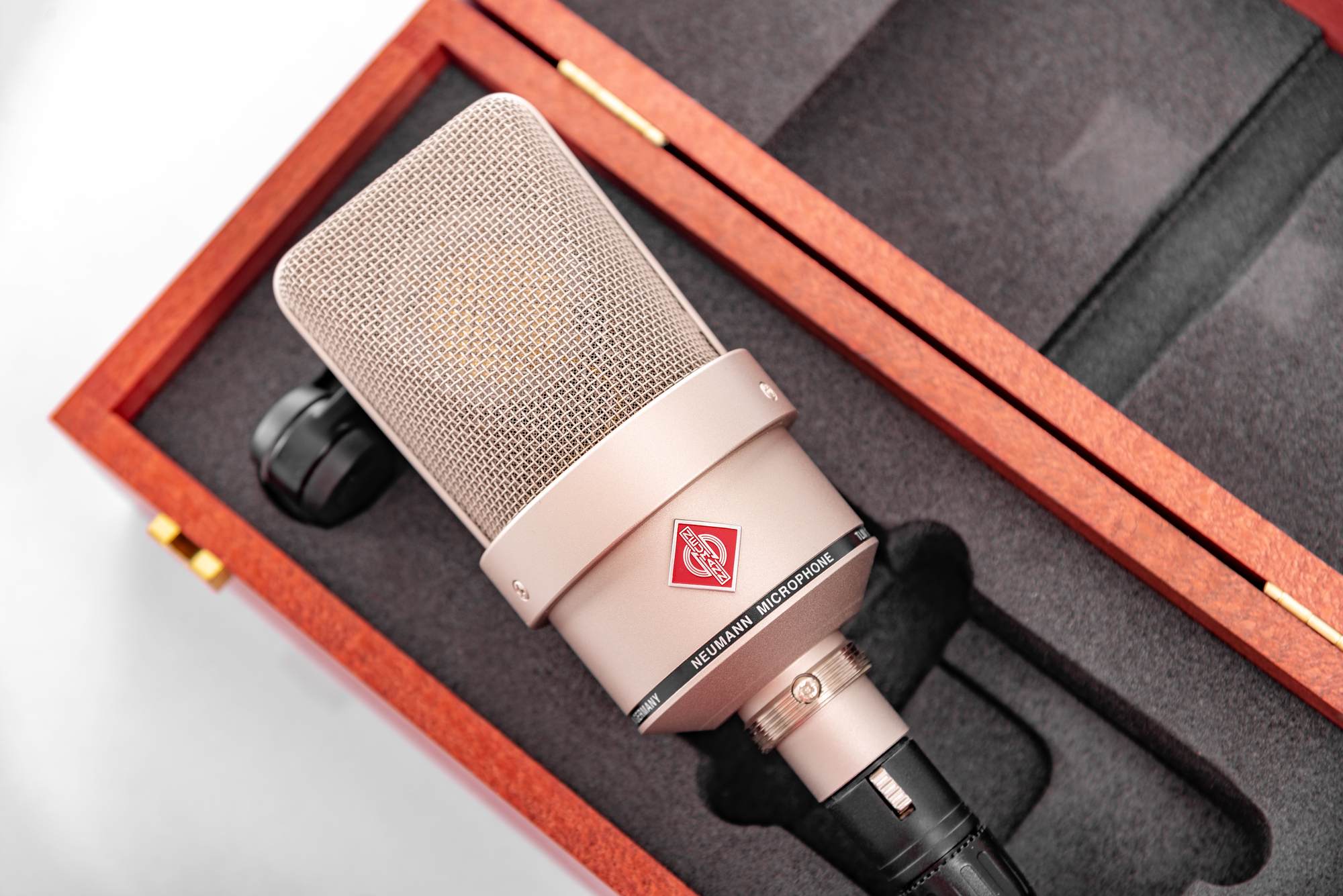
Neumann TLM 103 Recorder Review
The Neumann TLM 103 is a large-diaphragm cardioid condenser microphone built around a capsule derived from the legendary U 87. Since its release in 1997, it has become one of the most common Neumann mics in home studios, voiceover booths, and smaller professional facilities. Its appeal is straightforward: classic Neumann sound quality with fewer features and a lower barrier to entry than the U 87.
But “derived from the U 87” is doing a lot of heavy lifting in the marketing copy. This review breaks down exactly what you get, what you give up, and whether the TLM 103 is the right mic for your setup.
What the TLM 103 Actually Is
The TLM 103 uses the K 103 capsule, which is essentially the front half of the dual-diaphragm K 87 capsule found in the U 87 and older U 67. Since the TLM 103 only needs a cardioid pattern, Neumann replaced the rear diaphragm with a drilled brass backplate. The result is a single-pattern capsule that shares the same fundamental acoustic character as the U 87 in cardioid mode.
“TLM” stands for transformerless microphone. Instead of a traditional output transformer, the TLM 103 uses a solid-state electronic output circuit. This design choice keeps the mic compact, reduces manufacturing cost, and contributes to the mic’s exceptionally low self-noise.
The body is noticeably shorter and stubbier than a U 87, though the headbasket and wire mesh grille share identical dimensions with its bigger sibling. There are zero switches on the mic — no pad, no high-pass filter, no polar pattern selector. You plug it in, supply 48V phantom power, and record.
Key Specifications
- Capsule: K 103 (derived from K 87)
- Polar pattern: Fixed cardioid
- Frequency response: 20 Hz – 20 kHz
- Self-noise: 7 dB-A (among the lowest of any large-diaphragm condenser)
- Max SPL: 138 dB (at 0.5% THD)
- Dynamic range: 131 dB
- Sensitivity: 21 mV/Pa
- Output impedance: 50 ohms
- Power: 48V phantom power required
- Weight: 450g
Sound Character
The TLM 103 has a flat frequency response up to roughly 5 kHz, followed by a broad 4 dB presence boost that peaks between 6 kHz and 15 kHz before rolling off. On the low end, bass response begins to taper around 60–70 Hz.
In practice, this translates to a sound that is warm and full in the mids, with a forward presence range that helps vocals and acoustic instruments cut through a mix without sounding harsh. The presence lift is gentle enough that it rarely feels like it is imposing a character on the source — it just adds clarity and definition.
The proximity effect is substantial. Working close to the mic adds noticeable low-end warmth, which can be used creatively for voiceover work or intimate vocal recordings. Pull back to eight or ten inches and the bass response levels out to something more neutral.
Compared side-by-side with a U 87Ai, the TLM 103 sounds remarkably similar in cardioid mode. The main differences are subtle: the TLM 103 is slightly cleaner and more transparent due to its lower noise floor, while the U 87 can sound a touch more rounded in the midrange. For most home and project studio applications, the difference is negligible.
What It Does Well
Vocals
This is where the TLM 103 has built its reputation. The combination of low self-noise, smooth frequency response, and that gentle presence lift makes it an excellent vocal mic for both singing and spoken word. It sits forward in a mix naturally, without needing aggressive EQ to find its place.
Voiceover artists in particular have adopted the TLM 103 as a workhorse. The low noise floor means you can capture quiet, intimate reads without hiss creeping into the recording, and the warmth of the proximity effect gives voices a rich, broadcast-quality weight.
Acoustic Guitar
The presence boost translates well to acoustic guitar, adding shimmer and pick attack without sounding thin or brittle. Pointed at the 12th fret area from about eight inches away, the TLM 103 captures a balanced, full-bodied acoustic tone that typically needs very little processing.
Classical and Quiet Sources
With a self-noise of just 7 dB-A, the TLM 103 outperforms the U 87Ai (rated at 12 dB-A in cardioid) in quiet recording situations. This makes it an excellent choice for classical music, Foley work, and any application where ambient room tone or mic hiss would be a problem at higher gain settings.
Amp Miking
Jack White has used the TLM 103 on guitar amps in live settings. Its 138 dB max SPL handling means it will not distort on loud sources, and the cardioid pattern provides decent isolation from other stage noise. That said, most engineers reach for dynamic mics like the SM57 for this job — the TLM 103 is more of a studio-first microphone.
Where It Falls Short
Room Noise Pickup
The TLM 103’s high sensitivity is a double-edged sword. In an untreated room, the mic picks up everything — air conditioning hum, computer fans, traffic outside, footsteps in an adjacent room. The cardioid pattern rejects sound from the rear, but the polar pattern is relatively wide at lower frequencies, which means it captures more ambient noise than you might expect from a directional mic.
If your recording space is not acoustically treated, this is a real issue. You will spend time in post cleaning up room noise, which partly defeats the purpose of buying a low-noise microphone. Consider investing in basic acoustic treatment before stepping up to a mic this sensitive. A budget-friendly audio interface with clean preamps will also help you get the most out of it.
No Built-In Controls
The absence of a pad and high-pass filter keeps the circuit simple, but it means you are relying entirely on your preamp and mixer for signal management. If your preamp does not have a pad and you are recording a loud singer or a brass instrument up close, you may run into clipping at the preamp stage — not the mic itself, but the input that receives its hot output signal.
Similarly, the lack of a low-cut filter means you will need to handle proximity effect buildup and low-frequency rumble with external filtering. Most audio interfaces and DAWs have this covered, but it is one more step in your signal chain.
Susceptibility to Vibration
The capsule sits on an internal elastic mount, but the TLM 103 is notably sensitive to structural vibrations. Footsteps, desk bumps, and mic stand movement all transmit audibly into recordings. The included SG 1 swivel mount is fine for basic positioning, but for serious recording you will want to invest in a proper shockmount like the Neumann EA 1. It is an additional expense that should be factored into the total cost of ownership.
Not Ideal for Every Voice
The presence boost between 6–15 kHz is flattering on many voices, but if your voice is already bright or sibilant, the TLM 103 can accentuate those qualities. In that case, you might prefer a warmer mic with a flatter top end, or plan on using a de-esser during mixing. Testing the mic on your specific voice before committing is always wise.
Build Quality and Design
The TLM 103 is built to Neumann’s usual standard. The all-metal body feels solid and precisely machined. The dual-layer wire mesh grille is identical to the U 87’s and provides reasonable plosive protection, though a dedicated pop filter is still recommended for close vocal work.
The mic ships in a fitted wooden case with a foam insert — a nice touch that reinforces the premium feel. It comes with the SG 1 swivel mount and a 5/8” to 3/8” thread adapter.
Two finishes are available: satin nickel and matte black. The nickel version is far more popular, as it carries the classic Neumann look.
One minor complaint: the wire mesh grille, while sturdy, feels slightly lighter than the rest of the mic’s construction. It is not fragile, but it is not as tank-like as you might expect at this level. This is not a mic you should be dropping or banging around regardless.
Phantom Power and Preamp Pairing
The TLM 103 requires standard 48V phantom power and draws 3 mA of current. Any modern audio interface or mixer with phantom power will work. The mic’s sensitivity is 21 mV/Pa, which is slightly lower than the U 87Ai but still high by condenser mic standards — you will not need much preamp gain.
That said, preamp quality matters here. The TLM 103 is transparent enough that it will reveal the character (or lack thereof) of whatever preamp you feed it. A clean, low-noise preamp like those found in the Focusrite Scarlett series, Audient iD series, or Universal Audio Volt line will pair well. If you want to add some coloration, a tube or transformer-based preamp can push the sound in a warmer direction. Check out our beginner audio interface guide if you are still choosing your front end.
TLM 103 vs. U 87Ai
This is the comparison everyone wants to make, and it is fair since Neumann explicitly markets the TLM 103 as being derived from the U 87.
What the TLM 103 keeps: The same K 87-derived capsule character, the same general frequency response shape, and a similar warm-yet-present sound signature.
What the U 87 adds: Three switchable polar patterns (cardioid, omni, figure-8), a built-in 10 dB pad, a low-frequency roll-off switch, and decades of studio pedigree. The U 87 is also slightly more versatile as a recording tool since you can change its pickup pattern to suit different situations.
Where the TLM 103 wins: Lower self-noise (7 dB-A vs. 12 dB-A), higher max SPL without a pad (138 dB vs. 127 dB with pad engaged), and significantly lower cost.
For a home or project studio that primarily records vocals in cardioid, the TLM 103 gives you roughly 90% of the U 87 sound at a fraction of the cost. The features you lose — multi-pattern capability, pad, and filter — are rarely deal-breakers in a controlled studio environment.
Alternatives Worth Considering
If the TLM 103 is not quite right for your needs or budget, here are some alternatives in different directions.
Neumann TLM 102
Neumann’s even more affordable large-diaphragm condenser. It has a different capsule and a slightly different sonic character — brighter and more forward in the upper mids. Self-noise is higher at 12 dB-A. Think of it as the entry-level Neumann rather than a stripped-down U 87.
Audio-Technica AT4050
A multi-pattern condenser with cardioid, omni, and figure-8 options. It is a versatile studio workhorse with a smoother, less hyped top end than the TLM 103. If you need pattern flexibility and want to spend less, the AT4050 is a strong contender.
Rode NT1 5th Generation
One of the quietest mics available (4.5 dB-A self-noise) at a significantly lower cost. It has a more neutral frequency response than the TLM 103, with less of a presence boost. A solid option if you prefer to shape tone with EQ rather than have the mic impose a character.
Budget Path
If you are not ready to invest at this level, there are excellent condenser microphones under $200 and even capable vocal mics under $100 that will get you recording with quality results while you save toward a higher-end option.
Who Should Buy the TLM 103
The TLM 103 makes the most sense for:
- Home studio vocalists and singer-songwriters who want a professional-grade vocal mic that sounds polished out of the box.
- Voiceover artists and podcasters working in treated spaces who need low noise and a warm, present sound. The Audio Engineering Society has long recognized the importance of self-noise specs for spoken word applications — the TLM 103 excels here.
- Project studios that want Neumann quality on a tighter budget and do not need multi-pattern capability.
- Classical and acoustic musicians recording quiet sources where every decibel of noise floor matters.
The TLM 103 is less suited for untreated bedrooms, noisy environments, or engineers who need a Swiss-army-knife mic with multiple polar patterns. If your recording space needs work, addressing room acoustics first will yield a bigger improvement than any microphone upgrade.
Final Verdict
The Neumann TLM 103 is not a budget mic pretending to be a U 87, and it is not a U 87 with a discount sticker. It is a focused, well-engineered condenser microphone that takes the best part of Neumann’s flagship — the capsule — and wraps it in a no-frills package with genuinely impressive noise performance.
Its strengths are real: warm and musical sound character, exceptionally low self-noise, high SPL handling, and build quality that will last decades. Its weaknesses are equally real: sensitivity to room noise and vibration, lack of built-in controls, and a presence boost that does not flatter every voice.
If you record in a reasonably treated space, primarily need a cardioid mic, and want something that sounds like a Neumann because it is one, the TLM 103 delivers. It has been a studio staple for nearly three decades for good reason.