28 Types of Guitar Pedals To Create Your Unique Sound
Every guitarist’s sound starts with their hands, but pedals shape what the audience hears. Overdrive, delay, compression, modulation — each pedal type processes your signal in a specific way, and the order you chain them matters as much as which ones you pick.
This guide covers 28 types of guitar pedals, organized by function. For each one you will find what it does to your signal, where it belongs in the chain, and a song reference so you can hear the effect in context.
Signal Chain Overview
Before diving into individual pedals, understand the standard signal chain. The order matters because each pedal processes whatever comes before it:
Guitar → Tuner → Filters/Wah → Compressor → Pitch Effects → Gain (Overdrive/Distortion/Fuzz) → Noise Gate → Modulation (Chorus/Flanger/Phaser) → Volume → Time (Delay/Reverb) → Looper → Amp
This is the conventional starting point. Plenty of great tones break these rules — fuzz before wah is a classic move, and some players put compression after drive. But start here, learn what each position sounds like, then experiment.
Tuner and Volume Pedals
These are utility pedals. They do not color your tone, but every working pedalboard needs them.
Tuner
A tuner pedal detects the pitch of each string and shows you whether it is sharp, flat, or in tune. When engaged, most tuners mute your output so you can tune silently between songs.
Chromatic tuners recognize any note, which means you can use alternate tunings — drop D, open G, DADGAD, whatever you need. Non-chromatic tuners only handle standard tuning. For any serious player, chromatic is the only sensible choice.
Polyphonic tuners like the TC Electronic PolyTune let you strum all six strings at once and see which ones need adjustment. You still tune each string individually, but it speeds up the diagnostic step.
Place the tuner first in your chain. It needs the cleanest possible signal to track pitch accurately. Any dirt, modulation, or delay ahead of it will confuse the detection.
Volume
A volume pedal is an expression pedal that sweeps between silence and full signal. Where you place it changes what it controls:
- Before gain pedals: Acts like your guitar’s volume knob. Rolling back cleans up your drive.
- After gain, before time effects: Controls the volume of your driven tone without affecting delay/reverb tails.
- At the end of the chain: Master volume for everything.
Most players put it after their gain section and before delay/reverb. This lets you do volume swells that feed into your delay for ambient, pad-like textures.
Filter and Frequency-Shaping Pedals
These pedals alter which frequencies pass through your signal. They shape your tone without adding gain or time-based effects.
Equalizer
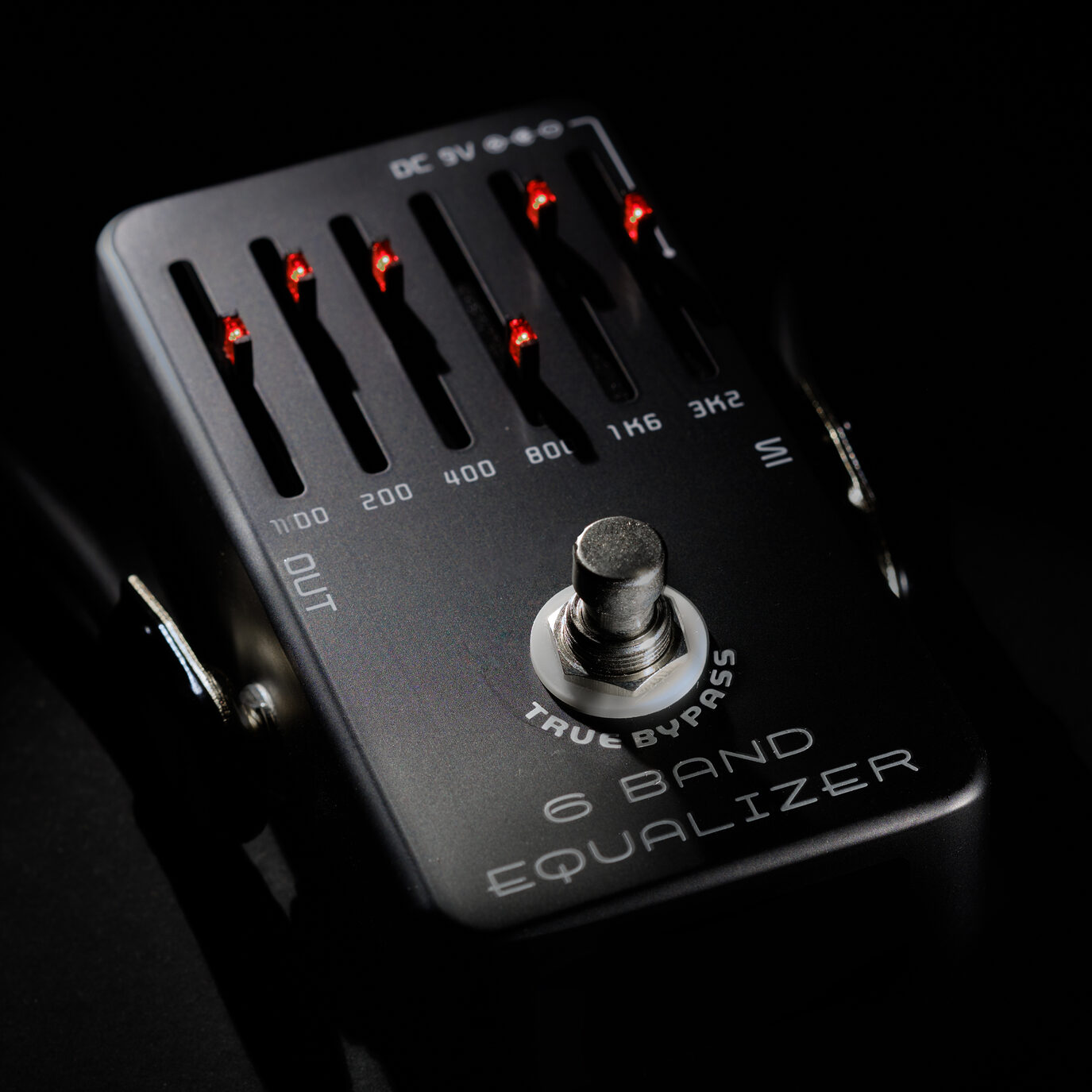
An EQ pedal gives you precise control over your frequency spectrum — the same idea as the tone controls on your amp, but with more bands and more precision.
Graphic equalizers (like the Boss GE-7) use sliders for fixed frequency bands. Push a slider up to boost that range, pull it down to cut. You can see your EQ curve at a glance, which makes adjustments fast on stage.
Parametric equalizers let you choose the center frequency for each band and adjust the bandwidth (Q). More flexible and more precise, but harder to dial in quickly. These are more common in recording setups and studio rigs.
A common use: boost mids to cut through a band mix, or scoop mids for a thrashier metal tone. Bass players use EQ pedals to tighten their low end and reduce muddiness.
Wah-Wah
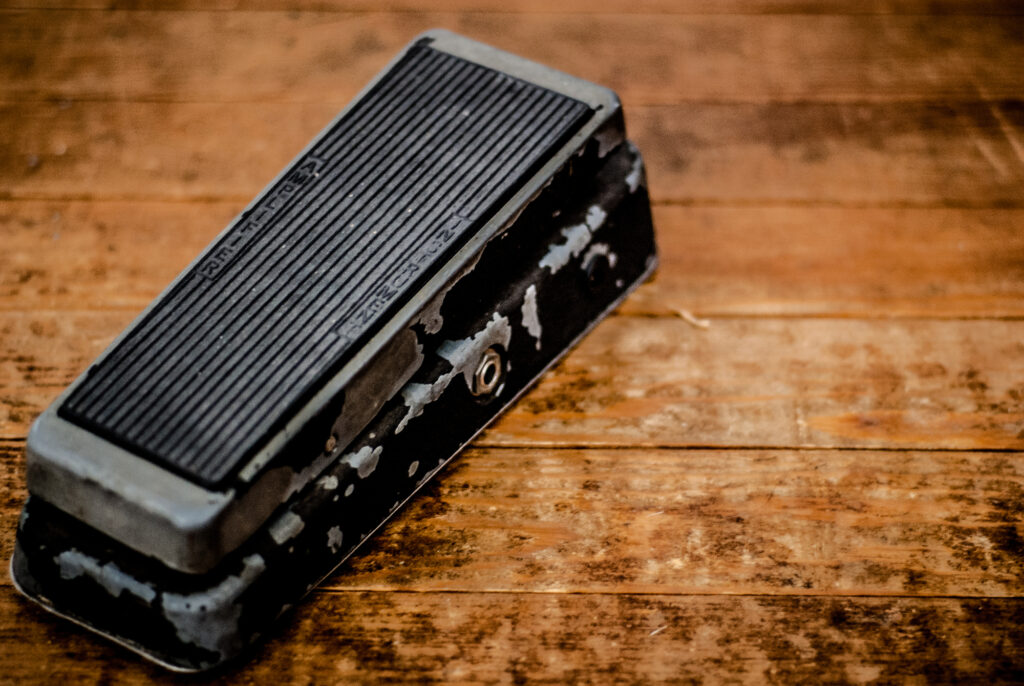
The wah is a bandpass filter controlled by a rocker pedal. Toe down sweeps to high frequencies, heel down sweeps to low. The result is that vocal “wah” sound.
You know this from Jimi Hendrix’s “Voodoo Child (Slight Return)” and Kirk Hammett’s solos on nearly every Metallica record. In funk, the wah becomes a rhythmic instrument — listen to the verse riff on Shaft by Isaac Hayes.
Placement matters. Wah before distortion gives a focused, vocal sweep. Wah after distortion produces a more dramatic, exaggerated effect. Most players run it before gain, but try both.
Envelope Filter
The envelope filter (auto-wah) does the same frequency sweep as a wah, but instead of foot control, it reacts to your picking dynamics. Pick hard and the filter opens wide; play softly and it barely moves.
This is the pedal behind the funky “quack” in Bootsy Collins’ bass lines and the liquid guitar tone in Guthrie Govan’s “Wonderful Slippery Thing.” It rewards dynamic playing — the harder you dig in, the more expressive it gets.
Talk Box
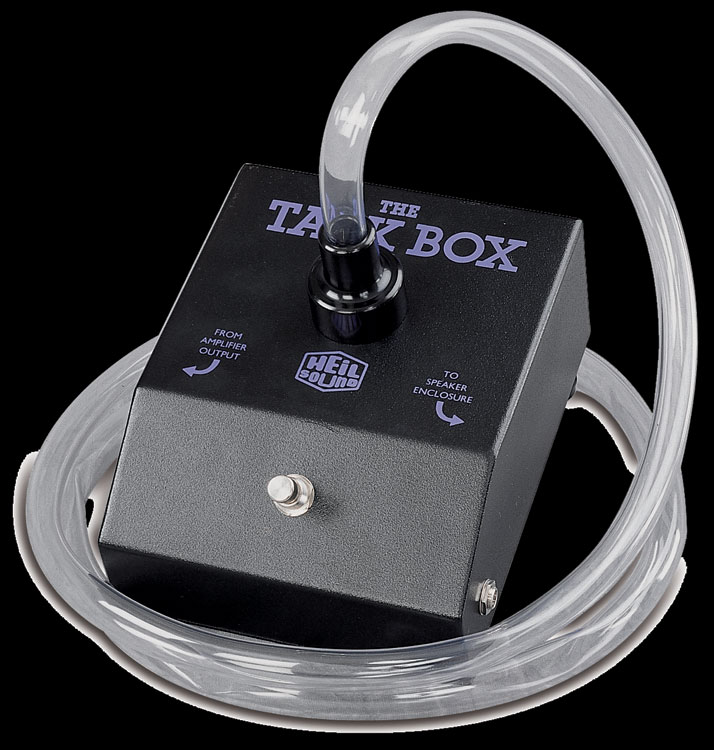
A talk box routes your guitar signal through a tube into your mouth. You shape the sound with your mouth — forming vowels and consonants — while a microphone picks up the result.
The classic example is Peter Frampton’s “Do You Feel Like We Do” and the intro to Bon Jovi’s “Livin’ on a Prayer.” Do not confuse this with a vocoder, which analyzes actual speech and applies it to a carrier signal — different device, different principle.
Acoustic Simulator
An acoustic simulator applies EQ curves and body resonance modeling to make your electric guitar approximate the sound of an acoustic. Useful if you need an acoustic tone for one song in a set and do not want to swap guitars.
The results are better for live performance than recording. In a studio, a real acoustic or a quality acoustic-electric will always sound more convincing.
Compressor Pedals
A compressor reduces the dynamic range of your signal. It makes loud notes quieter and quiet notes louder, resulting in a more even output. It also increases sustain because the tail of each note stays audible longer.
The compressor is not a glamorous effect — you often cannot “hear” it in the way you hear a delay or distortion. But it fundamentally changes how your playing feels. Clean funk rhythm parts, country chicken-picking, and smooth jazz leads all rely on compression.
Bass compression pedals are especially common because bass parts need consistent note volume to sit properly in a mix. For guitar, the MXR Dyna Comp and Keeley Compressor Plus are popular starting points.
Place the compressor early in your chain, after the tuner and any filters but before gain pedals. If you put it after distortion, it will compress the distortion’s noise floor along with your playing, which gets messy.
Pitch Effect Pedals
Pitch pedals alter the fundamental frequency of your notes — adding octaves, shifting pitch, or generating harmony.
Octaver and Octave Fuzz
An octaver takes your input note and generates a copy one or two octaves above or below, then blends it with the original signal.
Octave down is how Jack White gets that massive low-end riff in The White Stripes’ “Seven Nation Army” — there is no bass player, just an octave pedal on a semi-hollow guitar. The Boss OC-5 and EHX Micro POG are go-to choices for clean octave tracking.
Octave up (octave fuzz) adds a note one octave higher, usually with heavy fuzz. Jimi Hendrix’s “Purple Haze” used the Octavia — the original octave fuzz. The effect works best on single notes above the 12th fret where the tracking is cleanest.
Pitch Shifter
A pitch shifter transposes your signal by a set interval — a half step, a fourth, a full octave, or anything in between. Combined with an expression pedal, you can do smooth pitch bends across a wide range, producing a glissando effect that sounds like a slide or pedal steel.
The DigiTech Whammy is the benchmark here. Tom Morello uses it throughout Rage Against the Machine’s catalog, and Radiohead uses pitch shifting extensively on tracks like “Subterranean Homesick Alien.”
Harmonizer
A harmonizer generates a second note at a fixed musical interval above or below what you play. Set it to a third and you get instant two-part harmony. Some intelligent harmonizers (like the Boss PS-6 or TC Electronic Quintessence) detect the key you are playing in and adjust the interval to stay diatonic.
You can hear this in the guitar harmonies on Yes’ “Owner of a Lonely Heart” and throughout Iron Maiden’s twin-guitar arrangements.
Synthesizer Pedals
Synthesizer guitar pedals track the pitch of your guitar input and use it to trigger an onboard oscillator, producing synth tones from your instrument. The Boss SY-1 and EHX Synth9 are two popular options that do not require special pickups.
Controls typically include waveform selection (square, saw, sine), octave shifting, filter cutoff, and a mix knob to blend synth with your dry guitar signal. These pedals are niche but powerful — they let a guitarist cover keyboard pads, bass synth lines, or retro 8-bit textures without switching instruments.
Gain Effect Pedals
Gain pedals are the core of most rock, blues, and metal tones. They clip your signal in different ways to produce anything from gentle warmth to total sonic destruction. In the chain, place gain pedals after compressor and pitch effects but before modulation.
If you are stacking multiple gain pedals, order them from lowest gain to highest — boost into overdrive into distortion into fuzz. This way, each stage pushes the next without turning everything into mush.
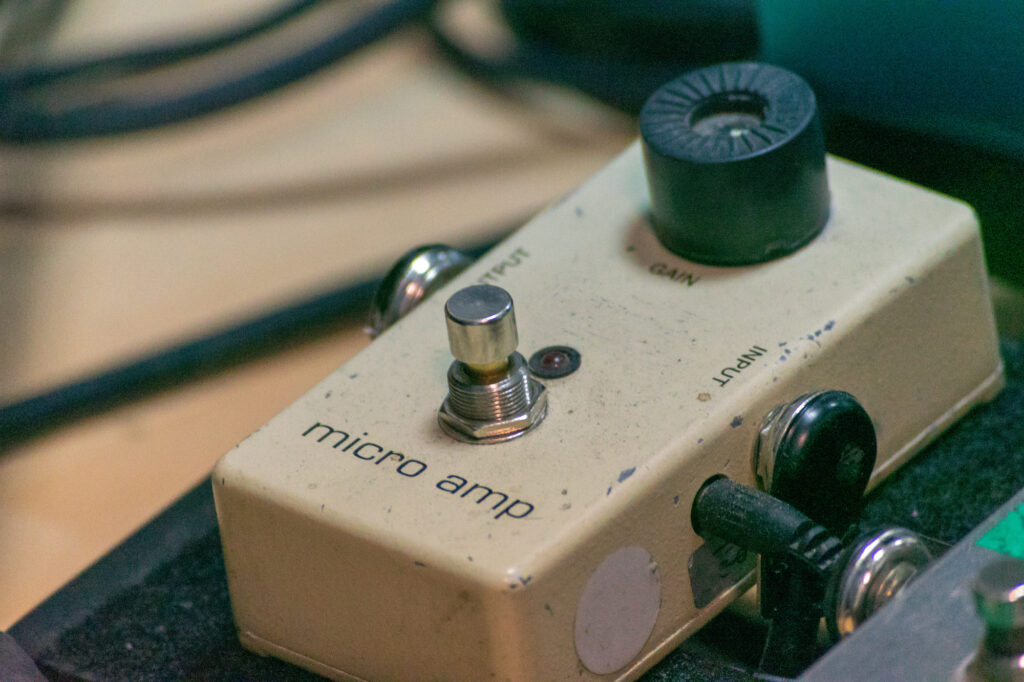
Boost
A boost pedal increases the level of your signal without intentionally adding distortion. It makes your amp work harder, which can push a tube amp into natural breakup.
Use it to lift your volume for solos, to hit the front of an overdrive pedal harder for more saturation, or to compensate for the volume drop of single-coil pickups. A clean boost at the start of your gain section is one of the most useful and underrated pedals you can own.
Overdrive
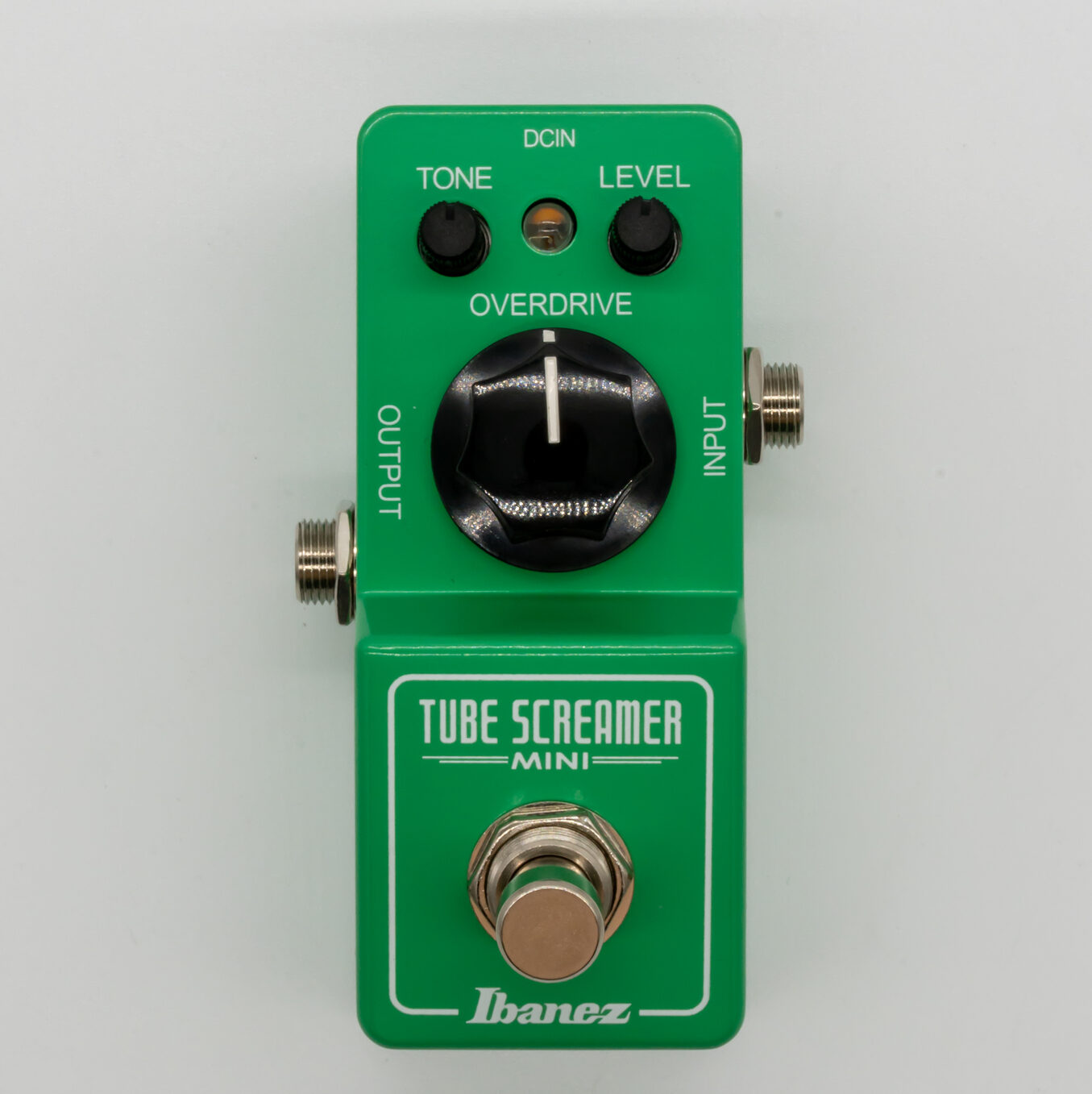
Overdrive emulates the sound of a tube amp pushed past its clean headroom — warm, compressed, and responsive to your picking dynamics. Roll back your guitar volume and it cleans up. Dig in hard and it crunches.
The Ibanez Tube Screamer is the most famous overdrive pedal in history. Its mid-hump character works brilliantly for blues leads and as a boost into a Marshall-style amp. The Rolling Stones’ “Start Me Up” is textbook overdrive tone.
Overdrive responds to your amp. A tube amp and an overdrive pedal interact — the pedal pushes the amp’s preamp tubes, and the result is more dynamic than either alone. This is why preamp pedals and overdrive pedals are popular even among players with good amps: they give you a second gain voice on tap.
Distortion
Distortion pedals produce harder clipping than overdrive, creating a more aggressive, compressed, and sustained tone. Unlike overdrive, distortion pedals impose their own character on the signal regardless of your amp — you get a consistent sound whether you are playing through a Fender Twin or a practice amp.
This is the sound of grunge, hard rock, and metal. Nirvana’s “Smells Like Teen Spirit” runs through a Boss DS-1. For heavier styles, the ProCo RAT and Boss HM-2 (the Swedish death metal chainsaw tone) are benchmarks. Bass distortion pedals typically include a blend knob to preserve low-end clarity while adding grit to the mids and highs.
Fuzz
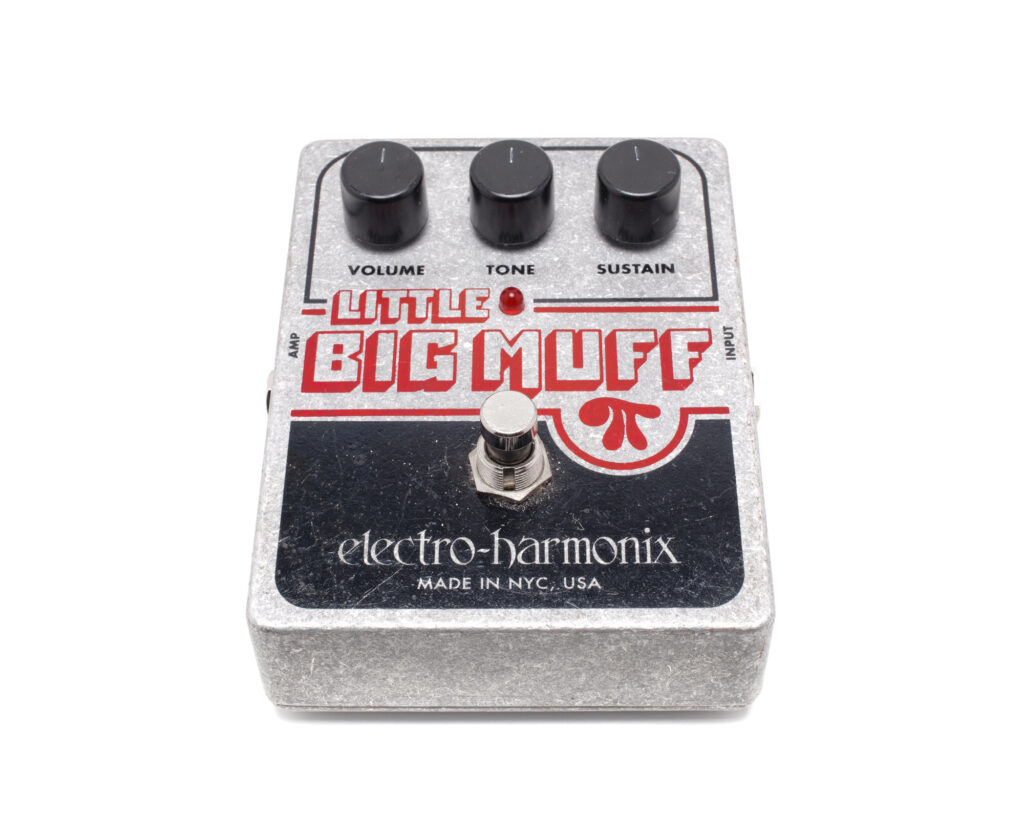
Fuzz is the most extreme form of clipping. It squares off the waveform almost completely, producing a thick, buzzy, harmonically rich tone that sounds nothing like a clean amp.
The story most often told is that the fuzz sound was discovered by accident — a faulty mixing console channel on Marty Robbins’ 1961 recording of “Don’t Worry” created the effect, and guitarists have chased it ever since. Norman Greenbaum’s “Spirit in the Sky” and the intro to The Rolling Stones’ “Satisfaction” (run through a Maestro Fuzz-Tone) are early landmarks. The Electro-Harmonix Big Muff remains the gold standard for thick, sustaining fuzz.
Fuzz pedals are picky about what comes before them. Many classic fuzz circuits — especially germanium ones — want to see your guitar’s pickups directly, without a buffer in between. If you run a buffered tuner or a boss pedal before a vintage-style fuzz, the fuzz may lose its character. Try it first in the chain (or right after a true-bypass tuner) and compare.
Noise Gate
High-gain rigs produce noise — hum, hiss, and buzz when you are not playing. A noise gate sets a volume threshold: any signal below it gets silenced.
Place the noise gate after your gain pedals. Set the threshold just above the noise floor so it cuts the hiss when you stop playing but does not choke off your sustain or note decay. The Boss NS-2 and ISP Decimator are the standards.
A noise gate is not optional for metal and high-gain players. Without one, your rests will be filled with amp hiss and pickup hum, especially under stage lighting.
Modulation Effect Pedals
Modulation pedals take your signal, copy it, alter the copy (by shifting pitch, timing, or amplitude), and blend the altered copy back with the original. The result is movement — sounds that shimmer, swirl, throb, or rotate.
Place modulation effects after your gain section. You want to modulate your driven tone, not drive a modulated signal (which tends to sound muddy).
Chorus
A chorus pedal duplicates your signal, detunes the copy slightly, and shifts it in and out of time with the original. The result is a thickened, shimmering sound — like two guitarists playing the same part in slight disagreement.
Chorus defined the clean guitar sound of the 1980s. Metallica’s “Welcome Home (Sanitarium)” uses it on the clean intro, and Nirvana’s “Come as You Are” runs the entire riff through chorus. At subtle settings it adds width and depth without being obviously “effected.”
Flanger
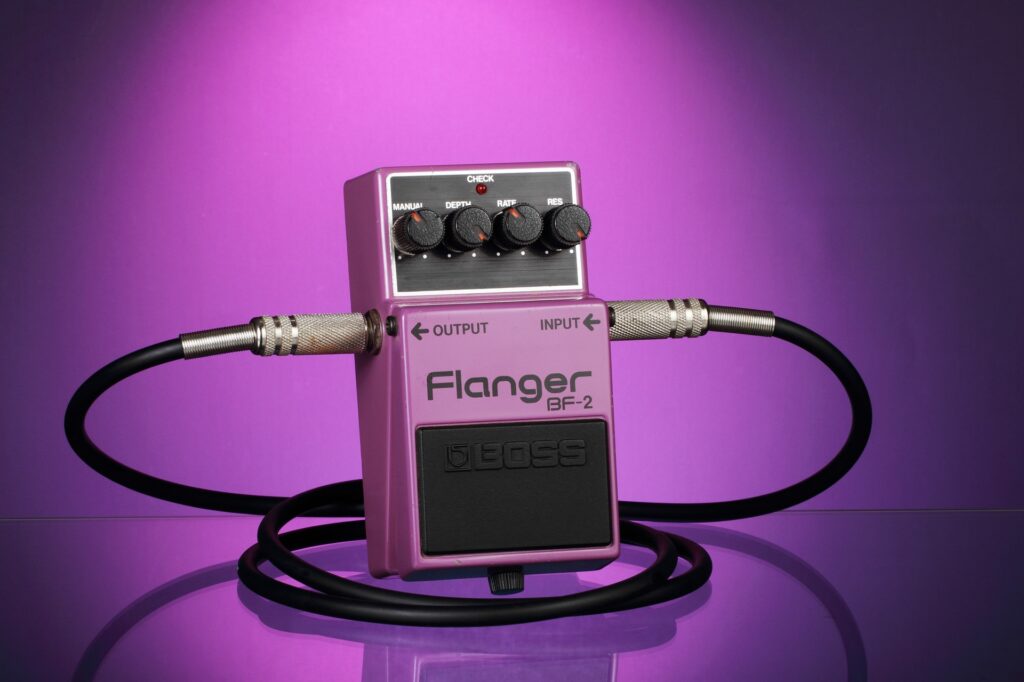
A flanger is similar to a chorus but with a shorter delay time and feedback, producing a more dramatic sweeping effect — sometimes described as a jet plane passing overhead.
The name comes from the original technique: pressing your finger against the flange of a tape reel to slow it down. Eddie Van Halen’s “Unchained” and “And the Cradle Will Rock” showcase flanging on a distorted guitar. The MXR Flanger and Boss BF-3 are popular options.
Phaser
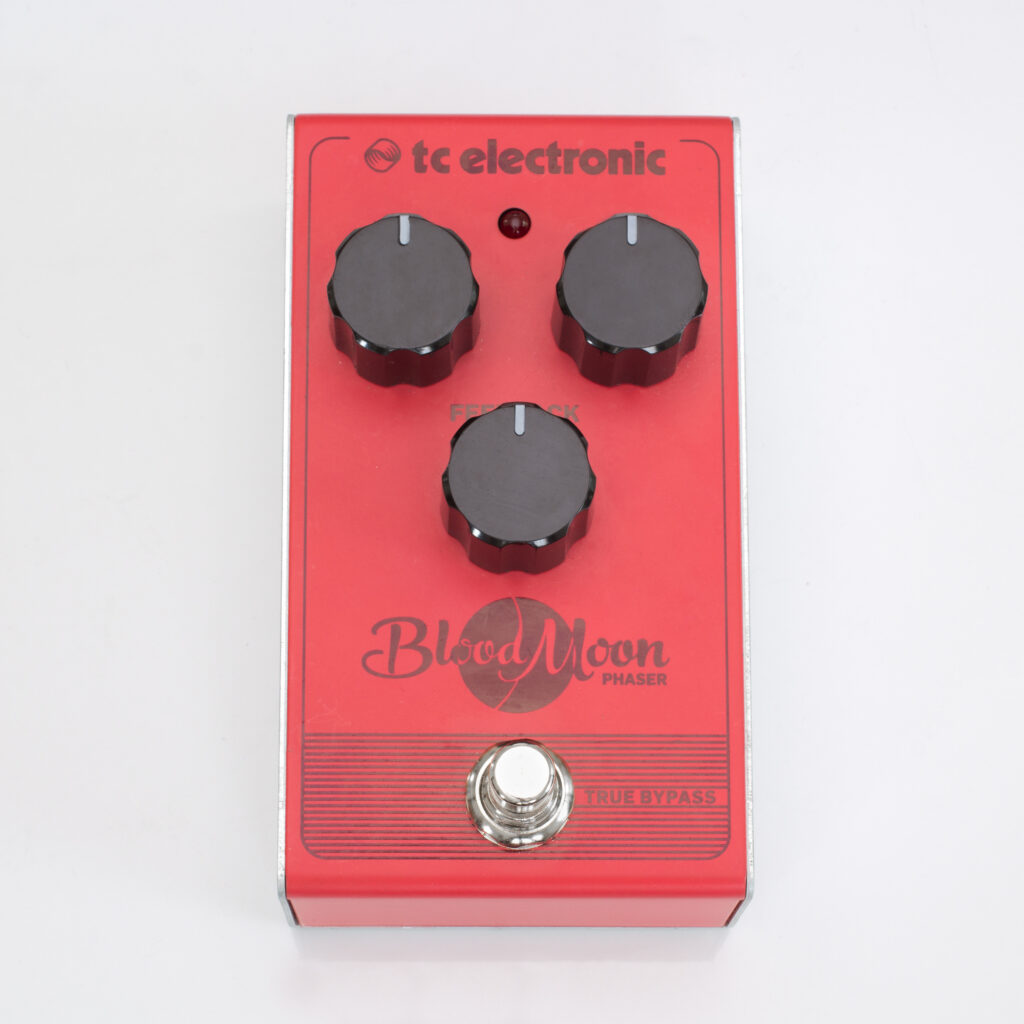
A phaser splits your signal, shifts the phase of the copy, and recombines them. Where the two signals cancel, you get notches in the frequency spectrum. As the phase shift sweeps, these notches move, creating a swirling, undulating effect.
Heart’s “Barracuda” is a textbook phaser riff. Van Halen’s “Ain’t Talkin’ ‘Bout Love” uses the MXR Phase 90 — the most iconic phaser pedal ever made. The phaser is more subtle than a flanger and works well on both clean and driven tones.
Vibrato
Vibrato modulates your pitch up and down at a regular rate, like a singer applying vibrato to a sustained note or a guitarist continuously using the whammy bar. Unlike chorus, vibrato replaces your dry signal entirely with the modulated version — there is no dry/wet blend.
The Smashing Pumpkins use vibrato throughout “Rhinoceros,” and it adds an unsettling, seasick quality to clean tones. The Boss VB-2 (now discontinued and very expensive) and the TC Electronic Shaker Vibrato are popular choices.
Univibe
The Univibe was designed in the late 1960s to emulate the Doppler effect of a Leslie rotary speaker cabinet, originally paired with Hammond organs. It produces a warbling, pulsing modulation that sits somewhere between a phaser and a chorus.
Jimi Hendrix used a Univibe on “Machine Gun” at the Band of Gypsys concert, and Robin Trower built his entire sound around it. Modern options like the Dunlop Uni-Vibe and MXR Uni-Vibe give you speed and intensity controls.
Volume Effect Pedals
These pedals control the amplitude of your signal. They are not simply “making things louder or quieter” — they shape dynamics and add rhythmic effects.
Envelope (Auto-Swell)
An envelope pedal automatically controls your volume attack. It masks the percussive pick attack and fades the note in, making guitar lines sound bowed, like a violin or cello.
You can hear this in the Red Hot Chili Peppers’ “Sir Psycho Sexy.” The Boss SG-1 Slow Gear (discontinued) pioneered this effect, and modern clones like the Mooer Slow Engine replicate it.
Tremolo
Tremolo is one of the oldest electric guitar effects — many 1950s and 1960s amps had it built in. It rapidly and rhythmically varies your volume, creating a pulsing, stuttering effect.
Set the rate to match your song’s tempo and the depth to taste. At subtle depths it adds gentle movement. At extreme settings it produces a choppy, rhythmic stutter. Tommy James and The Shondells’ “Crimson and Clover” is the classic example. For surf and indie, tremolo is practically mandatory.
Do not confuse tremolo (volume modulation) with vibrato (pitch modulation). Despite the names on many Fender amps — where the “vibrato” channel actually produces tremolo — these are two distinct effects.
Time Effect Pedals
Delay and reverb process your signal over time. They add space, depth, and atmosphere. Place them at the end of your chain (before the looper) so they process your final, fully effected signal.
Delay
Delay records your signal and plays it back after a set time interval. The three key controls are time (gap between repeats), feedback (number of repeats), and mix (blend of delayed signal with dry).
Analog delay (like the MXR Carbon Copy) produces warm, slightly degraded repeats that sit naturally in a mix. Each repeat loses some high-frequency content, which keeps the echoes from competing with your playing.
Digital delay (like the Boss DD-8) produces clean, precise repeats with longer maximum delay times. Useful for rhythmic delay patterns and ambient textures.
Tape delay emulations (like the Strymon El Capistan) model the behavior of vintage tape echo machines, with their characteristic warble, modulation, and slow decay.
The Edge of U2 built his entire playing style around rhythmic delay. “Where the Streets Have No Name” is a masterclass in using dotted-eighth delay as a compositional tool. Country players use a short, single-repeat “slapback” delay for rockabilly tones.
Reverb
Reverb simulates the natural reflections of a physical space. Your amp may already have built-in spring reverb, but a dedicated pedal gives you far more options.
Common reverb types:
- Spring: The classic twangy, dripping sound of Fender amps and surf guitar.
- Plate: Smooth and dense, favored for vocals and leads.
- Hall: Large and spacious, good for ambient passages.
- Room: Subtle and natural, adds presence without washing things out.
- Shimmer: Adds pitch-shifted octaves to the reverb tail for ambient and post-rock textures.
Chris Isaak’s “Wicked Game” uses heavy reverb on the guitar for that dreamy, cavernous sound. The Boss RV-6, Walrus Audio Slarp, and Strymon BigSky cover a wide range of reverb flavors.
Looper
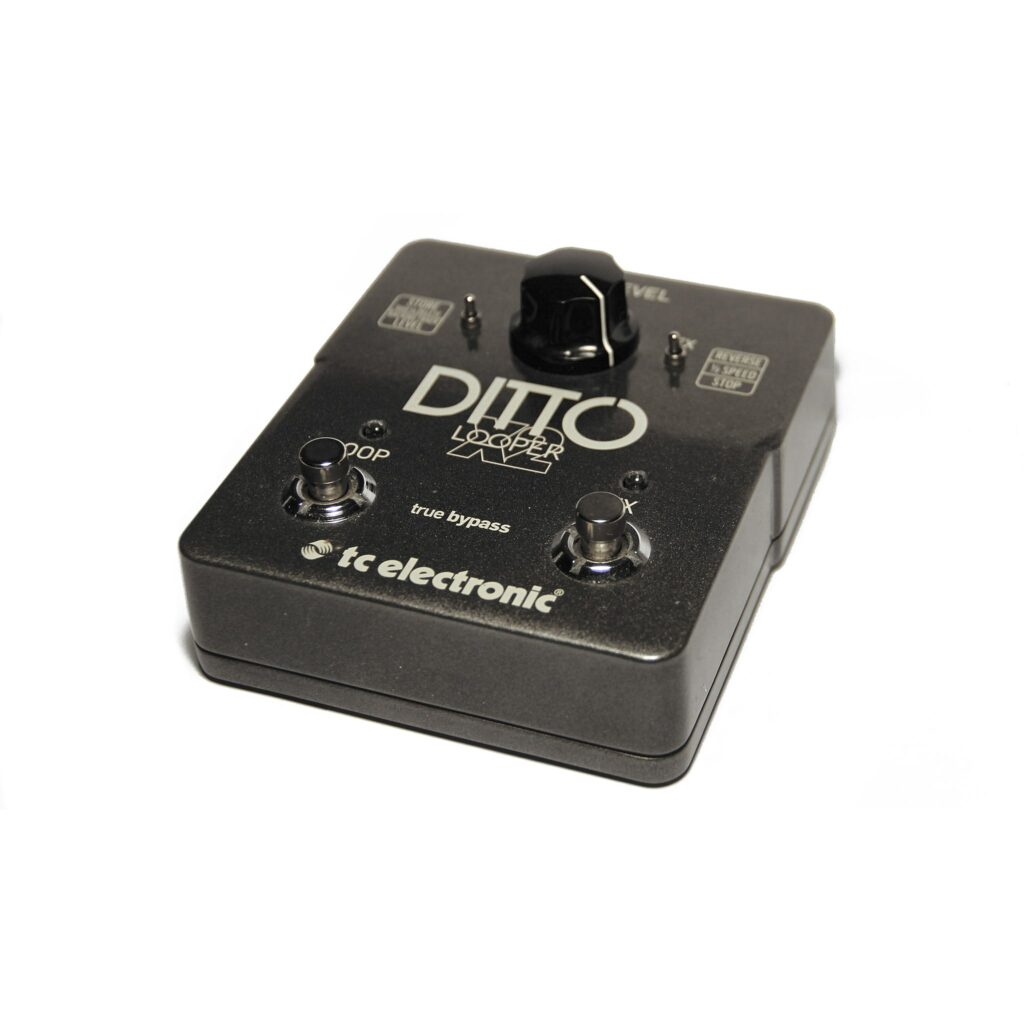
A looper records a phrase and plays it back in a continuous loop. You can overdub additional layers on top, building up a full arrangement from a single instrument.
Ed Sheeran built his live show around loop pedals — “Shape of You” performed live is a one-man-band tour de force. For practice, a looper is invaluable: record a chord progression, then practice soloing or harmonizing over it.
Basic loopers (Boss RC-1, TC Electronic Ditto) offer one track with a few minutes of recording. Advanced units (Boss RC-505, Headrush Looperboard) support multiple tracks, effects, quantization, and hours of recording time.
Place the looper last in your chain so it captures your fully processed signal.
Preamp Pedals
A preamp pedal contains the preamp stage of an amplifier in pedal form. It shapes your tone, adds gain, and often includes EQ — essentially giving you an amp’s voice without the power amp and speaker.
Preamp pedals are valuable for direct recording, fly-in gigs where you do not have your own amp, and for adding a second amp channel to a single-channel amp. Many modern bass preamp pedals double as DI boxes, going straight to the PA or audio interface. For context on how preamps relate to full amplifiers, see our preamp vs amp comparison.
Multi-Effects Units
Multi-effects processors combine dozens (or hundreds) of effects in a single unit. The Boss GT-1000, Line 6 Helix, and Neural DSP Quad Cortex are current leaders. They replace an entire pedalboard with one device, plus amp and cab simulation.
The tradeoff: convenience and consistency versus the hands-on feel and specific character of individual analog pedals. Many touring professionals now use multi-effects for reliability and ease of setup. Many others still prefer a board of individual stompboxes for their tactile control and unique sonic interactions.
For beginners on a budget, a multi-effects unit is a practical way to learn what each effect type does before investing in individual pedals.
Building Your First Pedalboard
If you are starting from scratch, here is a practical order of acquisition based on how much each pedal type improves your playing experience:
- Tuner — Non-negotiable. You cannot sound good out of tune.
- Overdrive or distortion — The most immediate tonal transformation.
- Delay — Adds depth and dimension to everything you play.
- Reverb — If your amp does not have it built in, get a pedal.
- Compressor — Improves feel and sustain, especially for clean playing.
- Modulation (chorus, phaser, or tremolo) — Pick one that fits your style.
- Everything else — Wah, fuzz, octave, looper, noise gate as your needs evolve.
Power your pedals with an isolated power supply (Voodoo Lab Pedal Power, Cioks, Truetone CS) rather than daisy-chaining wall warts. Isolated power eliminates ground loops and the hum that comes with them.
Use short, quality patch cables between pedals. Every cable connection adds a small amount of signal loss and potential noise. Keep the board tight and the cables tidy.
Final Thoughts
There is no single correct pedalboard. Your rig should match the music you play and the sounds you hear in your head. Start with the basics, learn what each pedal does to your signal, and add complexity only when you need it.
The best way to learn pedals is to use them — plug in, twist knobs, and listen. No amount of reading replaces the experience of hearing how an overdrive reacts to your specific guitar and amp, or discovering that your favorite sound comes from running your reverb into your distortion instead of the other way around.