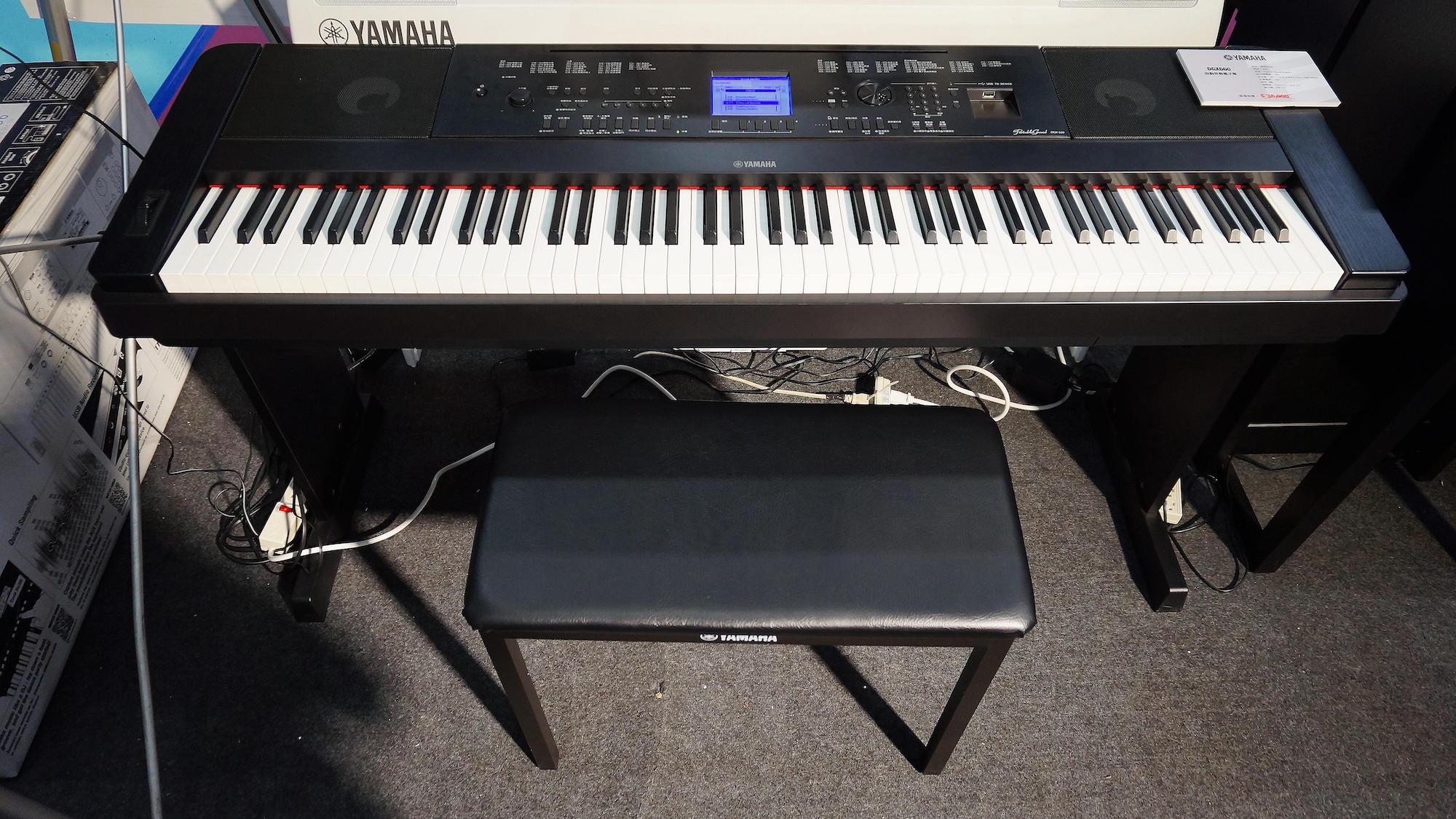
Yamaha DGX 660 Review
The Yamaha DGX-660 sits in a category of its own. It is not purely a digital piano and not purely an arranger keyboard — it is both. As the flagship of Yamaha’s Portable Grand line, it is the only model in that lineup with fully weighted, 88-key hammer action. That distinction matters if you want authentic piano feel combined with hundreds of built-in sounds, styles, and learning features.
The DGX-660 has since been discontinued and replaced by the Yamaha DGX-670, but it remains widely available on the secondhand market and through some retailers. If you are weighing it against current alternatives, everything in this review still applies — and the successor shares most of the same DNA.
Who the DGX-660 Is For
This keyboard works best for intermediate players who want a single instrument that covers practice, composing, and casual performance. It also suits beginners who plan to stick with piano long-term, since the weighted keys build proper finger technique from the start.
If you are after a pure, no-frills digital piano, something like the Yamaha P-125 or a model from our best digital pianos under $500 roundup may be a better fit. If you want every arranger feature Yamaha offers, check out our best arranger keyboard guide. The DGX-660 lands right in the middle — piano authenticity with arranger versatility.
For those with a larger budget, our best digital pianos under $1000 roundup covers alternatives in this range.
Keyboard Action: Graded Hammer Standard (GHS)
The DGX-660 uses Yamaha’s Graded Hammer Standard action, the same mechanism found in the Yamaha P-45 and P-125. Real hammers inside the keyboard create resistance that is heavier in the bass register and lighter in the treble — mimicking the graduated weighting of an acoustic grand piano.
Four touch sensitivity settings (Soft, Medium, Hard, and Fixed) let you tailor the response. On the Fixed setting, every keystroke produces the same volume regardless of force, which is useful for certain electronic sounds but removes the expressive dynamics that make the GHS action worth having.
The keys themselves are plastic, which is standard at this tier. The black keys have a matte finish that helps with grip when your fingers get sweaty. The white keys are glossy, which some players find slippery. For reference, Yamaha reserves their synthetic ivory and ebony key surfaces for higher-end models.
Compared to Yamaha’s GH3 action found on more expensive instruments, the GHS feels slightly lighter and less textured. But for building technique and playing expressively, it does the job. If weighted key feel is your top priority, our weighted keyboards and pianos guide covers the full spectrum.
Sound Engine and Voices
At the core of the DGX-660 is Yamaha’s Pure CF Sound Engine, which samples the Yamaha CFIIIS nine-foot concert grand piano. The default grand piano tone is genuinely impressive — warm, dynamic, and responsive to touch. Yamaha uses the same engine in the P-125 and several Arius (YDP) models, so the piano sound quality punches above what you would expect from an instrument in this category.
Beyond the flagship piano tone, there are 10 piano voices total, plus 554 instrument sounds altogether. That count includes electric pianos, organs, guitars, strings, brass, synths, drum kits, and 388 XGlite voices (Yamaha’s implementation of the GM2 standard).
A few things to know about the non-piano sounds: the electric piano patches are solid and usable, especially the classic Yamaha EP tones from the 1980s. The organs and guitar sounds are decent as supporting layers. The strings, brass, and flutes are weaker — they work when blended with piano but sound thin on their own. This is typical for instruments that prioritize piano tone quality over being a general-purpose sound module.
Effects and Sound Shaping
The effects library is extensive: 41 reverb types, 44 chorus types, 26 harmony types, and over 230 DSP effects including distortion, echo, and various filters. A five-band master EQ lets you shape the overall tone. For most players, the reverb and chorus are the effects worth exploring — they can transform a dry piano sound into something that feels like it is sitting in a concert hall.
The Intelligent Acoustic Control (IAC) feature automatically adjusts the EQ when you play at lower volumes, boosting bass and treble frequencies that tend to disappear at quiet levels. It is a subtle but thoughtful addition for late-night practice sessions.
Polyphony: 192 Notes
The DGX-660 offers 192-note polyphony, upgraded from the 128 notes on its predecessor, the DGX-650. For solo piano playing, 192 notes is more than sufficient — you will never run into dropped notes during normal performance.
However, when you start layering sounds, using auto-accompaniment, and recording multi-track MIDI, polyphony gets consumed quickly. In those scenarios, 192 notes is adequate but not generous. If you lean heavily into the arranger features while layering voices, you may occasionally notice the earliest notes cutting out. For purely piano-focused playing, this will never be an issue.
LCD Display and User Interface
The 320 x 240 pixel LCD screen is one of the DGX-660’s strongest practical features. It displays sheet music notation for built-in songs, shows chord diagrams, and even renders lyrics when available. During playback and recording, it provides visual feedback on what notes are being played through an on-screen virtual keyboard.
The trade-off is a control panel covered in buttons. At first glance, it looks overwhelming. You will spend time with the manual learning what each button does. Yamaha offsets this with a dedicated “Piano Room” button — press it, and the keyboard instantly loads optimized piano settings regardless of what mode you were in. It is a smart shortcut that gets you back to a pure piano experience in one press.
Arranger and Accompaniment Features
This is where the DGX-660 separates itself from standard digital pianos. Over 200 accompaniment styles span genres from jazz and pop to country, R&B, reggae, and Latin. Select a style, play chords with your left hand, and the keyboard generates a full backing arrangement — drums, bass, and harmonic accompaniment — that follows your chord changes in real time.
Three chord fingering modes give you control over how the accompaniment responds:
- Multi Finger — play full chords or use simplified single-finger voicings
- Full Keyboard — the entire keyboard range is analyzed for chord detection
- AI Fingered — the keyboard uses artificial intelligence to predict chord progressions
The Smart Chord feature takes this further by letting you trigger full chord-based accompaniments with a single finger, as long as you tell the keyboard what key you are playing in. For beginners still learning chord shapes, this keeps them making music immediately.
The Style Recommender listens to a bar or two of what you play, then suggests accompaniment styles that fit. It is not always perfect, but it is a useful starting point when you are not sure which style to choose.
Learning and Practice Tools
The built-in Yamaha Education Suite (Y.E.S.) turns the 100 preset songs into structured lessons. Three lesson modes are available:
- Waiting — the song pauses until you play the correct note, then continues
- Your Tempo — the playback speed adjusts to match how fast or slow you are playing
- Minus One — mutes one hand’s part so you can practice it while the other hand plays normally
The LCD displays notation and a virtual keyboard showing which keys to press, which means you do not need to read sheet music to follow along. Through Yamaha’s Musicsoft service, additional songs and songbooks can be downloaded to expand the lesson library.
For players who use external learning platforms, the DGX-660 works with apps like Flowkey and GarageBand over USB.
Recording Capabilities
The DGX-660 handles both MIDI and audio recording, which is unusual at this tier.
MIDI recording lets you capture up to five songs with six tracks each. You can record parts separately — lay down a piano track, then add bass, then strings — and play them back together. MIDI files can be transferred to a computer for editing in a DAW.
Audio recording captures the actual sound output as a WAV file (44.1kHz, 16-bit stereo) directly to a USB flash drive. You get up to 80 minutes of recording per session. The resulting files can be shared, played on any device, or burned to a CD. Having WAV recording built in eliminates the need for a separate audio interface just to capture ideas.
Speakers and Amplification
Four speakers (two 12cm woofers and two 5cm tweeters) powered by dual 6W amplifiers provide the onboard sound. They face upward, which at this speaker size produces clearer audio than downward-firing designs.
For home practice and small rooms, the speakers are perfectly adequate. They will not fill a large room or compete with a live drummer, but that is not what they are designed for. For performances or band rehearsal, you will want to run the headphone/line out jack into an external amplifier or PA system.
Connectivity
The DGX-660 has more ports than most digital pianos in its class:
- USB to Host — connects to a computer for MIDI data transfer and DAW control
- USB to Device — accepts a flash drive for loading/saving songs, recordings, and settings
- Headphone/Line Out (1/4” stereo) — for silent practice or connecting to external speakers
- Aux In (1/8” stereo) — play audio from a phone, tablet, or other device through the speakers
- Mic In (1/4”) — connect a microphone and sing along with your playing through the built-in speakers
- Sustain Pedal Jack — the included FC5 footswitch works but lacks the half-pedal response of a proper sustain pedal; upgrading to an FC3A pedal is recommended
The microphone input is a noteworthy addition. With vocal effects and reverb applied through the keyboard, it doubles as a simple vocal performance setup — useful for singer-songwriters or karaoke.
Size and Portability
Despite belonging to the “Portable Grand” line, the DGX-660 is not particularly portable. At 55 inches wide, 17.5 inches deep, and 46 pounds without the stand (roughly 62 pounds with the included furniture stand), it is a two-person lift.
For comparison, the Yamaha P-125 weighs 26 pounds and the Casio PX-S3000 weighs 25 pounds. If you need to transport your keyboard regularly for gigs or lessons, the DGX-660 is not the right choice. It is designed to be set up in one location — a home studio, practice room, or living room — and left there.
The included matching stand is sturdy and well-built. Assembly takes about 25-30 minutes and is straightforward.
What Yamaha Got Wrong
No instrument is perfect, and the DGX-660 has a few genuine weaknesses:
The included sustain pedal is basic. The FC5 footswitch that ships with the keyboard is a simple on/off switch with no half-pedal support. For expressive piano playing, this matters. Budget for an aftermarket pedal with continuous response.
The headphone jack is on the back panel. This means the cable runs behind the keyboard, which is mildly inconvenient if you frequently plug and unplug headphones.
Non-piano sounds lack depth. While the piano tones are excellent, many of the 554 voices are filler. The strings and wind instruments in particular sound flat and synthetic when played solo. They work fine as accompaniment layers but do not hold up on their own.
The GHS action is entry-level for weighted keys. Compared to Yamaha’s GH3 or Kawai’s Responsive Hammer actions, the GHS feels lighter and less realistic. For advancing players who eventually move to an acoustic piano, the transition will require adjustment.
No Bluetooth. The DGX-670 successor added Bluetooth audio and MIDI. On the DGX-660, all connections are wired.
DGX-660 vs. DGX-670: Should You Buy the Successor Instead?
The DGX-670 improves on the DGX-660 in several meaningful ways. It adds Bluetooth audio streaming and MIDI, a more powerful speaker system (two 12W amplifiers vs. the 660’s two 6W), an updated sound engine with better non-piano voices, and a sleeker design. The key action remains GHS, so the playing feel is essentially the same.
If you are buying new, the DGX-670 is the obvious choice. If you find a well-maintained DGX-660 at a significant discount on the used market, it still delivers strong value — the core piano sound and arranger features are largely the same.
Final Verdict
The Yamaha DGX-660 occupies a unique spot. It offers a convincing piano experience with fully weighted keys and a sampled concert grand tone, while packing in arranger features, recording tools, and learning aids that no standard digital piano in its range can match. It does many things well rather than one thing perfectly.
It is best suited for players who want a single keyboard that covers practice, composition, and casual performance without requiring external gear. The learning features make it genuinely useful for developing players, and the recording capabilities let you capture ideas without a computer.
The main limitations — weight, basic sustain pedal, and mediocre non-piano sounds — are real but manageable trade-offs for the breadth of what you get. If those compromises work for your situation, the DGX-660 remains one of the most capable all-in-one keyboards Yamaha has made.