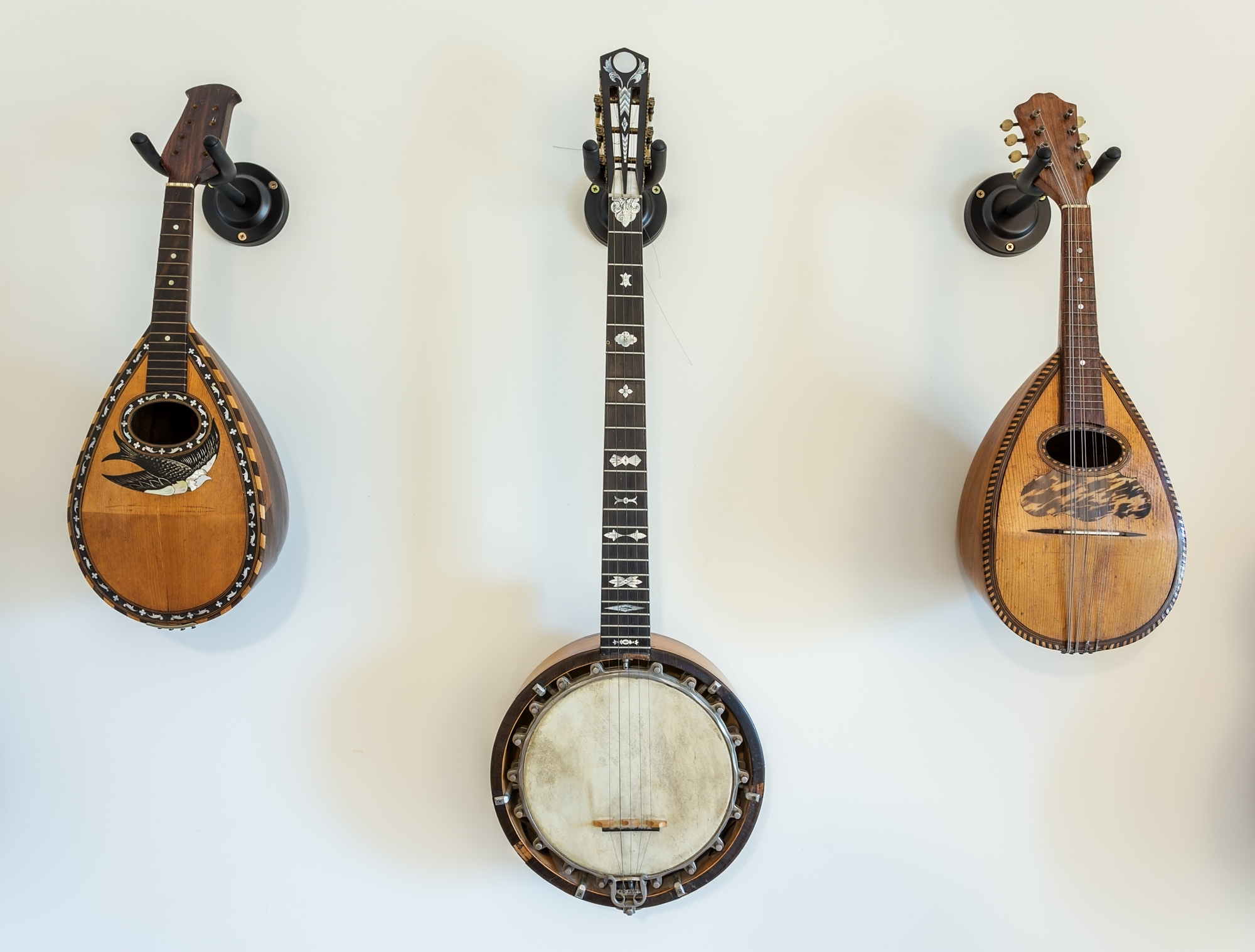
Mandolin vs. Banjo: What's the Difference?
The mandolin and banjo share roots in folk and bluegrass, but they are fundamentally different instruments. They sound different, feel different in your hands, and suit different musical roles. This guide breaks down the real differences so you can decide which one to learn.
Sound
The mandolin produces a bright, high-pitched tone with short sustain. Players use a technique called tremolo — rapidly picking a string back and forth — to simulate longer, sustained notes. The result is shimmering and melodic, well suited to carrying a tune or adding rhythmic chop chords.
The banjo is louder, twangier, and more percussive. A five-string banjo with a resonator can cut through an entire band. Open-back banjos are quieter and warmer, but still louder than most mandolins. The banjo’s distinctive drone string (the short fifth string) gives it that signature rolling sound you hear in bluegrass.
If you are not sure which sound you prefer, listen to recordings of each before deciding. Sound preference matters more than any other factor.
Size and Weight
The mandolin is one of the smallest fretted instruments. It fits comfortably in your lap, balances easily, and travels well. Most mandolins weigh around 2-3 pounds.
Banjos are significantly larger and heavier. A full-size five-string resonator banjo can weigh 10-12 pounds. Even open-back models weigh 5-7 pounds. Many beginners use a strap because the banjo does not balance as naturally in your lap as a mandolin does.
For younger players or people with smaller frames, the mandolin is the more comfortable choice. Three-quarter size banjos exist but are harder to find.
Strings and Tuning
The mandolin has eight strings arranged in four doubled pairs (courses), tuned G-D-A-E from low to high. This is the same tuning as a violin, in intervals of fifths. The doubled strings give the mandolin its characteristic shimmer and resonance.
The standard five-string banjo is tuned g-D-G-B-D (the lowercase g is the short drone string). The intervals between strings are inconsistent, which makes scale patterns less predictable than on mandolin.
The mandolin’s tuning in fifths is a major practical advantage. If you learn a scale shape on one pair of strings, you can move the same shape to the next pair and it works. On banjo, each string transition requires a different fingering pattern.
Playing Technique
Mandolin is typically played with a flat pick (plectrum). You hold the pick and strike the doubled string courses with downstrokes and upstrokes. The core right-hand techniques are single-note picking, strumming chords, and tremolo. If you already play guitar with a pick, the motion feels familiar.
Banjo technique depends on the style. Three-finger (Scruggs) style uses metal fingerpicks and a thumbpick to play arpeggiated roll patterns across the strings. Clawhammer (old-time) style uses a downward striking motion with the back of the fingernail. Both approaches feel very different from guitar or mandolin picking.
The right-hand roll patterns on banjo are the biggest hurdle for most beginners. They require coordination between thumb, index, and middle fingers in specific sequences. On mandolin, the pick-based approach is more intuitive if you have any experience with a guitar or similar instrument.
Difficulty: Which Is Easier to Learn?
Neither instrument is objectively “easy.” But they present different challenges at different stages.
Mandolin advantages for beginners:
- The fifths tuning makes scales and transposition logical — learn one pattern, shift it across strings
- You can play simple melodies with two fingers and open strings
- Pick-based technique is more intuitive for guitar players
- Smaller size makes it easier to hold and manage
- Chord shapes transfer from guitar (as mirror images)
Banjo advantages for beginners:
- Lighter string gauge means less finger pressure required to fret notes
- Standard tuning is an open G chord, so you get a pleasant sound immediately
- Basic three-finger rolls are simple patterns that sound impressive quickly
- You can start right-hand roll practice without any left-hand fretting at all
Where each gets harder:
- Mandolin requires strong left-hand grip. The string tension is higher than banjo, and the fret spacing is tight. Barre chords and closed-position chords demand real finger strength.
- Banjo rolls feel awkward at first, and the inconsistent string intervals make sight-reading and transposing more difficult. Playing cleanly at speed takes serious practice.
The honest answer from most multi-instrumentalists: the mandolin is slightly easier to start making music on, but both instruments demand equal commitment to play well. Pick the one whose sound excites you.
Price
Entry-level mandolins and banjos both start around $200-$300 for a playable instrument. Below that price point, quality drops fast and the instrument becomes harder to play and keep in tune.
At the mid-range ($500-$1,000), you can find excellent instruments in both categories. Check our guides to the best mandolins under $1,000 and the best beginner banjos for specific recommendations.
High-end mandolins (Gibson F-5 style, handmade) can run $3,000-$10,000+. High-end banjos (pre-war Gibsons, custom builds) reach similar prices. Neither instrument has a clear cost advantage.
Both instruments are notorious for tuning instability. Banjos go out of tune because of all the moving parts (head tension, neck angle, bridge position). Mandolins go out of tune because you are tuning eight strings instead of four, and the A string is famously temperamental.
Genre Fit
Mandolin shines in:
- Bluegrass (rhythm chop and lead melody)
- Classical (Vivaldi wrote concertos for mandolin; there is a large classical repertoire)
- Folk and Celtic music
- Singer-songwriter accompaniment
- Rock and pop (Led Zeppelin, R.E.M., and others used mandolin on recordings)
Banjo shines in:
- Bluegrass (the defining instrument of the genre)
- Old-time / Appalachian music
- Dixieland and early jazz (four-string tenor banjo)
- Folk and Americana
- Irish traditional music (tenor banjo)
Both instruments work in bluegrass, but they fill different roles. The banjo drives the rhythm with its rolling patterns. The mandolin takes melodic leads and provides percussive chop chords on the offbeat.
If you want to play classical music, the mandolin has centuries of written repertoire. The banjo does not, though players like Bela Fleck have pushed it into classical and jazz territory.
Types of Each Instrument
Mandolin Types
- A-style mandolin: Teardrop or pear-shaped body with an oval sound hole. Produces a warm, balanced tone. More affordable and common for beginners. Good for folk, classical, and general use.
- F-style mandolin: Asymmetrical body with a scroll and points, plus f-shaped sound holes. The classic bluegrass look, designed by Gibson’s Lloyd Loar in the 1920s. Brighter, more cutting tone. More expensive.
- Bowlback (Neapolitan) mandolin: Rounded back like a lute. The original European design. Favored in classical and Italian music.
For a deeper look, see our guide to the best mandolins.
Banjo Types
- Five-string resonator banjo: The standard bluegrass banjo. The resonator (a wooden back plate) projects sound forward and increases volume.
- Five-string open-back banjo: No resonator, lighter weight, softer tone. Preferred for old-time clawhammer playing.
- Four-string tenor banjo: Shorter neck, used in Dixieland jazz and Irish music. Tuned differently from a five-string.
- Four-string plectrum banjo: Longer neck than a tenor, played with a flat pick. Used in jazz and ragtime.
- Six-string (guitar) banjo: Tuned like a guitar. An easy crossover for guitarists who want banjo tone without learning new fingerings.
For more detail, read our complete guide to banjo types and the anatomy of a banjo.
Which Is Better for Guitar Players?
Guitar players often pick up both instruments faster than complete beginners, but the mandolin is typically the smoother transition.
Mandolin chord shapes are inversions of guitar chord shapes. If you know guitar chords, you can work out mandolin chords relatively quickly. The flat-pick technique also carries over directly. The main adjustment is the smaller fret spacing and higher string tension.
The five-string banjo requires learning an entirely new right-hand technique (rolls or clawhammer). Guitar flatpicking skills do not transfer. However, basic chord positions on the banjo’s first four strings resemble guitar shapes, and the lighter string tension makes fretting easier.
If you play fingerstyle guitar, banjo rolls may feel more natural. If you play with a pick, the mandolin will feel more familiar.
How to Decide
Ask yourself these questions:
- Which sound do you prefer? This is the most important factor. Listen to recordings of both instruments in the genres you care about.
- What genre do you want to play? If bluegrass is the goal, both work. For classical, choose mandolin. For old-time, choose banjo.
- Do you already play guitar? Flatpick players will transition to mandolin more easily. Fingerpickers may find banjo rolls intuitive.
- Does size matter? If portability or physical comfort is a priority, mandolin wins.
- Do you want to play with others? Both are welcome at jams, but mandolin can blend into the background more easily while you are still learning. A banjo is loud and hard to hide behind.
There is no wrong choice. Both instruments are rewarding to learn, have active communities, and open doors to a wide range of music. The best mandolin players and the greatest banjo players share one thing in common: they chose the instrument whose sound they loved and stuck with it.